

Views: 221 Author: Evercross Bridge Publish Time: 2026-09-01 Origin: Evercross Bridge


Content Menu
● Why Emergency Bridges Matter After a Disaster
● What Does AASHTO HL-93 Mean for an Emergency Bridge?
>> Why HL-93 Matters in Emergency Bridge Procurement
● The Core Criteria for Choosing an Emergency Bridge
● Five Emergency Bridge Solution Types to Consider
>> 1. Bailey Bridge: The Proven Modular Steel Truss System
>> 2. High-Capacity Panel Bridge Systems
>> 3. Bolted Modular Steel Bridges for Remote Sites
>> 4. Pontoon and Floating Bridges for Water Crossings
>> 5. Evercross Modular Steel Bridge Solutions
● A Practical Emergency Bridge Selection Workflow
>> Step 1: Define the Traffic Requirement
>> Step 3: Confirm Design Standards and Authority Requirements
>> Step 4: Evaluate Deployment Reality
>> Step 5: Plan for Inspection and Future Reuse
>> 1. What is an AASHTO HL-93 emergency bridge?
>> 2. How quickly can a Bailey bridge be installed?
>> 3. Can a modular steel bridge carry fire trucks and relief vehicles?
>> 4. Are emergency steel bridges reusable?
>> 5. What information is needed to request an emergency bridge quotation?
>> 6. Is a Bailey bridge suitable for permanent use?
● Restore Access With an Engineered Emergency Bridge Solution
When a flood removes a highway crossing, an earthquake closes a critical route, or a permanent bridge requires urgent replacement, restoring access is not simply a construction task. It is a public-safety decision. Emergency vehicles, relief trucks, utility crews, school buses, and local businesses may all depend on a crossing that must be delivered quickly—but never at the expense of structural safety.
For government agencies, contractors, military engineering units, mining operators, and disaster-response organizations, an AASHTO HL-93 emergency bridge can provide a practical route back to mobility. Yet choosing the right modular bridge requires more than comparing product brochures. Decision-makers must assess loading requirements, span geometry, foundation conditions, logistics, installation resources, climate exposure, and the supplier's ability to support the project from design through commissioning.
With more than 30 years of steel bridge industry experience, Evercross Bridge designs, manufactures, transports, and supports prefabricated steel bridge systems for global infrastructure projects. Our modular solutions—including Bailey bridges, emergency bridges, temporary bridges, and customized steel truss bridges—are engineered around real site conditions and project-specific design requirements.
This guide explains what HL-93 means, compares leading emergency bridge approaches, and provides a practical selection framework for buyers who need a reliable bridge solution under urgent conditions.
> Important engineering note: HL-93 is a design live-load model used in AASHTO LRFD bridge design. A bridge should be evaluated by qualified engineers for its specific span, width, lane configuration, deck system, substructure, wind, seismic, hydraulic, fatigue, and local code requirements before installation or opening to traffic.
An emergency bridge is a rapidly deployable structure used to restore transportation when an existing crossing is damaged, inaccessible, or temporarily out of service. Unlike a conventional cast-in-place bridge, a modular emergency bridge uses standardized, factory-manufactured components that can be transported to site, assembled, launched, and later dismantled or relocated when needed.
In my experience working with modular bridge projects, the bridge itself is often only one part of the emergency. The larger problem is restoring an entire corridor: access for ambulances, food deliveries, fuel, repair equipment, and local residents. A temporary crossing can therefore become the first physical step toward broader economic and social recovery.
Common applications include:
- Flood recovery, when scour, debris, or high water damages an existing bridge
- Earthquake response, when a permanent structure requires closure pending inspection or replacement
- Washed-out rural roads, especially where communities depend on a single access route
- Temporary construction detours, allowing traffic to continue while a permanent bridge is rebuilt
- Mining, energy, and industrial access, where heavy vehicles need a durable temporary crossing
- Military and humanitarian operations, where mobility must be restored in remote environments
In the United States, the Federal Highway Administration's Emergency Relief program recognizes emergency repairs as work required to restore essential traffic, reduce additional damage, or protect remaining facilities following a disaster. Temporary detours and temporary bridge crossings may form part of that emergency response pathway.
AASHTO HL-93 is not a bridge product or a universal certification badge. It is a vehicular live-load model used within the AASHTO LRFD Bridge Design Specifications to represent highway traffic effects on bridges.
In simplified terms, HL-93 requires engineers to check the most demanding effects produced by combinations that include:
- A design truck plus a design lane load
- A design tandem plus a design lane load
- Additional loading configurations where required for specific force effects, such as negative moments
The HL-93 design truck has a total weight of 72 kips, while the design tandem consists of two 25-kip axles spaced 4 feet apart. The associated design lane load is 0.64 klf distributed along the bridge length and assumed over a 10-foot lane width.
A temporary bridge may be installed quickly, but it can still carry heavy and dynamic traffic. Fire trucks, loaded relief vehicles, cranes, fuel trucks, and construction machinery can create significant structural demands. The loading model helps engineers determine whether the bridge system, deck, connections, bearings, abutments, and foundations are suitable for the intended service.
A responsible HL-93 emergency bridge supplier should be prepared to discuss:
1. Design span and bridge configuration
2. Required roadway width and number of traffic lanes
3. Specified design vehicle and live-load requirements
4. Vehicle restrictions during temporary operation
5. Deck type, anti-skid surface, and pedestrian protection
6. Wind, seismic, flood, and corrosion exposure
7. Abutment, pier, and bearing conditions
8. Installation method and launch sequence
9. Inspection, maintenance, and reopening procedures
> Expert perspective: A bridge superstructure can be designed for HL-93 loading, but that does not automatically mean the complete installed crossing is compliant. The abutments, foundations, approaches, guardrails, drainage, traffic control, and construction quality must all be evaluated as part of the final system.
The right emergency bridge is not necessarily the fastest-looking system or the lowest-priced quotation. It is the solution that safely restores the required route with the lowest practical risk across design, transportation, assembly, operation, and eventual removal or reuse.
Selection criterion | What project teams should verify | Why it matters |
Design load | HL-93, local code, actual emergency vehicle loads, special heavy vehicles | Prevents under-designed crossings and traffic restrictions |
Clear span | River width, damaged roadway gap, hydraulic clearance, support locations | Determines truss configuration and erection approach |
Roadway width | Single lane, two lane, pedestrian lane, emergency access | Affects bridge width, deck layout, barriers, and traffic control |
Deployment speed | Factory readiness, shipping lead time, crane access, crew availability | Determines how soon the route can reopen |
Site conditions | Soil bearing, scour risk, slope, water flow, access roads | Controls foundation and abutment design |
Installation method | Crane erection, incremental launching, cantilever launch, manual assembly | Avoids unsafe or impractical field work |
Durability | Galvanizing, paint system, drainage, corrosion category | Supports temporary, medium-term, or long-term use |
Reusability | Standardized components, labeling, storage and inspection plan | Creates value beyond a single emergency |
Supplier support | Design drawings, shipping plan, installation guidance, training, spares | Reduces project coordination and operational risk |
The procurement team should not treat all systems as interchangeable, but rather compare the fit between their underlying engineering design and delivery.
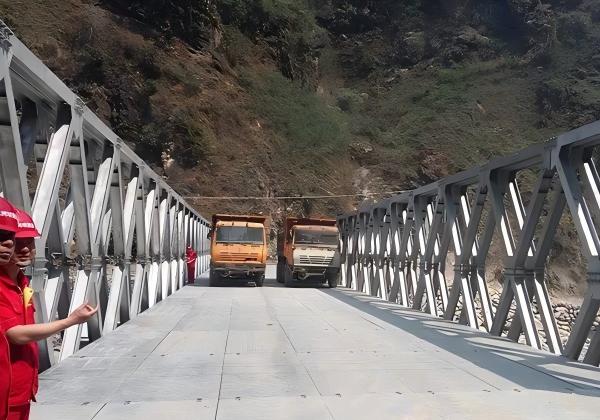
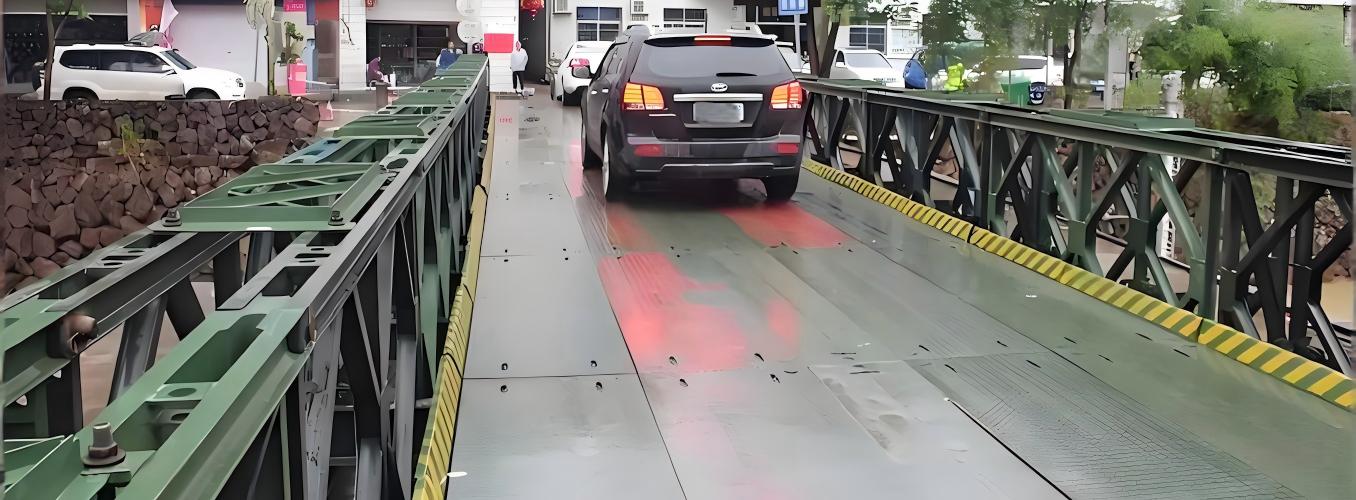
A Bailey bridge remains one of the best-known modular emergency bridge concepts in the world. Its core advantage is its repeatable panel-and-transom configuration. Standardized steel components can be transported in sections and assembled into different lengths, widths, and truss arrangements.
Bailey-type bridges are particularly practical when a project needs:
- A rapidly deployable steel truss bridge
- Components suitable for difficult transport routes
- A system that can be dismantled and reused
- Flexible configurations for different spans and loads
- A solution for flood recovery, rural access, or temporary detours
However, "Bailey bridge" should not be treated as a one-size-fits-all technical specification. The required panel arrangement, truss reinforcement, deck, width, bearings, and foundation design depend on the actual project.
Best fit: Rural access restoration, temporary detours, emergency relief routes, industrial access roads, and projects where reusable standardized components are valuable.
High-capacity panel bridge systems, such as the Mabey Compact 200 and Acrow 700XS series, are designed for demanding temporary and permanent applications. These systems typically employ modular steel plates and truss components, configured according to site-specific span and traffic requirements.
Their advantages often include:
- Modular scalability for different bridge lengths
- Configurable roadway widths
- Capability for heavy vehicle applications when engineered accordingly
- Faster installation than conventional site-built bridge construction
- Potential use as a temporary or semi-permanent crossing
Best fit: Heavy vehicle detours, public road rehabilitation, large infrastructure work zones, and government projects requiring an engineered modular bridge package.
Bolted modular steel bridges are often selected where logistics, terrain, and installation conditions are more challenging than the structural span itself. In remote regions, the ability to transport bridge components in manageable loads and complete field assembly with conventional equipment can be decisive.
The critical question is not simply whether bolts are used. It is whether the connection design, erection sequence, torque control, inspection process, and worker access have been planned correctly.
Best fit: Remote roads, mining camps, agricultural zones, forest routes, and developing infrastructure corridors where equipment availability is limited.
A pontoon bridge provides a floating crossing using linked buoyant units. It can be useful in specific temporary water-crossing scenarios, particularly when constructing conventional abutments is difficult or when a riverbank crossing is needed quickly.
However, pontoons are not a universal replacement for a steel truss emergency bridge. Water velocity, debris load, anchoring, vessel traffic, flood conditions, and seasonal water-level variation must be assessed carefully.
Best fit: Controlled water crossings, military mobility operations, short-term temporary access, and locations where hydraulic conditions are appropriate.
Evercross Bridge provides customizable prefabricated steel bridge solutions for emergency, temporary, permanent, and industrial applications. Our strength is not merely manufacturing bridge steelwork. It is combining engineering design, fabrication, logistics planning, installation support, and after-sales service into one project-oriented delivery package.
Evercross serves clients in more than 50 countries and has supported more than 200 major government infrastructure projects across Southeast Asia, Africa, and Latin America. With annual steel bridge production capacity of up to 100,000 tons, we can support projects requiring both standardized modular components and tailored steel bridge engineering.
An Evercross modular bridge solution can be configured around:
- Required span length and roadway width
- Project-specific loading criteria, including HL-93 where applicable
- Single-lane or two-lane traffic requirements
- Temporary, semi-permanent, or permanent service life
- High-strength steel truss arrangements
- Anti-skid decks and safety railings
- Protective coating systems for severe climates
- Containerized or project-specific shipping plans
- On-site assembly guidance and technical support
Best fit: Government emergency programs, heavy-duty access routes, overseas infrastructure projects, disaster recovery crossings, and clients who require one supplier for design-to-installation coordination.
The most successful emergency bridge projects begin with a disciplined intake process. Before requesting a quotation, project owners should gather essential technical and operational information.
Identify the heaviest vehicle expected to use the bridge. Do not assume that ordinary truck traffic is the only concern. Consider fire apparatus, loaded water tankers, relief trucks, mobile cranes, fuel tankers, military vehicles, and construction equipment.
Prepare:
- Maximum gross vehicle weight
- Axle configuration and axle loads
- Traffic volume and direction
- Required lane width
- Pedestrian or bicycle requirements
- Operating speed and traffic control plan
A bridge supplier needs more than a span measurement. A preliminary site package should include photographs, drone images if available, elevation data, river or ravine width, approach road details, soil information, and flood history.
Key questions include:
- What is the true clear span between stable support points?
- Can a crane reach the erection location?
- Is incremental launching possible?
- Are abutments existing, damaged, or new?
- Is the site exposed to scour, debris, or high-velocity water?
- Are there transport limits on the access route?
Clarify whether the bridge must comply with AASHTO LRFD, national highway specifications, local ministry requirements, military standards, or project-specific employer requirements.
For an HL-93 project, engineers should confirm the full load combination and limit-state requirements—not just the basic design truck. The governing design case must be determined by analysis.
A bridge that is fast to assemble in a factory demonstration may not be fast at a flood-damaged site. Review the actual field conditions:
- Crew size and skills
- Crane capacity and availability
- Lifting points and rigging plans
- Weather window
- Temporary works
- Site access
- Material staging area
- Safety supervision
A reusable modular bridge becomes a strategic asset when managed correctly. Establish a documentation system for component identification, bolt inspection, deck condition, coating repairs, storage, and future redeployment.
This is especially valuable for municipalities, emergency agencies, and contractors operating across multiple regions.
An AASHTO HL-93 emergency bridge is a temporary or modular bridge designed and evaluated using the HL-93 vehicular live-load model where required by the project specification. HL-93 considers combinations of a design truck or design tandem with a distributed lane load. The final design must also account for span, deck, supports, wind, seismic effects, hydraulic conditions, and local code requirements.
Installation time depends on the bridge span, bridge width, site access, crew experience, equipment availability, launching method, foundation readiness, and weather. Smaller, well-prepared crossings may be assembled quickly, while larger or more complex projects require a detailed erection plan. Never rely on generic "hours versus days" claims without a project-specific installation assessment.
Yes, a properly engineered modular steel bridge can be designed for fire trucks, relief vehicles, construction trucks, and other heavy traffic. However, the bridge must be designed for the actual vehicle loads and traffic conditions. Project engineers should verify all load cases before the bridge is opened.
Many modular steel bridges are designed for dismantling, transportation, storage, and reuse. Reuse depends on proper inspection, maintenance, component tracking, corrosion protection, and the suitability of the original components for the new span and loading conditions.
Provide the required span, roadway width, target loading standard, vehicle information, site photographs, foundation or abutment details, destination country, installation timeline, and any special requirements such as corrosion protection, pedestrian lanes, or containerized transport.
A Bailey bridge or modular steel truss bridge can serve as a long-term crossing when it is engineered, protected, maintained, and approved for the intended design life and traffic demand. Whether it is classified as temporary or permanent depends on the project's technical specification, authority requirements, environmental exposure, and maintenance plan.
When transport access is interrupted, project teams need more than a bridge supplier. They need a partner that understands emergency timelines, structural design requirements, manufacturing quality, international logistics, installation planning, and long-term operational reliability.
Evercross Bridge provides end-to-end prefabricated steel bridge solutions—from bridge design and factory production to global shipping, installation guidance, and after-sales support. Whether you need a Bailey bridge for disaster recovery, a heavy-duty modular steel bridge for an HL-93 project, or a customized temporary crossing for a remote site, our engineering team can help assess the right configuration.
Contact Evercross Bridge today with your span, loading requirement, site photos, and destination details to receive a project-specific modular steel bridge proposal.
1. Evercross Bridge / Steel Bailey Bridge. "[Top 5 AASHTO HL93 Emergency Bridge Solutions You Can Trust]."
2. STRUCTURE magazine. "[AASHTO Vehicle Live Loading]."
3. Contech Engineered Solutions. "[Part I: That's a Load … Off My Mind]."
4. Federal Highway Administration. "[Emergency Relief Manual, Chapter II]."
5. Congressional Research Service. "[Emergency Relief Program for Disaster-Damaged Highways and Bridges]."
6. Federal Highway Administration. "[Emergency Relief]."


