

Views: 233 Author: Evercross Bridge Publish Time: 2026-09-01 Origin: Evercross Bridge


Content Menu
● Why Flood Recovery Requires More Than a Fast Bridge
● HD200 Bailey Bridge Overview
>> Why HD200 Can Be More Steel-Efficient
>> 321 Bridge Key Specifications
● HD200 vs. 321 Bailey Bridge Comparison
● Flood Resilience: The Critical Engineering Factors
>> 1. Scour and Abutment Protection
>> 2. Debris Impact and Waterway Clearance
>> 3. Corrosion Protection and Maintenance
● How to Choose the Right Emergency Bridge
>> Step 1: Confirm the Real Crossing Geometry
>> Step 2: Define Traffic and Load Requirements
>> Step 3: Select a Bridge Configuration
>> Step 4: Engineer Foundations and Flood Protection
>> Step 5: Plan Logistics and Installation
>> Step 6: Establish Inspection Before Opening
● Why Evercross Bridge for Flood Recovery Projects
● FAQs
>> 1. Is an HD200 Bailey Bridge stronger than a 321 Bailey Bridge?
>> 2. Which bridge is better after a torrential flood?
>> 3. Can a Bailey bridge be used as a permanent bridge?
>> 4. What is the main flood risk for a temporary steel bridge?
>> 5. How quickly can an HD200 or 321 Bailey Bridge be installed?
>> 6. What information is needed for a bridge quotation?
When a flood destroys a road crossing, the right emergency bridge must do more than span a gap. It must safely carry relief vehicles, tolerate difficult site conditions, arrive in transportable modules, and be installed with a realistic plan for foundations, scour, debris, and inspection.
For many government agencies, contractors, military logistics teams, and infrastructure owners, the comparison often comes down to an HD200 Bailey Bridge vs. 321 Bailey Bridge. Both are proven modular steel bridge systems. However, for projects requiring a wider single lane, longer practical span options, stronger structural rigidity, and improved steel efficiency under demanding loading conditions, the HD200 system can offer clear advantages—provided that hydraulic and foundation conditions are properly engineered.
At Evercross Bridge, we have spent more than 30 years working with prefabricated steel bridge solutions for temporary, emergency, and permanent applications. From our perspective, the bridge superstructure is only one part of post-flood success. The complete solution must combine bridge selection, hydraulic assessment, abutment design, logistics, installation planning, corrosion protection, and post-event inspection.
Torrential rainfall can wash out approach roads, undermine abutments, scour riverbeds, trap debris against bridge structures, and cut off access to hospitals, relief supplies, farms, industrial areas, and rural communities. In these situations, speed matters—but so does engineering judgment.
A temporary or emergency steel bridge should never be selected only because it can be erected quickly. A bridge that is fast to assemble but incorrectly matched to site hydraulics, traffic loads, or foundation conditions may face avoidable restrictions, repairs, or replacement.
From an emergency-infrastructure perspective, the decision should be based on five questions:
1. What span is actually required after the river channel changes?
2. What vehicles must cross immediately and during reconstruction?
3. Can the site support the bridge's reactions at the abutments?
4. How will floodwater, debris, erosion, and scour affect the crossing?
5. Can the bridge be transported, launched, erected, inspected, and maintained locally?
The Federal Highway Administration identifies scour as a major bridge-safety concern and provides guidance for bridge design, evaluation, inspection, and countermeasures through its Hydraulic Engineering Circulars. In practical terms, a strong steel truss alone cannot compensate for an abutment that has been undermined by floodwater.
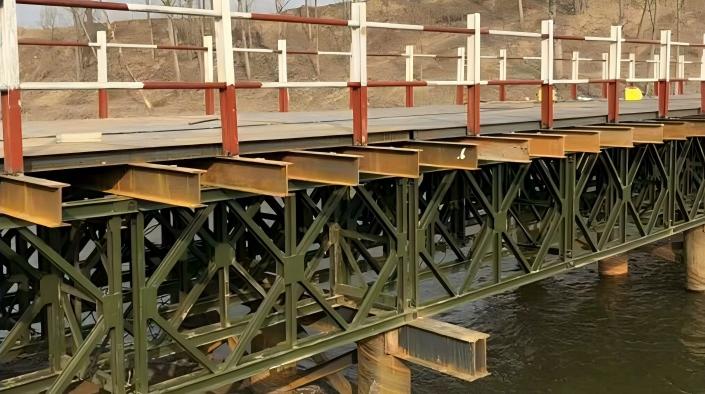
The HD200 Bailey Bridge is a heavy-duty prefabricated steel bridge system designed around modular truss components. It is commonly selected for emergency access, temporary detours, military logistics, rural road development, construction access, and long-term crossings where installation speed and carrying capacity both matter.
The system is known for a simple modular structure, convenient transportation, fast erection, straightforward dismantling, high structural rigidity, and long fatigue life. It can be configured for different spans and traffic requirements, including temporary, emergency, and fixed bridge applications.
Specification | HD200 Bailey Bridge |
Single-lane clear width | 4.2 m |
Double-lane clear width | 7.4 m |
Single-lane span range | 9.14–76.2 m |
Double-lane span range | 9.14–57.9 m |
Main advantages | Wider single lane, high rigidity, modular construction, strong load capability |
Typical uses | Emergency bridges, temporary bypasses, government infrastructure, logistics routes |
A 4.2 m clear roadway width is a meaningful operational benefit. It gives more room for emergency trucks, delivery vehicles, maintenance equipment, and drivers operating in poor weather or low-visibility conditions. By comparison, a narrower bridge may create vehicle restrictions or reduce the margin for safe passage.
One of the most useful comparison points is steel consumption in a larger-span application. According to the supplied technical comparison, for a 39 m crossing designed around a Car-20 load condition, a 321 configuration using a three-row, single-layer reinforced arrangement weighs approximately 57.2 tonnes. An HD200 configuration using a double-row, single-layer reinforced arrangement weighs approximately 54.8 tonnes.
That difference equals 2.4 tonnes less steel for the cited HD200 arrangement, while also providing a 4.2 m clear lane width.
This does not mean HD200 is automatically lighter in every project. Final weight depends on span, deck type, loading standard, truss arrangement, wind requirements, accessories, and project-specific structural calculations. But it demonstrates an important procurement lesson: buyers should compare complete engineered configurations—not only the name of the bridge system.
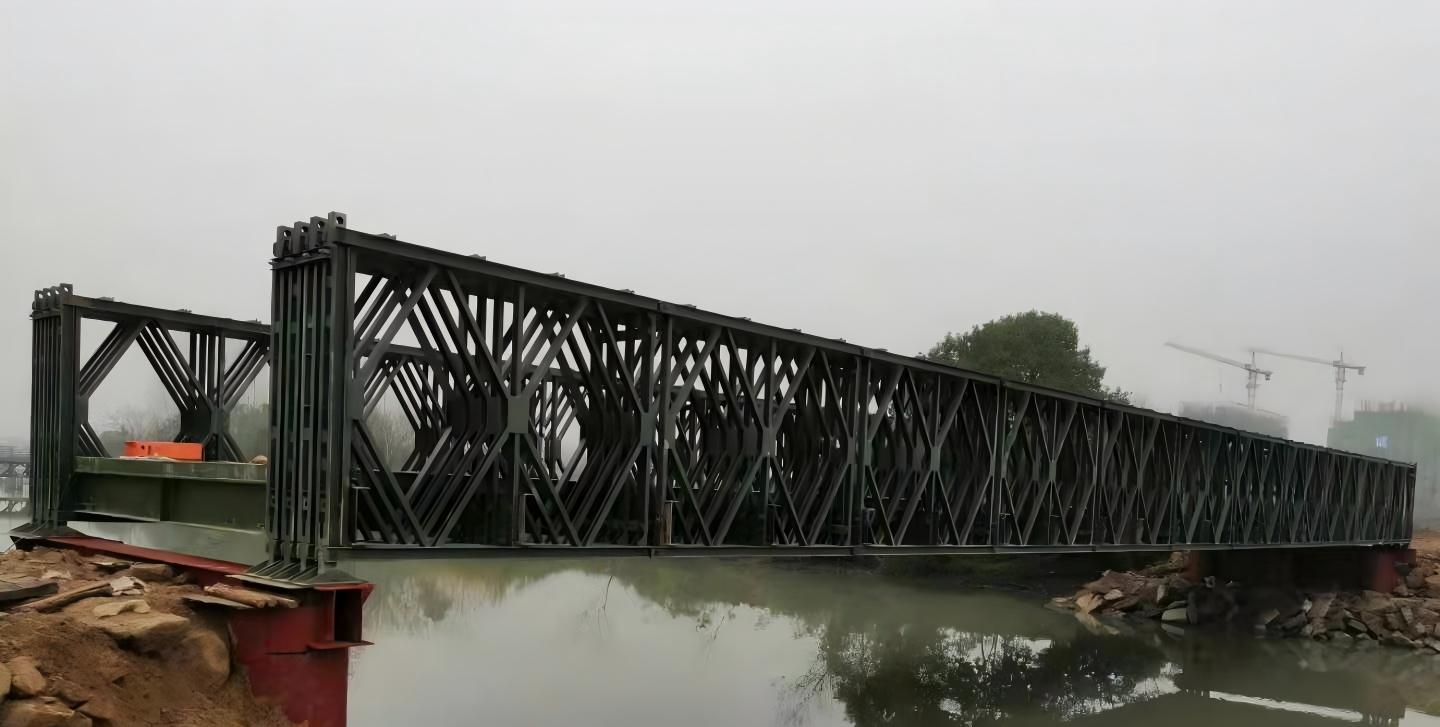
The 321 Bailey Bridge, sometimes called a 321-type or metric Bailey bridge, is also a modular steel truss bridge system built for rapid assembly and flexible use. It uses standardized components, making it familiar to many contractors and agencies that have worked with traditional Bailey bridge inventories.
A standard 321 panel is 3.048 m long. The system can be configured as a single-lane or double-lane bridge and is commonly used for emergency replacement crossings, temporary traffic diversion, military movement, remote-area infrastructure, and repair projects.
Specification | 321 Bailey Bridge |
Standard panel length | 3.048 m |
Single-lane clear width | 3.7 m |
Double-lane clear width | 7.4 m |
Maximum span cited in source material | Up to 60 m |
Main advantages | Proven modular system, rapid deployment, adaptable configuration |
Typical uses | Emergency recovery, temporary crossings, logistics and military applications |
The 321 system remains valuable because of its familiar modularity. When a road authority already has compatible components, trained assembly crews, and established erection equipment, a 321 Bailey Bridge can be an efficient recovery option.
However, in new procurement, decision-makers should evaluate whether a legacy-compatible system is actually the best answer for the required vehicle width, span, load class, lifecycle requirements, and flood-resilience plan.
The following table summarizes the most important differences for post-flood bridge selection.
Decision Factor | HD200 Bailey Bridge | 321 Bailey Bridge | What It Means After Flooding |
Single-lane clear width | 4.2 m | 3.7 m | HD200 gives more operating space for trucks and emergency vehicles |
Double-lane clear width | 7.4 m | 7.4 m | Both can support two-lane configurations |
Span capability | Up to 76.2 m single lane; 57.9 m double lane | Up to 60 m cited | HD200 offers a broader cited single-lane span range |
Structural rigidity | High | High | Both require configuration-specific engineering verification |
Steel efficiency in cited 39 m example | 54.8 tonnes | 57.2 tonnes | HD200 saved 2.4 tonnes in the compared configuration |
Component familiarity | Advanced heavy-duty modular system | Widely known legacy-style modular system | 321 can be attractive where existing stock and trained crews are available |
Flood recovery suitability | Excellent for heavier-duty, wider, and longer-span needs | Excellent for standard emergency access needs | Selection must follow site, loading, and installation conditions |
The best system is not determined by a generic statement such as "stronger" or "faster." A professional selection process considers the bridge configuration, actual span, load model, deck, wind exposure, waterway behavior, site access, equipment availability, and design standard.
A common content gap in basic Bailey bridge comparisons is the assumption that flood resilience comes only from the steel bridge truss. In reality, the most serious flood failures often involve scour, erosion, debris accumulation, approach-road washout, and foundation instability.
The Federal Highway Administration's scour guidance emphasizes the need for structured assessment and risk-based planning for bridges over waterways. Scour analysis and countermeasures are essential because floodwater can remove supporting soil around piers and abutments even when the visible bridge structure appears intact.
Scour is the erosion of riverbed or bank material caused by flowing water. During a major flood, localized scour can develop quickly around bridge supports and abutments.
For an emergency steel bridge project, the engineering team should assess:
- Existing channel geometry and recent flood changes
- Expected flow velocity and water level
- Potential contraction scour at the crossing
- Local scour around abutments or intermediate supports
- Bank erosion and approach-road vulnerability
- Need for riprap, gabions, concrete protection, sheet piles, or other countermeasures
- Temporary versus permanent foundation requirements
Expert insight: In flood recovery, it is often wiser to spend extra time improving the abutment and waterway solution than to rush the bridge launch. A bridge can be installed in a day, but a poorly protected foundation can create months of additional work.
Floodwater frequently carries trees, branches, construction debris, damaged utility materials, and sediment. Debris can become trapped against bridge members, reducing the waterway opening and increasing hydraulic forces.
Bridge planning should include:
- Adequate clearance between the low chord and expected flood level
- Riverbank debris-management access
- Consideration of upstream vegetation and floating debris risk
- Inspection procedures after high-flow events
- A defined closure and reopening process
Debris accumulation can change hydraulic behavior and increase local scour, which is why it should be included in the hydraulic analysis rather than treated as an afterthought.
Both HD200 and 321 Bailey bridges use steel components that require suitable protection for the climate and service environment. In tropical, coastal, or flood-prone regions, moisture, abrasion, sediment, and contaminants can accelerate deterioration.
A procurement specification should clearly define:
- Steel grade and fabrication standard
- Surface preparation requirements
- Galvanizing, painting, or duplex coating system
- Fastener protection
- Replacement-component availability
- Inspection intervals and maintenance responsibilities
This is especially important for "temporary" bridges that remain in service for years. Many temporary emergency crossings become long-term assets because permanent reconstruction takes longer than originally expected.
A structured selection process reduces risk and prevents the wrong bridge configuration from being ordered.
Do not rely only on pre-flood drawings. Survey the current riverbanks, channel profile, damaged approaches, and available launch area. Floods can widen channels, move sediment, and alter the required span.
List the heaviest vehicles expected during both emergency and recovery phases. Include ambulances, fire trucks, relief trucks, construction machinery, agricultural vehicles, fuel tankers, and future commercial traffic.
The bridge supplier and project engineer should determine the appropriate truss arrangement, deck system, width, span, loading class, wind design, and safety factors.
For projects needing more lane width or a longer single-lane reach, the HD200 may provide a stronger starting point. For standard spans and projects that already use 321 inventory, the 321 system can remain highly practical.
Confirm bearing capacity, abutment layout, scour depth, drainage, bank protection, and approach transitions. This step is not optional.
Verify component packaging, container loading, port handling, inland transport, crane capacity, launching equipment, local labor capability, installation sequence, and site safety plan.
Before traffic is allowed to cross, inspect deck connections, pins, bolts, bearings, bracing, approach slabs, guardrails, drainage, and abutment stability. After another high-water event, inspect again before reopening the bridge to unrestricted traffic.
For public agencies and EPC contractors, bridge procurement is not only about buying steel components. It is about reducing project uncertainty.
Evercross Bridge provides prefabricated steel bridge solutions supported by more than 30 years of industry experience. Our capabilities cover steel bridge design, manufacturing, transportation coordination, installation support, and project-specific technical service.
We serve clients in more than 50 countries, with annual steel bridge production capacity of 100,000 tonnes. Our project experience includes more than 200 major government infrastructure projects delivered across Southeast Asia, Africa, and Latin America.
For a flood-recovery project, our team can help evaluate:
- Whether HD200 or 321 is more suitable for the required span and loading
- Single-lane versus double-lane configuration
- Emergency temporary use versus long-term service
- Site-access and transport constraints
- Deck, guardrail, and approach requirements
- Corrosion-protection options
- Installation planning and technical documentation
If your project involves a washed-out crossing, damaged rural road, emergency detour, government recovery program, or remote logistics route, do not choose a bridge system based on a catalog comparison alone.
Contact Evercross Bridge to discuss your span, traffic load, flood conditions, delivery destination, and installation requirements. Our engineering and project teams can help develop a practical prefabricated steel bridge solution—from concept and manufacturing through shipping and installation support.
The answer depends on the final engineered configuration. HD200 systems are generally positioned for heavier-duty applications and offer a wider 4.2 m single lane, compared with 3.7 m for the cited 321 configuration. In the supplied 39 m, Car-20 comparison, HD200 also used less steel. Final capacity must always be verified through project-specific calculations.
For projects requiring a wider lane, high structural rigidity, and longer cited single-lane span capability, HD200 is often the more suitable option. For conventional emergency access, especially where 321 components and experienced crews are already available, a 321 Bailey Bridge can be an effective solution.
Yes. Depending on the design, loading, corrosion protection, foundations, deck system, maintenance plan, and local regulations, a modular steel bridge can be used for long-term service. The bridge should be engineered for its intended design life rather than treated as a temporary structure by default.
Scour and foundation instability are among the most critical risks. Floodwater can erode soil around abutments or supports, while debris accumulation can increase hydraulic loads and worsen scour. A proper hydraulic and geotechnical assessment is essential.
Installation time depends on span, configuration, site access, foundation readiness, available labor, equipment, weather, and local conditions. Modular systems can be erected much faster than conventional cast-in-place bridge construction, but responsible suppliers should avoid promising a fixed timeline without reviewing the project conditions.
Provide the required span, roadway width, vehicle load requirements, site location, photos or drawings, desired service life, foundation information if available, corrosion environment, delivery requirements, and expected installation method. This allows the supplier to recommend an appropriate configuration rather than providing a generic price.
1. Evercross Bridge. "[HD200 Bailey Bridge vs 321 Bailey Bridge: Which Performs Better After Torrential Floods?]"
2. IbeeHive Steel Structures. "[The Difference Between HD200 Bailey Bridge and 321 Bailey Bridge]."
3. Federal Highway Administration. "[Infrastructure: Developing a Risk-Based Scour Program]."
4. Federal Highway Administration. "[Bridge Scour]."
5. U.S. Congressional Research Service. "[Emergency Relief Program for Disaster-Damaged Highways and Bridges]."
6. Federal Highway Administration. "[Debris Control Structures: Evaluation and Countermeasures]."


