

Views: 211 Author: Evercross Bridge Publish Time: 2026-09-24 Origin: Evercross Bridge


Content Menu
● Why Malaysia Needs Rapid-Deployment Flood Bridges
● What Is a Temporary Steel Bridge?
>> Why the Bailey Bridge Principle Still Works
● Four Reasons Temporary Steel Bridges Perform Well in Flood Relief
>> 1. Fast Restoration of Emergency Access
>> 2. Reliable Strength for Relief Vehicles
>> 3. Adaptability Across Different Flood Sites
>> 4. Better Whole-Life Value Than Improvised Crossings
● How to Specify a Flood Relief Bailey Bridge
>> Essential Information for Your RFQ
>> Questions to Ask a Bridge Supplier
● Expert Checklist for Safer Flood Deployment
● Choose a Bridge Partner Before the Emergency
● FAQ
>> 1. What is a temporary steel bridge for flood relief?
>> 2. How quickly can a Bailey bridge be installed?
>> 3. Can a temporary modular bridge carry trucks and ambulances?
>> 4. Can a temporary steel bridge be reused?
>> 5. Does a flood-relief bridge require foundations?
>> 6. What documents should a bridge supplier provide?
>> 7. Why is early emergency-bridge planning important?
When floodwaters damage roads, wash out approach embankments, or isolate villages, restoring access cannot wait for a conventional bridge project. A temporary steel bridge for flood relief gives Malaysian agencies, contractors, and infrastructure owners a practical way to reopen critical crossings quickly—supporting rescue operations, evacuations, medical access, and the delivery of food, fuel, and construction materials.
For more than 30 years, Evercross Bridge has specialized in prefabricated steel bridge systems, including Bailey bridges and emergency bridge solutions. With an annual production capacity of 100,000 tonnes and experience supporting more than 200 major government infrastructure projects across Southeast Asia, Africa, and Latin America, we understand an essential fact about disaster infrastructure: a bridge is not useful only when it is strong; it must also be available when access is urgently needed.
Malaysia's flood exposure makes rapid-access infrastructure increasingly important. Floods are the country's most frequent natural disaster, and climate-risk assessments indicate that flood frequency and intensity may continue to rise as rainfall patterns change.
Malaysia's northeast and southwest monsoon systems, combined with intense rainfall, river overflow, flash-flood risk, and low-lying coastal areas, create recurring pressure on roads and bridges. Flooding is not simply a water-management issue. It is a connectivity issue.
When a bridge becomes unsafe or an access road is washed away, communities can lose direct connections to:
- Hospitals and emergency medical services
- Evacuation centres and rescue teams
- Schools, markets, and public facilities
- Agricultural collection points and industrial sites
- Relief supplies, fuel, drinking water, and food distribution routes
The World Bank notes that flooding accounts for 85 percent of Malaysia's recorded natural disasters since 2000. Its more recent climate assessment also identifies thousands of flood hotspots nationwide and warns that flood risk is expected to increase in many river basins.
A permanent reinforced-concrete bridge may be the right long-term asset, but it is rarely the right first response. Permanent construction normally requires survey work, hydraulic review, foundation construction, approvals, material mobilization, and a much longer delivery schedule. During a disaster, authorities need a crossing that can be transported, assembled, inspected, and opened in a compressed timeframe.
That is where a modular temporary steel bridge provides value.
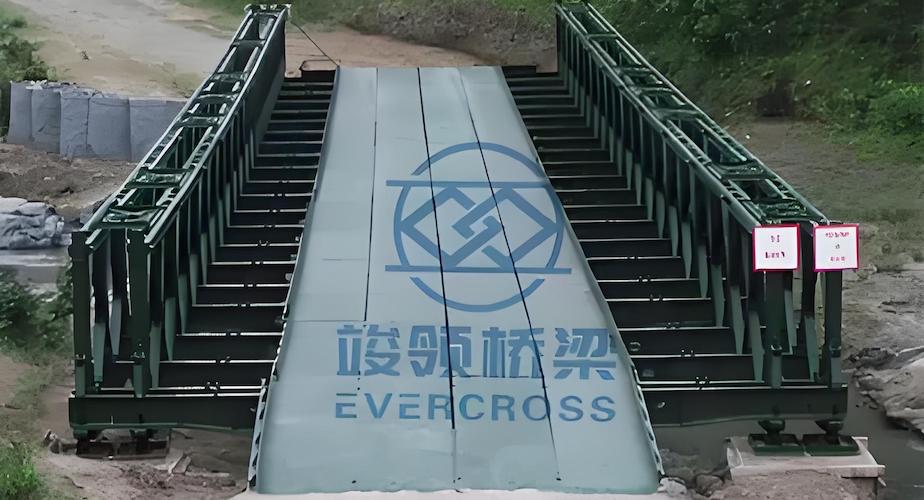
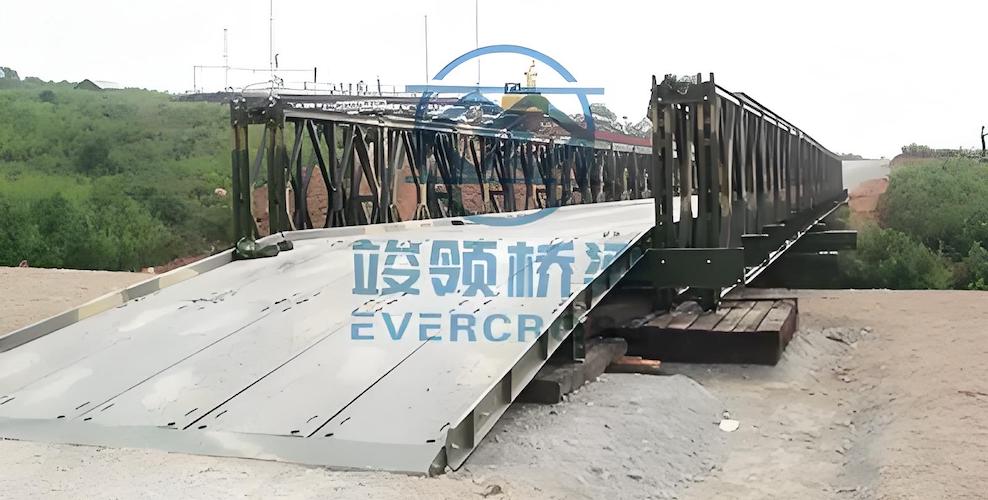
A temporary steel bridge is a prefabricated crossing made from standardized steel components that are delivered to site and assembled into a complete bridge structure. A Bailey bridge is the best-known example: a modular steel truss system formed from repeatable panels, transoms, bracing, deck units, pins, and other connecting parts.
Rather than manufacturing the entire bridge on site, the supplier produces precision components in advance. The project team then configures these components to match the required span, lane width, traffic type, and site constraints.
The Bailey bridge concept remains relevant because it combines three requirements that are often difficult to achieve together:
Requirement | Why it matters during flood relief | Modular steel bridge advantage |
Speed | Isolated communities need access quickly | Prefabricated parts reduce on-site fabrication time |
Strength | Emergency vehicles and trucks require dependable load capacity | Steel truss configurations can be engineered for project loads |
Flexibility | Flood sites vary in width, approaches, and ground conditions | Panel-based systems can be configured for different spans and widths |
Reusability | Disaster agencies need long-term asset value | Components can be dismantled, stored, moved, and redeployed |
Maintainability | Emergency assets must remain ready between events | Individual components can be inspected and replaced as needed |
In our experience as a steel bridge manufacturer, the most successful emergency-bridge programmes do not treat a bridge as a one-time purchase. They treat it as a strategic response asset: a system that can be inspected, stored, mobilized, installed, removed, and reused over multiple emergency events.
The greatest advantage of a temporary steel bridge is its ability to shorten the time between infrastructure failure and restored access.
Because major components are pre-engineered and prefabricated, site crews can focus on logistics, abutments, assembly, launching, deck installation, safety checks, and traffic management rather than fabricating primary bridge members from raw steel on site.
The existing Evercross Bridge case article reports that a Malaysian Army Bailey bridge installation restored access within 48 hours in a flood-affected setting. This is an important illustration of the potential speed of modular bridge deployment, although the actual programme for any project will depend on span, site access, foundation readiness, equipment, river conditions, trained labour, and approval requirements.
A realistic emergency bridge programme should plan for:
1. Site reconnaissance and hazard assessment
2. Hydraulic and geotechnical verification
3. Selection of bridge span, width, and design loading
4. Delivery of bridge modules and installation equipment
5. Preparation of foundations, abutments, or temporary supports
6. Assembly, launching, decking, and guardrail installation
7. Inspection, load verification, traffic control, and handover
Expert insight: The bridge kit is only one part of rapid deployment. The strongest response plans pre-qualify transport routes, lifting equipment, local contractors, installation crews, and decision-making authority before a flood occurs.
A flood-relief bridge must carry more than pedestrians. Depending on the response plan, it may need to accommodate ambulances, fire and rescue vehicles, utility-repair trucks, military vehicles, relief-supply trucks, and maintenance equipment.
A properly designed modular steel bridge can be configured around the project's required loading, span, roadway width, deck system, wind exposure, and intended service period. However, "steel bridge" alone is not a safety guarantee. Safe performance depends on correct engineering.
The design review should consider:
- Vehicle load class and axle configuration
- Single-lane or two-lane traffic requirements
- Pedestrian walkway and guardrail needs
- Span length and truss arrangement
- Deck type and anti-slip surface requirements
- Approach-road stability and scour protection
- River flow, debris impact, and flood clearance
- Temporary or permanent foundation arrangement
- Corrosion-protection requirements for wet and humid environments
A well-engineered emergency bridge is not merely placed over water. It is integrated into a complete temporary transport system that includes stable approaches, traffic-control measures, drainage, drainage protection, signage, and periodic inspection.
Malaysia's flood scenarios are not identical. One project may involve a narrow rural river crossing; another may require a detour over a washed-out culvert, a temporary access route to an industrial facility, or a replacement crossing near a damaged permanent bridge.
A modular steel bridge can be adapted through combinations of panels, bracing, deck components, and support arrangements. This provides agencies with more operational flexibility than a fixed, single-purpose structure.
Typical applications include:
- Emergency replacement of a damaged rural road bridge
- Temporary diversion route during permanent bridge reconstruction
- Access bridge for flood recovery and utility repair
- Disaster-relief crossing for isolated villages
- Construction bridge for rebuilding damaged roads
- Temporary crossing at mining, plantation, or industrial sites
- Long-term modular crossing where permanent works are delayed
The ability to dismantle and relocate the bridge can increase lifetime value. Once the permanent crossing is repaired, the bridge modules can be inspected, refurbished if required, and stored for the next deployment.
Cost is important in public emergency procurement, but purchase price alone is the wrong comparison. Decision-makers should evaluate the total value of restored connectivity.
An improvised timber crossing may appear cheaper at first, yet it may offer limited load capacity, shorter service life, inconsistent safety, and poor suitability for emergency trucks. A temporary modular steel bridge typically has a higher engineering standard and can serve multiple sites over its life cycle.
Instead of relying on generalized claims such as "50–70 percent savings," procurement teams should request a project-specific comparison that includes:
- Bridge supply and transport cost
- Civil works and approach-road repairs
- Installation equipment and labour
- Required emergency response time
- Traffic downtime and detour cost
- Load capacity and expected service duration
- Inspection, maintenance, and removal cost
- Residual value and future redeployment potential
Practical principle: A bridge that restores a hospital route, emergency-supply corridor, or evacuation connection may deliver value far beyond its direct installation cost.
A strong procurement brief helps bridge suppliers provide an accurate technical proposal rather than a generic quotation.
Before requesting a temporary steel bridge quotation, prepare the following information:
Information required | Why suppliers need it |
Required clear span | Determines bridge configuration and structural design |
Required roadway width | Defines one-lane, two-lane, or pedestrian arrangement |
Design vehicle or load class | Ensures the bridge suits trucks, rescue vehicles, and traffic needs |
Site photographs and coordinates | Helps assess access, terrain, river alignment, and logistics |
Water level and flood history | Supports clearance, scour, and hydraulic planning |
Soil or foundation information | Helps determine abutments, supports, and ground preparation |
Service period | Clarifies temporary, semi-permanent, or permanent-use requirements |
Delivery location and target date | Supports shipping and mobilization planning |
Local standards and approval requirements | Helps align design documents with the project jurisdiction |
Do not select a supplier based only on bridge-panel pricing. Ask whether the supplier can provide the complete delivery chain:
- Preliminary bridge configuration and technical drawings
- Load calculations and engineering documentation
- Manufacturing quality-control records
- Galvanizing or coating specifications
- Packing list and shipping support
- Installation manual and assembly drawings
- On-site technical guidance or remote installation support
- Spare-parts recommendations
- Inspection and maintenance guidance
Evercross Bridge provides an integrated approach covering steel bridge design, production, transportation, and installation support. This is particularly valuable for emergency projects, where coordination failures between engineering, manufacturing, logistics, and installation teams can cost critical time.
Flood conditions require additional caution. A rapid bridge should never be installed at the expense of engineering control.
- Confirm that water flow, debris conditions, and bank stability allow safe work.
- Verify bridge location, span, elevation, and approach alignment.
- Assess scour risk around abutments and temporary foundations.
- Confirm that delivery vehicles and cranes can safely access the site.
- Establish a traffic-management and emergency-exclusion plan.
- Check that workers have the correct lifting, launching, and fall-protection equipment.
- Follow approved drawings and assembly sequences.
- Inspect pins, bolts, panels, bracing, deck components, and bearings.
- Maintain controlled lifting operations and clear communication.
- Monitor weather and river-level changes continuously.
- Prevent unauthorized entry beneath or around the bridge during construction.
- Confirm deck, guardrail, approach, signage, and drainage completion.
- Carry out the required structural and operational inspection.
- Set speed, lane, vehicle-weight, and pedestrian-use controls.
- Establish a documented inspection schedule for the operational period.
The best time to source a temporary steel bridge is not after access has already failed. Government agencies, contractors, disaster-response organizations, and infrastructure owners should establish a bridge-readiness plan in advance.
That plan should include pre-approved bridge configurations, stock or production options, installation-team training, transport routes, site data, and defined decision authority. With the right preparation, a modular Bailey bridge can become a reliable part of Malaysia's flood-resilience toolkit.
Need a temporary steel bridge for flood relief, emergency access, or a damaged-road detour? Contact Evercross Bridge with your span, width, load, site location, and required delivery date. Our engineering and project teams can help you evaluate a modular steel bridge configuration and develop a practical supply-and-installation solution.
A temporary steel bridge for flood relief is a prefabricated modular bridge used to restore road access after flooding damages a permanent bridge, culvert, embankment, or approach road. It is commonly built from reusable steel truss components, such as a Bailey bridge system.
The timeline depends on bridge length, design loading, foundation readiness, delivery access, available equipment, weather, water conditions, and the experience of the installation team. The Evercross case article cites a 48-hour Malaysian Army installation, but each emergency site requires its own engineering and deployment assessment.
Yes, when it is engineered for the required traffic load and installed correctly. Buyers must define the intended vehicle types, maximum axle loads, lane width, and expected traffic volume during the design stage. A bridge should not be opened until inspections and applicable approvals are completed.
Yes. One of the major advantages of modular steel bridge systems is their ability to be dismantled, transported, stored, and reassembled at another location. Components should be inspected for corrosion, wear, deformation, and connection condition before redeployment.
Usually, yes. The exact support system depends on site conditions, span, soil capacity, flood level, scour risk, and intended bridge load. Temporary bridges may use engineered abutments, concrete foundations, existing sound supports, or other designed support solutions. A qualified engineer should assess the site.
A capable supplier should provide bridge drawings, assembly guidance, material specifications, quality-control documentation, packing information, installation instructions, and maintenance recommendations. Depending on the project, structural calculations and third-party inspection documentation may also be required.
Pre-disaster planning reduces delays caused by incomplete site information, untrained crews, uncertain logistics, and unclear design requirements. It allows agencies to prepare bridge inventories, framework agreements, transport plans, and standard operating procedures before the next flood event.
1. Evercross Bridge. "[Why Temporary Steel Bridge for Flood Relief Is the Best Fix for Malaysia]."
2. Asian Development Bank and World Bank Group. "[Climate Risk Country Profile: Malaysia]."
3. World Bank. "[Malaysia Country Climate and Development Report]."
4. World Bank. "[Malaysia Country Climate and Development Report—Full Report]."
5. ASEAN Coordinating Centre for Humanitarian Assistance on Disaster Management. "[Flash Update: Flooding and Landslide in Peninsular Malaysia]."


