

Views: 221 Author: Evercross Bridge Publish Time: 2026-10-30 Origin: Evercross Bridge


Content Menu
● Choosing the Right Bailey Bridge for Philippine Infrastructure
● Understanding Simply Supported and Continuous Bailey Bridge Systems
>> What Is a Simply Supported Bailey Bridge?
>> What Is a Continuous Bailey Bridge?
>> Simply Supported vs. Continuous Bailey Bridges: Key Differences
● Why Philippine Site Conditions Matter When Selecting a Bailey Bridge
>> Soft Soils and Differential Foundation Settlement
>> Typhoons, Flooding, and River Scour
>> Seismic Design and Bearing Movement
● Construction and Lifecycle Advantages of Modular Bailey Bridges
>> Faster Installation Through Modular Construction
>> Reusable Components and Lifecycle Cost Control
>> Maintenance and Inspection Planning
● Choosing the Right Bailey Bridge Configuration for Philippine Projects
>> Type 321 and HD200 Bailey Bridges
>> When Should Engineers Consider a Continuous Arrangement?
● What Philippine Bridge Buyers Should Verify Before Procurement
>> Step 1: Define the Design Requirements
>> Step 2: Confirm the Applicable Design Standards
>> Step 3: Review Drawings and Engineering Calculations
>> Step 4: Verify Manufacturing and Quality Documentation
>> Step 5: Establish Delivery, Installation, and After-Sales Scope
● Evercross Bridge: Manufacturing Capability and International Project Experience
● A Practical Recommendation for Emergency and Rural Bridges
● Frequently Asked Questions About Bailey Bridges in the Philippines
>> FAQ 1: Is a simply supported Bailey bridge suitable for Philippine rural roads?
>> FAQ 2: Can a Bailey bridge withstand heavy farm trucks and construction vehicles?
>> FAQ 3: Is a simply supported Bailey bridge safer than a continuous Bailey bridge?
>> FAQ 4: How long does it take to install a prefabricated Bailey bridge?
>> FAQ 5: Can Bailey bridge components be reused after temporary construction?
>> FAQ 6: Does Evercross Bridge supply complete Bailey bridge systems?
>> FAQ 7: Can Evercross Bridge provide a 91-meter single-span modular bridge?
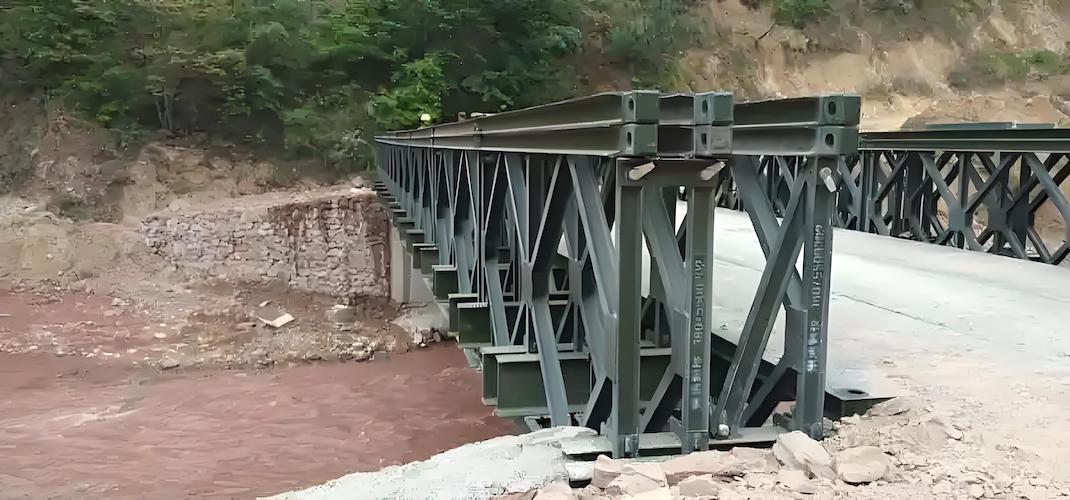
A simply supported Bailey bridge can be a practical solution for road rehabilitation, rural connectivity, emergency access, and temporary infrastructure projects in the Philippines. Its modular construction, standardized components, and ability to operate as an individual span make it attractive for projects where construction time, transportation logistics, foundation conditions, and future reuse are important considerations.
However, selecting a Bailey bridge is not simply a matter of choosing a standard truss and assembling it on site. Engineers and project owners must evaluate the required span, vehicle loading, flood levels, foundation capacity, seismic demands, erection conditions, and applicable design specifications before deciding whether a simply supported or continuous structural arrangement is appropriate.
At Evercross Bridge, we specialize in prefabricated steel bridge solutions, including Type 321 and HD200 Bailey bridges, modular steel bridges, and emergency bridge systems. With more than 30 years of stated industry experience, an established manufacturing base in Jiangsu, China, and projects delivered to multiple international markets, we understand the importance of balancing structural performance with practical construction requirements.
This article explains how simply supported Bailey bridges work, why their characteristics can be useful in Philippine infrastructure projects, how they compare with continuous systems, and what buyers should verify before placing an order.
A simply supported Bailey bridge consists of a span supported at its two ends. Under the idealized structural model, the supports allow the bridge to carry vertical loads while accommodating the movements and rotations required by the design.
When a vehicle travels across the span, the bridge develops bending moments, shear forces, and deflection. For a conventional simply supported beam under typical downward loading, the maximum positive bending moment generally occurs within the span rather than as a negative bending moment over an intermediate support.
Bailey bridges use interconnected steel truss panels, pins, transoms, bracing, and decking to form a modular load-bearing system. Their actual structural behavior depends on the bridge configuration, connection details, bearing arrangements, and design assumptions.
The main advantage is structural independence between spans. Where each span is designed and supported independently, the engineer can analyze and manage the structural response of each span without relying on the same continuous superstructure to redistribute bending moments across several piers.
This can simplify certain temporary bridge layouts and make individual spans easier to replace or relocate.
A continuous bridge extends across multiple supports with structural continuity between adjacent spans. Unlike a simply supported arrangement, its bending moments and reactions depend on the behavior of the entire connected system.
Continuous structures can distribute loads differently and may offer advantages in stiffness, deflection control, or material efficiency for suitable designs. However, they also require the engineer to consider interactions between spans, support movement, bearing behavior, and differential foundation settlement.
A conventional Bailey truss cannot automatically be treated as a continuous bridge simply by connecting standard modules across several supports. The complete system must be designed for the forces, connections, restraint conditions, and load combinations associated with the proposed arrangement.
Evaluation factor | Simply supported arrangement | Continuous arrangement |
Structural behavior | Each span is analyzed primarily as an individual supported unit | Internal forces depend on interaction between connected spans |
Bending moments | Positive span moments under typical gravity loading | Positive span moments and potentially negative support moments |
Settlement sensitivity | Individual spans can limit the transfer of superstructure forces between spans | Differential support movement can alter forces throughout the connected system |
Construction | Individual spans may be assembled and installed separately | Erection and connection sequences must account for system continuity |
Maintenance | Localized span inspection and component replacement may be possible | Inspection must also address continuity connections and support regions |
Reuse | Standardized components can often be dismantled and redeployed | Reuse depends on the design, connection details, and dismantling sequence |
Engineering requirements | Requires complete span, support, stability, and load verification | Requires analysis of the full continuous system and its support conditions |
Neither arrangement is universally superior. The correct solution depends on the design loads, geometry, site conditions, construction method, service life, and maintenance strategy.
The Philippines presents a combination of geographic, climatic, and logistical challenges that should be addressed during preliminary bridge planning.
River crossings and rural road corridors may contain alluvial deposits, loose soils, weathered materials, or other ground conditions that require careful investigation. Foundation capacity can vary considerably between locations, so engineers should not assume that neighboring abutments or temporary piers will settle equally.
For a simply supported Bailey bridge, each span has its own support reactions. This arrangement can reduce the transfer of superstructure bending effects between adjacent spans when compared with a continuous system.
However, simply supported does not mean settlement-proof. Differential settlement can still change bearing contact, introduce unintended restraint, affect deck alignment, and create additional forces if the bridge details do not accommodate movement as intended.
Before installation, project teams should assess:
- Soil bearing capacity and expected settlement.
- Abutment and pier stability under vertical and horizontal loads.
- Scour potential and the risk of foundation exposure during floods.
- Bearing-seat elevation, alignment, and movement capacity.
- Access for foundation construction and future inspection.
For projects with uncertain ground conditions, a geotechnical investigation and a site-specific foundation design are essential. Selecting the superstructure without evaluating its supports can undermine the performance of even a well-manufactured bridge.
According to the Philippine Atmospheric, Geophysical and Astronomical Services Administration (PAGASA), approximately 20 tropical cyclones enter the Philippine Area of Responsibility each year, with around eight or nine crossing the country. PAGASA identifies July through October as the peak period for tropical cyclone activity..
These conditions make hydraulic and environmental assessments important for permanent and temporary bridge projects.
Heavy rainfall can increase river discharge, accelerate scour around piers, transport debris, and damage approach roads. A bridge that satisfies its vehicle-loading requirements may still be vulnerable if its foundations, approach embankments, bearings, or lateral restraints are not designed for the site conditions.
A simply supported arrangement can help localize certain structural effects if an individual span or support is damaged. It does not, however, guarantee that adjacent spans will remain operational after a flood or foundation failure.
For a flood-prone Bailey bridge project, engineers should consider:
1. Design flood levels and required freeboard.
2. Hydraulic opening and potential debris accumulation.
3. Scour depth and foundation protection.
4. Wind loads and lateral stability.
5. Bearing restraint, uplift, and movement requirements.
6. Inspection and post-flood access.
Where rapid recovery is a project priority, a modular bridge can offer a useful construction advantage, provided the complete system is designed for the relevant hazards.
The Philippines is located in a seismically active region. Bridge design must therefore account for the applicable seismic requirements, site conditions, support movements, and potential interaction between the superstructure and substructure.
Sliding bearings can accommodate specified movement when properly designed and installed. They should not be assumed to provide complete earthquake protection on their own.
A simply supported bridge still requires suitable lateral restraints, bearing seats, connections, bracing, and checks against unseating. The engineer must establish how seismic forces travel through the deck, trusses, bearings, abutments, and foundations.
The choice between simply supported and continuous construction should therefore follow structural analysis rather than a general assumption that one system is automatically safer in earthquakes.
One of the strongest advantages of a Bailey bridge is that its standardized components can be manufactured, transported, and assembled using a planned construction sequence.
Depending on the site, the bridge may be assembled on an approach embankment and launched into position, or installed using cranes and other lifting equipment. A suitable method depends on span length, terrain, river conditions, available equipment, and the weight of the assembled structure.
For emergency road restoration, this modular approach can reduce the amount of site fabrication and help project teams organize installation activities more efficiently.
Nevertheless, a short installation window is not a universal guarantee. Foundation preparation, access-road construction, permitting, river conditions, logistics, and load testing can all affect the delivery schedule.
Project owners should request a complete erection plan that identifies:
- Foundation and abutment preparation.
- Component delivery and storage.
- Assembly and launching procedures.
- Temporary works and lifting requirements.
- Traffic management and worker safety measures.
- Final inspection and commissioning.
This information is more useful for schedule planning than an unsupported promise that every bridge can be installed within a fixed number of hours.
Bailey bridges are designed around modular steel components, which can make dismantling, transportation, repair, and redeployment practical for suitable applications.
After a temporary crossing is no longer required, reusable panels and accessories may be transferred to another site, subject to inspection and confirmation that the configuration meets the new project's design requirements.
The economic benefit depends on more than the initial steel quantity. Buyers should evaluate the full lifecycle cost, including:
- Initial purchase and engineering.
- Foundations, bearings, decking, and approach works.
- Transportation and unloading.
- Installation equipment and labor.
- Corrosion protection and periodic inspection.
- Dismantling, storage, refurbishment, and reuse.
A simply supported arrangement may make span-by-span replacement or relocation easier in some projects. However, a continuous system may also be reusable if it has been designed for disassembly.
The most economical bridge is the one that meets the required performance and service life at the lowest justified lifecycle cost, not necessarily the one with the lowest initial purchase price.
Modular construction can help maintenance teams identify individual components for inspection and replacement. This is particularly useful when the owner needs to manage several crossings in remote locations.
A maintenance plan should cover:
- Truss panels, pins, and connection holes.
- Transoms, bracing, decking, and fasteners.
- Bearings, movement clearances, and bearing seats.
- Corrosion protection and water drainage.
- Deck condition and vehicle restraint systems.
- Foundation movement, scour, and approach settlement.
Inspection intervals should be established according to the design, exposure, traffic intensity, applicable requirements, and findings from previous inspections.
A simply supported arrangement may simplify certain aspects of structural assessment, but it does not eliminate the need for qualified inspections or detailed engineering when damage, unusual movement, or overloading is suspected.
A bridge configuration should be selected according to the actual project requirements rather than span length alone.
Type 321 and HD200 Bailey bridges are established modular truss bridge configurations used for applications such as temporary roads, construction access, and replacement crossings.
The appropriate configuration depends on factors such as:
- Required clear span and bridge width.
- Design vehicle and traffic frequency.
- Number of truss lines and reinforcement arrangement.
- Deck system and approach geometry.
- Available launching or lifting equipment.
- Environmental exposure and intended service life.
The names Type 321 and HD200 identify particular bridge configurations; they do not, by themselves, establish the permissible load capacity for every span.
For example, a longer bridge carrying heavy construction vehicles may require a different truss arrangement or reinforcement strategy from a shorter crossing serving light rural traffic.
A continuous bridge may be worth evaluating where the project requires greater structural continuity, specific deflection performance, or a configuration that benefits from multi-span interaction.
The assessment should include the effects of differential settlement, bearing behavior, temperature movement, construction sequence, and the feasibility of future component replacement.
For a temporary or frequently relocated bridge, a simply supported arrangement may be attractive because of its modularity and independent span layout. For a permanent crossing, the decision should also consider long-term maintenance, foundation performance, traffic demands, and the overall structural design.
There is no sound basis for claiming that all or nearly all Philippine Bailey bridge projects must use one structural arrangement. The final selection should be supported by project-specific engineering calculations and approval from the responsible authorities.
Selecting a qualified Bailey bridge manufacturer involves more than comparing quotations.
Provide the manufacturer and project engineer with the required span, roadway width, design vehicle, traffic volume, expected service life, and environmental conditions.
Identify whether the bridge is intended for emergency use, construction access, rural transport, industrial traffic, or permanent public infrastructure.
Confirm the standards and approval requirements specified by the project owner and the Philippine Department of Public Works and Highways (DPWH), where applicable.
The DPWH's provide a starting point for understanding Philippine bridge engineering requirements. AASHTO's provide a recognized reference for bridge design, but the governing edition and applicable provisions must be established for each project.
NSCP requirements should also be identified where relevant to the project scope. Do not assume that a standard bridge configuration or a manufacturer's general certification automatically establishes compliance with every local requirement.
Request general arrangement drawings, truss configuration details, deck specifications, bearing details, connection information, and design calculations appropriate to the project.
The technical review should address structural strength, serviceability, stability, foundation reactions, wind, seismic effects, and relevant hydraulic considerations.
Ask for traceable material documentation, applicable welding and fabrication quality records, dimensional inspection results, corrosion protection specifications, and inspection procedures.
Where load testing is required or offered, verify the test configuration, loading procedure, measured results, acceptance criteria, and relationship between the tested specimen and the proposed bridge.
Confirm the supply scope, packing method, shipping arrangements, installation support, spare parts, warranty conditions, and documentation provided at handover.
For remote projects, logistics and technical support can materially affect the overall project cost and completion schedule.
At Evercross Bridge, we provide prefabricated steel bridge solutions for infrastructure owners, government-related projects, contractors, and engineering companies.
Our product range includes Type 321 and HD200 Bailey bridges, modular steel bridges, truss bridges, and other steel bridge configurations for different project requirements.
According to our company information, our headquarters are in Shanghai, China, and our manufacturing base is in Zhenjiang, Jiangsu. Our reported facilities include 47,000 m² of total site area, 22,000 m² of production workshops, and 100-ton lifting capacity. We also report that our D-type modular bridge has undergone load testing for a single span of up to 91 meters. The permissible configuration and design capacity must be confirmed for each application.
Our published project experience includes:
- Colombia: Supply of 40 sets of Bailey bridges for a government project.
- Malaysia: Supply of four logistics support bridge sets for the Ministry of Defence.
- Myanmar: Supply of 45 Compact-200 and Compact-100 Bailey bridge sets for the railway sector.
- Ecuador: Supply of 23 Compact-200 Bailey bridge sets for a highway authority.
- Laos: A 110-meter truss bridge project.
- Cambodia: A modular bridge project totaling approximately 500 meters.
- China: A 1,600-meter steel bridge project at Xuanmenwan.
These projects illustrate experience across different bridge types, operating environments, and infrastructure applications. The specific project scope, delivered configuration, and performance requirements should be reviewed against the needs of any new project.
We report holding ISO 9001, ISO 14001, ISO 45001, and other relevant quality, environmental, occupational health and safety, and market-related certifications. Buyers should verify the current validity, scope, and issuing body of each certificate before relying on it for procurement qualification.
Our goal is to help customers evaluate bridge configurations based on engineering requirements, manufacturing capability, logistics, installation conditions, and long-term value.
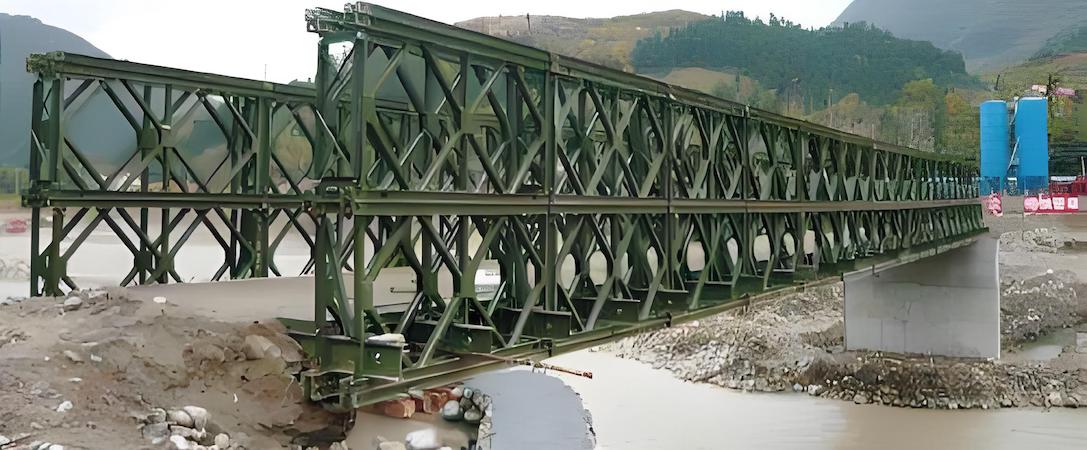
For Philippine projects involving emergency road restoration, rural river crossings, temporary construction access, or relocatable infrastructure, a simply supported Bailey bridge deserves consideration because of its modular construction and the possibility of treating individual spans as separate structural units.
Before making a final decision, project owners should confirm four essentials:
1. Structural suitability: The span, loading, truss configuration, and deflection satisfy the design requirements.
2. Site suitability: Foundations, flood levels, scour, seismic effects, and approach conditions have been evaluated.
3. Construction feasibility: Transportation, launching or lifting, access, and installation sequencing are realistic.
4. Lifecycle value: Inspection, repair, corrosion protection, dismantling, and reuse have been included in the cost assessment.
A well-selected modular bridge is not simply a collection of prefabricated steel panels. It is an engineered system whose performance depends on the relationship between the superstructure, foundations, bearings, connections, and construction method.
Evercross Bridge welcomes inquiries from Philippine contractors, government project suppliers, engineering consultants, and infrastructure developers seeking Bailey bridge and modular steel bridge solutions.
Contact Evercross Bridge to discuss your required span, design loading, site conditions, and project schedule. Share your preliminary drawings or technical specifications, and our team can help identify a suitable bridge configuration for further engineering review.
It can be suitable where the span, vehicle loading, foundation conditions, hydraulic requirements, and applicable design standards have been properly evaluated. The final arrangement should be selected by the responsible bridge engineer.
Potentially, yes, if the bridge is designed for the relevant vehicle loads, axle configurations, traffic conditions, and span. Truss arrangement, reinforcement, decking, and deflection limits must be verified before operation.
Neither system is automatically safer. Simply supported spans can reduce structural interaction between adjacent spans, while continuous bridges may offer other structural benefits. Safety depends on the complete design, supports, connections, construction quality, and site conditions.
Installation time varies with span length, foundation readiness, transport access, assembly method, available equipment, weather, and inspection requirements. A reliable schedule should be based on a project-specific installation plan rather than a universal time promise.
Yes, suitable components can often be dismantled, inspected, repaired where necessary, and reused. Their condition and suitability for the new bridge configuration must be verified before redeployment.
Evercross Bridge reports supplying prefabricated steel bridge systems, including Type 321 and HD200 Bailey bridges. Buyers should confirm the specific scope of supply, including panels, pins, transoms, bracing, decking, bearings, accessories, and installation support, in the quotation.
Evercross Bridge reports that its D-type modular bridge has undergone load testing for a single span of up to 91 meters. Project feasibility, load capacity, configuration, deflection, foundations, and applicable approvals must be verified for the specific site and design requirements.
1. PAGASA — Tropical Cyclone Information. [pagasa.dost.gov]
2. AASHTO — LRFD Bridge Design Specifications, 10th Edition. [store.transportation]
3. Department of Public Works and Highways (DPWH), Philippines. [dpwh.gov.ph]
4. Evercross Bridge — Company Profile and Project Experience. [baileybridgesolution]
5. Evercross Bridge — About Us. [baileybridgesolution]


