

Views: 211 Author: Evercross Bridge Publish Time: 2026-10-30 Origin: Evercross Bridge


Content Menu
● Our Approach to Steel Bridge Reconstruction in Nepal
● Understanding the Challenges of Mountain Bridge Reconstruction
>> Flash Floods and Debris Impact
>> Restricted Construction Access
>> Corrosion Protection in Humid Mountain Environments
● Deck-Type vs. Through-Type Steel Truss Bridges: Our Engineering Perspective
● Why We Consider Deck-Type Steel Truss Bridges for Post-Disaster Reconstruction
>> Supporting Heavy Construction Traffic
>> Accelerating Installation Through Modular Construction
>> Evaluating Flood Resilience Beyond Bridge Configuration
>> Improving Long-Term Maintainability
● Our HD200 Reinforced Bailey Bridge Experience in Nepal
>> What Our Nepal Project Experience Means for Buyers
● Our Recommended Checklist for Selecting a Reconstruction Bridge
>> Step 1: Define the Required Traffic Capacity
>> Step 2: Assess River and Foundation Conditions
>> Step 3: Compare Bridge Types and Erection Methods
>> Step 4: Confirm Applicable Standards
>> Step 5: Review Manufacturing and Quality Documentation
>> Step 6: Plan Installation and Long-Term Operation
● How We Approach International Bridge Standards and Quality Assurance
● How We Help Customers Plan Reliable Steel Bridge Solutions
>> 1. What is a deck-type steel truss bridge?
>> 2. Is a deck-type steel truss bridge always the best choice for flood-prone areas?
>> 3. Can our HD200 Bailey bridge solutions support heavy construction vehicles?
>> 4. Can a modular steel bridge be installed without a large crane?
>> 5. Why do we recommend hot-dip galvanizing for some mountain bridge projects?
>> 6. What information should customers provide when requesting a bridge quotation?
>> 7. How do we help customers choose between a Bailey bridge and a custom steel truss bridge?
At Evercross Bridge, we believe that selecting a steel bridge for post-disaster reconstruction requires more than meeting a basic span or load requirement. Engineers must consider the entire operating environment, including flood risks, debris impact, difficult terrain, transportation limitations, construction schedules, and long-term maintenance.
The catastrophic debris flow and flooding that occurred in Nepal on August 26, 2026, highlighted the vulnerability of mountain infrastructure to sudden natural hazards. According to the, the event affected the Lende Khola and Trishuli Khola river corridors and damaged infrastructure in the wider region.
For hydropower operators, government agencies, and engineering contractors, restoring road connectivity is essential to supporting emergency response, transporting heavy machinery, and reconnecting affected communities.
As a Chinese manufacturer specializing in modular steel bridges, including HD200 reinforced Bailey bridges, we understand the importance of matching bridge design to actual site conditions. Our experience with steel bridge projects in Nepal provides a practical foundation for discussing the advantages and limitations of different bridge configurations.
In this article, we explain why we consider deck-type steel truss bridges a potential solution for demanding reconstruction projects, how they compare with through-type truss bridges, and what project owners should evaluate before making a final engineering decision.
Mountain rivers can experience rapid changes in water level during intense rainfall, landslides, and glacially influenced events. Floodwater may transport boulders, tree trunks, sediment, and other debris capable of damaging bridge structures.
When we evaluate a bridge project in a flood-prone region, we recommend assessing three closely related risks:
- Hydraulic loading: Fast-moving water can exert significant forces on bridge components.
- Debris impact and blockage: Floating timber and larger objects may strike structural members or accumulate around the bridge.
- Foundation scour: Flowing water can erode soil around abutments and piers, compromising structural stability.
A bridge with sufficient vehicle load capacity may still be unsuitable if its foundations cannot withstand the anticipated hydraulic conditions.
For this reason, we encourage project owners to commission appropriate hydrological, hydraulic, geotechnical, and structural assessments before selecting a bridge configuration.
Narrow valleys and steep riverbanks create additional challenges for reconstruction teams. Damaged access roads may prevent large cranes and other heavy lifting equipment from reaching the construction site.
We address these logistical challenges through modular prefabrication and project-specific installation planning.
By manufacturing bridge components in advance, we can help reduce the amount of fabrication required at the site. Depending on the bridge configuration and site conditions, installation may use incremental launching, cantilever erection, or other engineered construction methods.
These methods require careful planning of temporary stability, launching equipment, assembly space, and worker safety. The most appropriate approach depends on the actual project rather than the bridge type alone.
High humidity, frequent rainfall, condensation, and exposure to waterborne sediment can accelerate steel corrosion if protective systems are not properly specified and maintained.
For steel bridges intended for these environments, we consider the following factors important:
- Appropriate coating or hot-dip galvanizing specifications.
- Protection of connections, edges, and other vulnerable details.
- Effective drainage and prevention of water accumulation.
- Inspection access for bolts, panels, deck components, and other connections.
- Procedures for repairing damaged protective coatings.
We believe that corrosion protection should be treated as part of the complete bridge lifecycle strategy, not simply as a manufacturing specification.
One of the important decisions in steel bridge selection is whether to use a deck-type or through-type truss configuration.
A deck-type steel truss bridge carries the roadway above the principal truss system. A through-type steel truss bridge places the roadway between the main trusses, which extend upward alongside the traffic lanes.
At Evercross Bridge, we recommend comparing these configurations according to vehicle clearance, structural requirements, hydraulic conditions, erection methods, and maintenance needs.
Evaluation factor | Deck-Type Steel Truss Bridge | Through-Type Steel Truss Bridge |
Vehicle clearance | Usually provides an open overhead vehicle envelope | Overhead bracing may restrict vehicle height |
Heavy machinery access | Can simplify access for tall equipment when roadway and approach geometry are suitable | Requires careful verification of overhead and lateral clearance |
Flood and debris exposure | Under-deck trusses may have less direct exposure to some floating debris | Side trusses may be exposed to debris impact, depending on flood conditions |
Installation | Can suit engineered launching or cantilever methods | Can also use launching or other engineered erection methods |
Inspection | Under-deck members and connections must remain accessible | Side trusses may be accessible, although upper connections can require special access |
Key design considerations | Clearance, deck elevation, structural capacity, launching requirements | Clearance, structural arrangement, erection requirements, and hydraulic exposure |
We do not consider either configuration universally superior. The final choice should reflect the bridge's intended use, river characteristics, structural calculations, and construction constraints.
For example, where oversized hydropower machinery must cross a bridge, the open overhead clearance of a deck-type configuration may offer a practical advantage. However, if floodwater reaches the underside of the bridge deck, the superstructure can still experience substantial hydraulic forces and debris loading.
Our recommendation is to select the bridge configuration through a complete engineering assessment rather than relying on one structural feature alone.
Restoring a hydropower facility often involves the movement of excavators, loaders, dump trucks, and specialized maintenance equipment.
When we assess a bridge for these applications, we recommend verifying:
- Maximum gross vehicle weight and axle loads.
- Vehicle width, height, and turning requirements.
- Required roadway width and vertical clearance.
- Expected traffic frequency and operational conditions.
- Any exceptional loads associated with construction or equipment replacement.
A deck-type bridge can offer an advantage where overhead clearance is important because its principal trusses are generally positioned beneath the roadway.
Nevertheless, the available traffic envelope also depends on the deck arrangement, railings, approach gradients, and surrounding infrastructure. We therefore recommend confirming actual vehicle dimensions rather than assuming that every deck-type bridge can accommodate oversized machinery.
At Evercross Bridge, we focus on prefabricated steel bridge solutions that can be manufactured, transported, and assembled according to project requirements.
Modular construction can provide several benefits for remote or emergency projects:
1. Factory production: Components can be manufactured and inspected before delivery.
2. Organized transportation: Components can be packed and identified to simplify handling and assembly.
3. Reduced site fabrication: Standardized connections can reduce the need for extensive on-site fabrication.
4. Flexible erection: Suitable configurations may be installed through launching or other engineered methods.
5. Component replacement: Individual parts may be replaced when damaged, subject to engineering assessment and compatibility requirements.
These benefits can help project teams manage difficult site conditions. However, we do not regard prefabrication as a guarantee of a particular installation period. Actual schedules depend on foundations, transport access, river conditions, workforce experience, and the selected erection method.
We recognize that flood resilience depends on the complete bridge system.
Although placing the main trusses below the deck may reduce direct exposure to some floating debris, the structure can remain vulnerable to water pressure, impact, uplift, blockage, scour, and approach-road failure.
When planning a bridge for a flood-prone location, we recommend evaluating:
- Design flood levels and relevant extreme-event scenarios.
- Potential debris size, volume, and impact.
- Bridge deck elevation and underside clearance.
- Waterway opening and potential flow obstruction.
- Abutment and foundation stability under scour conditions.
- Approach-road erosion and possible overtopping.
Our engineering approach emphasizes identifying these risks early so that the bridge configuration, foundations, and installation strategy can be evaluated together.
For bridges exposed to monsoon rainfall and humid environments, we recommend specifying an appropriate corrosion-protection system and establishing a clear maintenance plan.
Hot-dip galvanizing can protect suitable steel components with a zinc coating. Its performance depends on coating quality, detailing, environmental exposure, and the repair of damaged areas.
We also value the maintainability of modular steel bridge systems. When the bridge has been designed with compatible replaceable components, individual damaged parts may be repaired or replaced without reconstructing the entire bridge.
For owners planning long-term use, we recommend periodic inspections of connections, deck components, protective coatings, drainage, and foundations, with additional inspections following significant flood events.
At Evercross Bridge, our experience in Nepal includes two HD200 reinforced steel Bailey bridge projects reported as completed in 2026.
One of these project records describes a 51.816-meter, three-row, single-layer reinforced steel Bailey bridge with full hot-dip galvanizing.
This project provides a relevant example of how modular steel truss systems can be configured for demanding bridge applications. The bridge's span, reinforcement arrangement, and corrosion-protection system illustrate several considerations that also matter when evaluating temporary access and reconstruction infrastructure.
The reported project details are as follows:
Project parameter | Reported information |
Bridge type | HD200 reinforced steel Bailey bridge |
Span | 51.816 meters |
Truss configuration | Three-row, single-layer reinforced arrangement |
Corrosion protection | Full hot-dip galvanizing |
Project location | Nepal |
Project year | 2026 |
These details are based on the project information supplied by our company and should be distinguished from independently verified engineering performance data.
The project should not be interpreted as proof that the same configuration is suitable for every flood-prone crossing. Span capacity, traffic loading, foundation requirements, and hydraulic resistance must be verified for each individual site.
We believe that a bridge supplier's value extends beyond manufacturing steel components. For infrastructure contractors and public-sector buyers, a successful project also depends on engineering coordination, production quality, logistics, installation planning, and after-sales support.
Our bridge supply and technical support process can address the following requirements:
- Design coordination: Reviewing span requirements, traffic loads, and bridge configuration.
- Manufacturing: Producing modular components according to the agreed project specifications.
- Quality control: Supporting dimensional inspection, material traceability, and fabrication verification.
- Export logistics: Coordinating packaging and transportation for international projects.
- Installation guidance: Providing drawings and technical documentation for the approved erection method.
- Maintenance support: Identifying compatible spare parts and inspection requirements.
We encourage prospective customers to review project references, relevant calculations, inspection records, and supporting technical documents before finalizing a procurement decision.
Our objective is to help customers select a solution that fits their engineering requirements, construction resources, and long-term operating needs.
Based on the engineering considerations discussed above, we recommend that project owners follow a structured selection process.
Identify the heaviest expected vehicles, axle loads, vehicle dimensions, traffic frequency, and any exceptional construction loads.
Confirm the applicable design load model and obtain calculations for the proposed bridge configuration. Nominal tonnage ratings alone are not sufficient to establish suitability.
Collect topographic and geotechnical information and assess the river's hydraulic characteristics.
The assessment should consider design flood levels, debris impact, scour, bank erosion, slope stability, and possible changes in the river channel.
Compare deck-type and through-type steel truss bridges, as well as other feasible structural alternatives.
Review the required span, roadway width, vertical clearance, deck elevation, launching requirements, temporary supports, and construction-stage stability.
Nepal's Department of Roads publishes bridge standards and road-and-bridge construction specifications. Project teams should identify the current standards and contractual requirements applicable to the specific project.
Depending on the contract, the design may reference Nepalese requirements alongside an agreed international standard.
We recommend requesting the governing design code, edition, structural calculations, material specifications, and inspection requirements before approving a bridge configuration.
Before shipment, buyers should request the documentation appropriate to their contract, including:
- Material certificates and traceability records.
- Fabrication and welding inspection records.
- Dimensional inspection reports.
- Corrosion-protection documentation.
- Applicable load-test or proof-test records.
- Installation drawings and assembly instructions.
- Inspection, maintenance, and repair guidance.
The required documents should be agreed upon before production begins.
The erection plan should identify the construction method, equipment requirements, temporary stability measures, worker safety arrangements, and inspection hold points.
After installation, the owner should establish a maintenance schedule and define inspection procedures following major floods or other extreme events.
We believe that this lifecycle approach helps project teams assess not only the initial bridge cost but also installation risks, maintenance needs, and long-term operating requirements.
At Evercross Bridge, we recognize the importance of matching bridge design and manufacturing documentation to the requirements of each project.
Different standards address different aspects of bridge design. For example, AASHTO LRFD provides a framework for highway bridge design, including the HL-93 live-load model. Eurocode 3 addresses steel structure design within the relevant Eurocode system.
These standards should not be treated as interchangeable certifications. The governing design basis must be clearly established for the specific project, and the bridge calculations must demonstrate compliance with the applicable requirements.
We recommend that buyers confirm:
1. The governing design code and edition.
2. The specified vehicle loading and load combinations.
3. The material grades and connection requirements.
4. The structural analysis and design calculations.
5. The fabrication and inspection procedures.
6. The corrosion-protection specification.
7. The required testing and approval procedures.
Our company profile identifies international bridge standards and quality-management systems among our technical capabilities. For every project, we encourage customers to verify the relevant certificates, scope of application, and supporting documents against the actual contract requirements.
Our principle is straightforward: bridge specifications, quality records, and engineering calculations should be reviewed together—not as separate purchasing formalities.
At Evercross Bridge, we see deck-type steel truss bridges as a practical option for reconstruction projects where heavy-vehicle clearance, prefabricated components, and suitable launching methods are important considerations.
However, we do not believe that a single bridge configuration can solve every challenge associated with mountain floods and debris flows. Structural capacity, hydraulic loading, foundations, scour, corrosion protection, installation conditions, and maintenance must all be considered.
Our reported HD200 reinforced Bailey bridge projects in Nepal give us relevant project experience to discuss modular steel bridge solutions with infrastructure contractors, hydropower operators, and government procurement teams.
We aim to help customers translate site conditions and traffic requirements into a clearly defined bridge specification supported by appropriate technical documentation.
Planning a steel bridge project in Nepal or another challenging terrain?
Contact Evercross Bridge to discuss your required span, traffic loading, bridge configuration, corrosion protection, transportation constraints, and installation method.
To help us assess your project, please provide any available site drawings, vehicle specifications, river survey information, target installation schedule, and applicable design standards. These details can support a more focused technical discussion and preliminary proposal.
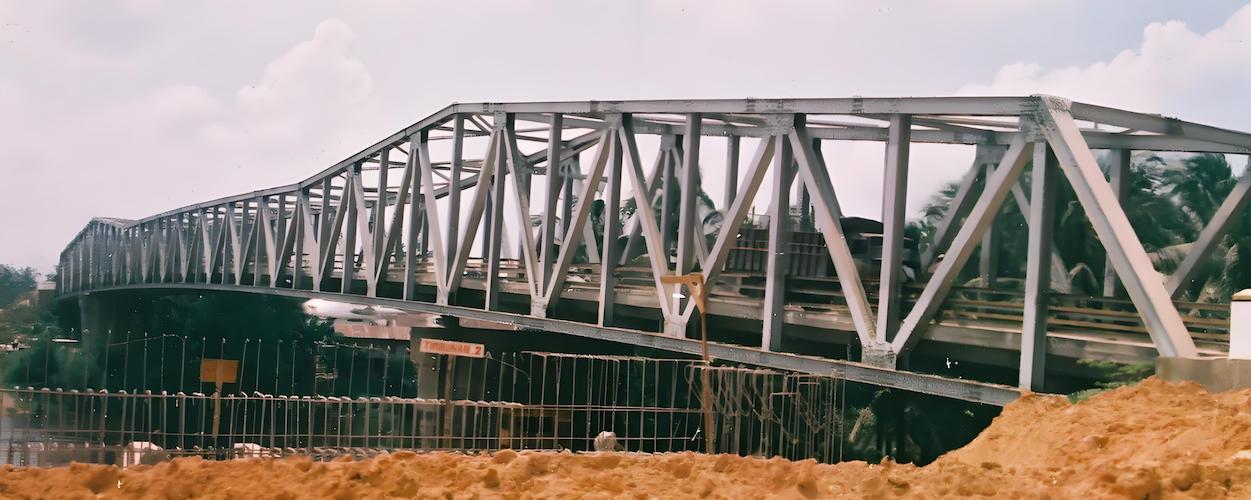
A deck-type steel truss bridge carries its roadway above the principal truss system. This configuration can provide an open overhead vehicle envelope, depending on the complete bridge geometry and surrounding infrastructure.
No. We recommend selecting a bridge based on site-specific hydraulic, structural, and geotechnical assessments. Flood elevation, debris impact, scour, foundation stability, and approach-road conditions all influence the decision.
An HD200 Bailey bridge can be configured for specified traffic requirements, but its capacity depends on the span, truss arrangement, reinforcement, deck system, and approved design. We recommend confirming the actual vehicle loads and obtaining the relevant engineering calculations before procurement.
In suitable conditions, modular steel bridges may be installed using incremental launching or cantilever erection. The appropriate method depends on the bridge configuration, available space, launching equipment, temporary stability, and foundation conditions.
Hot-dip galvanizing provides a zinc coating that helps protect suitable steel components from corrosion. Its effectiveness depends on coating quality, detailing, exposure conditions, damage repair, and maintenance.
We recommend providing the required span, roadway width, traffic loads, vehicle dimensions, site location, foundation information, expected flood conditions, installation method, applicable design code, and target delivery schedule.
The more complete the project information, the easier it is to evaluate suitable bridge configurations and prepare a technically relevant proposal.
We compare the required span, loading, clearance, construction access, installation method, design requirements, maintenance needs, and project budget. A modular Bailey bridge may be advantageous where standardized components and flexible assembly are priorities. A custom steel truss bridge may be more suitable for particular geometry or performance requirements.
1. U.S. Geological Survey (USGS). "2026 Nepal Debris Avalanche and Flash Flood." [usgs.gov]
2. Department of Roads, Government of Nepal. "Nepal Bridge Standards 2067." [dor.gov.np]
3. Department of Roads, Government of Nepal. "Standard Specification of Roads and Bridges."[dor.gov.np]
4. Federal Highway Administration (FHWA). "Load and Resistance Factor Design (LRFD) for Highway Bridge Superstructures Reference Manual."[fhwa]


