

Views: 211 Author: Evercross Bridge Publish Time: 2026-11-17 Origin: Evercross Bridge


Content Menu
● HD200 vs 321 Bailey Bridge: The Main Differences
● What Is a Bailey-Type Prefabricated Steel Bridge?
>> How HD200 and 321 Systems Differ Structurally
● Why Flood Performance Depends on More Than the Bridge Model
>> Debris, Water Levels, and Hydraulic Clearance
● When an HD200 Bailey Bridge May Be the Better Choice
● When a 321 Bailey Bridge May Be the Better Choice
● A Six-Step Selection Process for an Emergency Steel Bridge
>> 1. Establish a Safe Crossing Location
>> 2. Define Actual Traffic Requirements
>> 3. Agree on the Governing Design Requirements
>> 4. Evaluate Transport and Installation
>> 5. Compare Complete Installed Cost
>> 6. Define Acceptance and Operating Controls
● How Quickly Can a Prefabricated Steel Bridge Restore Access?
● Evercross Bridge: Manufacturing Capability and Overseas Project Experience
● What to Request Before Approving a Bridge Supplier
>> Is an HD200 Bailey Bridge Always Better Than a 321 Bridge After Floods?
>> What Is the Maximum Load Capacity of Each System?
>> Can HD200 and 321 Components Be Used Together?
>> Can a Bailey Bridge Be Used Permanently?
>> Does Galvanizing Make a Steel Bridge Flood-Proof?
>> What Information Should Be Included in an Initial Enquiry?
● Choose the Bridge Around the Crossing
Choosing a prefabricated steel bridge after severe flooding requires more than comparing steel strength or delivery prices. For government agencies, contractors, and infrastructure owners, the real question is which system can restore access safely under the site's hydraulic conditions, traffic requirements, and construction constraints. In an HD200 Bailey bridge vs 321 Bailey bridge comparison, the HD200 may offer advantages in roadway width and material efficiency for certain configurations. However, neither system is automatically the better flood-recovery solution.
At Evercross Bridge, our approach is to evaluate the complete crossing: the bridge superstructure, foundations, approach roads, installation method, and operating conditions. A modular bridge can simplify deployment, but its performance still depends on project-specific engineering.
This guide explains the differences between HD200 and 321 Bailey bridges, identifies the factors that matter after floods, and provides a practical framework for selecting an emergency steel bridge.
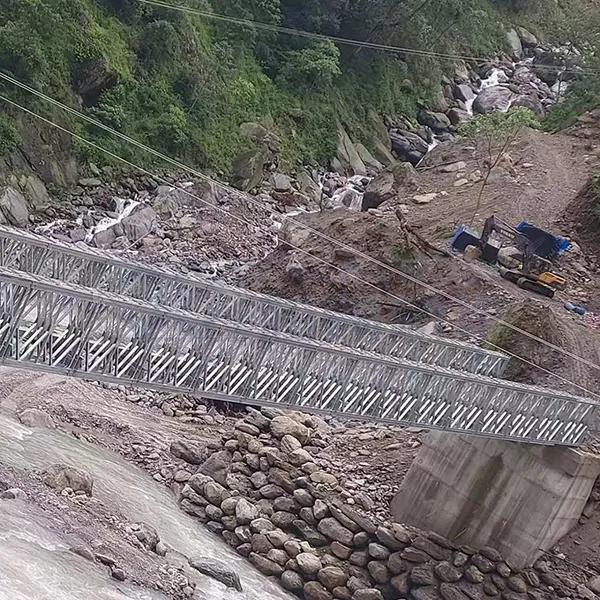
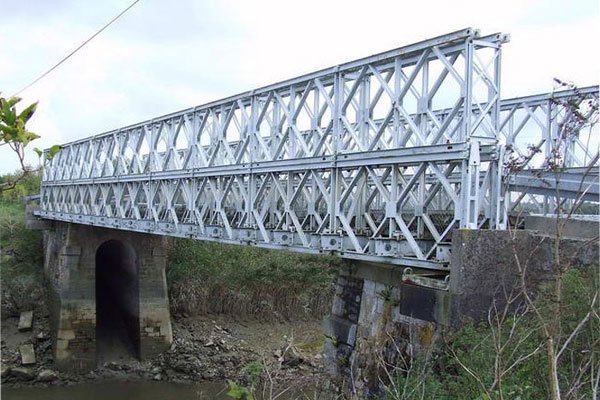
Both systems belong to the Bailey-type modular steel bridge family. They use prefabricated structural components that can be transported to the site and assembled into an engineered crossing.
Their similarities do not make them interchangeable. Panel geometry, connection details, reinforcement arrangements, and other components must match the approved system drawings.
The following comparison uses the product ranges supplied by Evercross for this article. These figures describe available configurations, not guaranteed combinations of maximum span and maximum load.
Comparison point | HD200 Bailey bridge | 321 Bailey bridge |
Structural concept | Modular steel panel bridge | Modular steel panel bridge |
Supplied single-lane clear roadway width | 4.2 m | 3.7 m |
Supplied single-lane span range | 9.14–76.2 m | 9–75 m |
Supplied double-lane configuration | 7.4 m clear width; 9.14–57.9 m span range | Requires confirmation for the proposed system |
Potential selection advantage | Wider standard roadway and possible material efficiency | Potential suitability where matching components and trained crews are available |
Load capacity | Determined by span, configuration, and approved calculations | Determined by span, configuration, and approved calculations |
Flood suitability | Requires hydraulic, foundation, and structural assessment | Requires hydraulic, foundation, and structural assessment |
A useful principle is configuration: the system name alone does not establish the bridge's allowable traffic, deflection, fatigue performance, or safe installation method.
A Bailey bridge is a type of prefabricated steel bridge, but not every prefabricated steel bridge is a Bailey bridge.
Bailey-type systems typically combine standardized truss panels with transoms, longitudinal deck-support members, decking, bearings, bracing, pins, and other connections. Their modular arrangement allows engineers to develop different structural configurations within the system's verified limits.
Prefabricated steel bridges also include other designs, such as modular girder bridges, larger truss systems, and specialized long-span structures.
The HD200 and 321 systems use different component arrangements and connection details. Their parts should not be mixed simply because they appear similar.
Depending on the approved design, capacity can be adjusted through arrangements such as additional truss rows, additional storeys, or chord reinforcement. These changes also affect weight, assembly work, transport requirements, and foundation reactions.
For buyers, the practical lesson is straightforward: compare complete engineered bridge configurations, not isolated panel specifications.
A stronger truss cannot compensate for an undermined abutment.
The Federal Highway Administration identifies scour—the erosion of material around bridge foundations—as a major mechanism behind flood-related bridge failures. Its guidance treats hydraulic conditions, foundation stability, and structural performance as connected engineering issues.
Floodwater can remove supporting soil around piers and abutments. It can also erode riverbanks or damage approach embankments.
A bridge may therefore remain structurally intact while becoming unsafe because its supports or access roads have deteriorated.
Before selecting a replacement crossing, engineers should assess:
- The condition and location of existing foundations.
- Potential scour depth.
- Riverbank stability and channel movement.
- Approach-road settlement or washout.
- Whether existing abutments can safely be reused.
Floating logs and other debris can accumulate against bridge elements. This can increase water levels, hydraulic forces, and local scour.
A longer clear span may help avoid an intermediate river support, but it does not automatically eliminate flood risk. The deck elevation, waterway opening, abutment arrangement, and anticipated debris must still be assessed.
Likewise, corrosion protection does not make a bridge suitable for prolonged submersion. Coatings protect steel surfaces; they do not replace checks for hydraulic loading, foundation stability, or post-flood damage.
The HD200 deserves consideration where its wider supplied roadway or structural arrangement provides a measurable project advantage.
The supplied HD200 single-lane clear width is 4.2 m, compared with 3.7 m for the supplied 321 arrangement.
That additional width may be useful for construction vehicles, relief trucks, and routes with demanding vehicle envelopes. However, a wider roadway does not automatically permit unrestricted traffic.
Engineers must still check vehicle dimensions, barriers, lateral clearance, turning approaches, and traffic management.
The 321 system can remain a practical option when the proposed configuration meets the project requirements and offers logistical advantages.
For example, an owner may already hold compatible 321 components, maintain a verified inventory, and employ crews familiar with that system.
In that situation, using existing resources may reduce procurement complexity. However, reused components need documented condition assessment, dimensional checks, and engineering acceptance.
Potential reasons to consider a 321 bridge include:
- Availability of matching, serviceable components.
- Familiarity among local assembly teams.
- A roadway requirement compatible with the proposed width.
- A competitive complete-project cost.
- A verified configuration suitable for the required traffic.
The correct comparison is not "older versus newer." It is whether each proposed system can satisfy the same design brief with acceptable risk, cost, and delivery conditions.
Begin with site assessment rather than a product quotation.
Record the damaged crossing, river geometry, access routes, bank conditions, and available construction space. Confirm whether the original alignment remains appropriate.
Existing bridge supports should not be assumed reusable merely because they remain visible after the flood.
Specify the vehicles that must cross, including axle arrangements and axle loads.
Relevant traffic may include:
- Ambulances and emergency vehicles.
- Water tankers and relief trucks.
- Construction equipment.
- Public buses.
- Agricultural or industrial freight vehicles.
A single gross-weight figure is not a sufficient design brief. Vehicle spacing, simultaneous traffic, operating speed, and future use also require consideration.
The project team should identify the applicable bridge code, loading model, design life, and authority approval process.
Historical labels such as HS20, car-20, crawler-50, or trailer-80 are not automatically equivalent. The selected loading model must be understood and used consistently throughout the calculations.
Compare component packaging with actual site access.
Check road restrictions, unloading areas, lifting equipment, assembly space, and launching requirements. Where launching is proposed, construction-stage stability and temporary support reactions require specific verification.
The fastest assembly method on paper may not be the most practical method at a constrained riverbank.
Include more than the steel supply price:
- Design and checking.
- Freight and customs.
- Foundations and approach works.
- Assembly and lifting equipment.
- Coating maintenance.
- Inspection and replacement components.
- Dismantling or relocation, where relevant.
A small reduction in bridge weight may help transport planning, but it may not change the number of shipments or the total installed cost.
Before opening, establish the required inspections, installation records, and engineering acceptance.
Any proof-load testing should follow the governing authority's requirements and an approved procedure.
Handover should also define operating restrictions, inspection responsibilities, and actions following future flood events.
Modular construction can shorten site assembly compared with building every structural element on location. However, assembly time and total restoration time are different measures.
A realistic programme includes:
1. Site investigation and design approval.
2. Component availability or fabrication.
3. Shipping and inland transport.
4. Foundations and approach-road preparation.
5. Assembly, launching, or lifting.
6. Inspection and authorization to open.
For this reason, statements such as "installed within hours" should identify exactly what work is included.
Emergency preparedness can improve readiness by establishing standard documentation, maintained component inventories, trained crews, and preliminary crossing plans. It cannot remove the need to verify the actual post-flood conditions.
Evercross Bridge integrates research and development, production, and sales, with services covering bridge design, manufacturing, transportation, and installation support.
With over 30 years of industry experience and operations spanning more than 50 countries, Evercross is headquartered in Shanghai and maintains a production base in Zhenjiang, Jiangsu:
- A 47,000 m² manufacturing site.
- Approximately 22,000 m² of production workshops.
- A 100-tonne lifting capability.
- Annual production capacity of approximately 30,000 tonnes.
In addition, Evercross has successfully delivered over 200 large-scale government infrastructure projects across Southeast Asia, Africa, and Latin America. Our company is recognized as a "National High-Tech Enterprise" in China, holds a qualification certificate for steel structure manufacturing, and has obtained various quality and management system certifications, including ISO 9001, ISO 14001, ISO 45001, CIDB, COC, and PVOC.
For a comparable project review, buyers should request the location, completion date, span arrangement, design loading, installation method, and client acceptance documentation.
A credible proposal should provide a traceable route from design assumptions to delivered components.
Request the following documentation as applicable:
Document | Buyer's purpose |
General arrangement drawings | Confirm geometry, roadway width, and support positions |
Design basis and calculations | Verify loading, structural checks, and assumptions |
Foundation reactions | Coordinate the bridge with substructure design |
Material certificates | Confirm specified steel grades and traceability |
Welding and inspection records | Demonstrate compliance with fabrication requirements |
Coating specification and inspection records | Verify the agreed corrosion-protection system |
Packing and component schedules | Support inventory and assembly control |
Installation method statement | Define equipment, sequence, and temporary works |
Operation and maintenance guidance | Establish inspection and service responsibilities |
This documentation is especially important when a temporary crossing may remain in use longer than initially planned.
No. HD200 may provide useful width or material-efficiency advantages in a particular configuration. The preferred solution still depends on traffic, span, foundations, hydraulic conditions, available components, and installation constraints.
There is no reliable universal tonnage applicable to every HD200 or 321 bridge. Capacity depends on the approved configuration, span, deck system, loading model, and other design conditions. Request project-specific calculations.
Do not assume compatibility. Components must match the approved drawings and system requirements. Any proposed combination requires engineering verification of geometry, connections, materials, and structural performance.
Potentially, if it is designed and approved for permanent service. This requires appropriate checks for design life, fatigue, durability, foundations, drainage, road safety, inspection, and maintenance.
No. Galvanizing can provide corrosion protection, but it does not prevent scour, bank erosion, debris accumulation, or structural overload. Flood resilience requires a complete crossing assessment.
Provide the location, required span, roadway width, vehicle loading, intended service period, site photographs, available surveys, governing standards, and installation-access information. Identify missing information so the investigation scope can be agreed.
HD200 and 321 Bailey bridges can both support emergency access restoration when properly selected and engineered. The strongest procurement decision connects the bridge configuration with the river, foundations, traffic, and construction plan.
For a project-specific proposal, send Evercross Bridge your crossing location, required span, clear roadway width, traffic requirements, and available site information. Request a comparison covering structural configuration, foundations, transport, installation, and handover documentation—not only a steel supply quotation.
1. Federal Highway Administration. *Evaluating Scour at Bridges, Fifth Edition*. [fhwa.dot]
2. Federal Highway Administration. *Evaluating Scour at Bridges — Technical Advisory*. [fhwa.dot]
3. Federal Highway Administration. *Bridge Scour and Stream Instability Countermeasures*[fhwa.dot]
4. Federal Highway Administration. *Stream Stability at Highway Structures, Fourth Edition*[fhwa.dot]
5. Evercross Bridge. *About Us*. [baileybridgesolution]
6. Evercross Bridge / Bailey Bridge Solution. *Company and Manufacturing Overview*.[baileybridgesolution]


