

Views: 211 Author: Evercross Bridge Publish Time: 2026-10-30 Origin: Evercross Bridge


Content Menu
● Key Takeaways: The Technologies Transforming Emergency Bridge Construction
● Modular Steel Bridge Systems: The Foundation of Rapid Assembly Emergency Bridges
>> How modular Bailey bridge technology works
>> Why modular steel bridges are suitable for emergency applications
>> How to evaluate bridge load capacity and span
● Prefabrication and Digital Manufacturing: Reducing On-Site Construction Time
>> How prefabricated bridge components improve deployment
>> The role of BIM and digital engineering
● Advanced Materials: Balancing Strength, Weight, and Durability
● Smart Monitoring and Structural Health Assessment
>> How bridge sensors support safer operations
>> A practical monitoring plan for emergency bridges
● 3D Printing and Additive Manufacturing: Emerging Opportunities
● Cantilever Launching: Installing Bridges Where Crane Access Is Limited
● How to Choose the Right Rapid Assembly Emergency Bridge
>> A five-step procurement checklist
● Evercross Bridge: Manufacturing Capacity and International Project Experience
● Future Trends in Emergency Bridge Technology
● Find the Right Emergency Bridge Solution for Your Project
● Frequently Asked Questions (FAQ)
>> 1. What is a rapid assembly emergency bridge?
>> 2. How quickly can an emergency bridge be installed?
>> 3. Can a modular steel emergency bridge support heavy trucks?
>> 4. What is the maximum span of an Evercross Bridge modular bridge?
>> 5. Are emergency bridges suitable for long-term use?
>> 6. What is the difference between a Bailey bridge and a conventional permanent bridge?
>> 7. What information should buyers provide when requesting an emergency bridge quotation?
>> 8. Do emergency bridges require structural health monitoring?
Rapid assembly emergency bridges are essential for restoring transportation networks after floods, earthquakes, landslides, and other infrastructure disruptions. As a manufacturer of prefabricated steel bridges, Evercross Bridge combines modular bridge engineering, factory-controlled manufacturing, adaptable installation methods, and project-specific design to help governments and contractors restore access efficiently. From Bailey bridges and modular steel bridge systems to digital planning and structural health monitoring, modern emergency bridge technology focuses on reducing on-site construction time without compromising structural safety.
With more than 30 years of industry experience, Evercross Bridge provides integrated prefabricated steel bridge solutions covering design, manufacturing, transportation, and installation support. Our headquarters are in Shanghai, China, and our production base is in Zhenjiang, Jiangsu Province, with a 47,000 m² site, 22,000 m² of production workshops, and lifting capacity of up to 100 tonnes.
Our D-type modular bridge has achieved a tested single-span length of up to 91 metres. We serve customers in more than 50 countries and have delivered over 200 large government infrastructure projects across Southeast Asia, Africa, and Latin America. These capabilities inform our practical approach to rapid bridge deployment: the right bridge technology must match the crossing, required load capacity, site conditions, installation resources, and long-term operational needs.
- Modular steel bridge systems: Standardized, prefabricated components enable efficient transportation, repeatable assembly, and flexible bridge configurations.
- Off-site prefabrication: Factory manufacturing helps improve dimensional consistency, quality control, and installation efficiency.
- Advanced materials: High-strength steel, fiber-reinforced polymer (FRP), and aluminum offer different combinations of strength, weight, durability, and handling requirements.
- Digital engineering and monitoring: Building Information Modeling (BIM), sensors, and digital inspection records can improve planning, maintenance, and structural assessment.
- Cantilever launching: Engineered launching methods can facilitate bridge installation across rivers, ravines, and other obstacles where conventional crane access is difficult.
- Site-specific engineering: Foundation conditions, hydraulic clearance, traffic loads, logistics, and local regulations remain critical to safe deployment.
The Federal Highway Administration (FHWA) identifies prefabricated bridge elements and systems as an important accelerated bridge construction approach because components can be manufactured off-site, transported to the project location, and installed rapidly. This principle underpins many modern emergency bridge solutions.
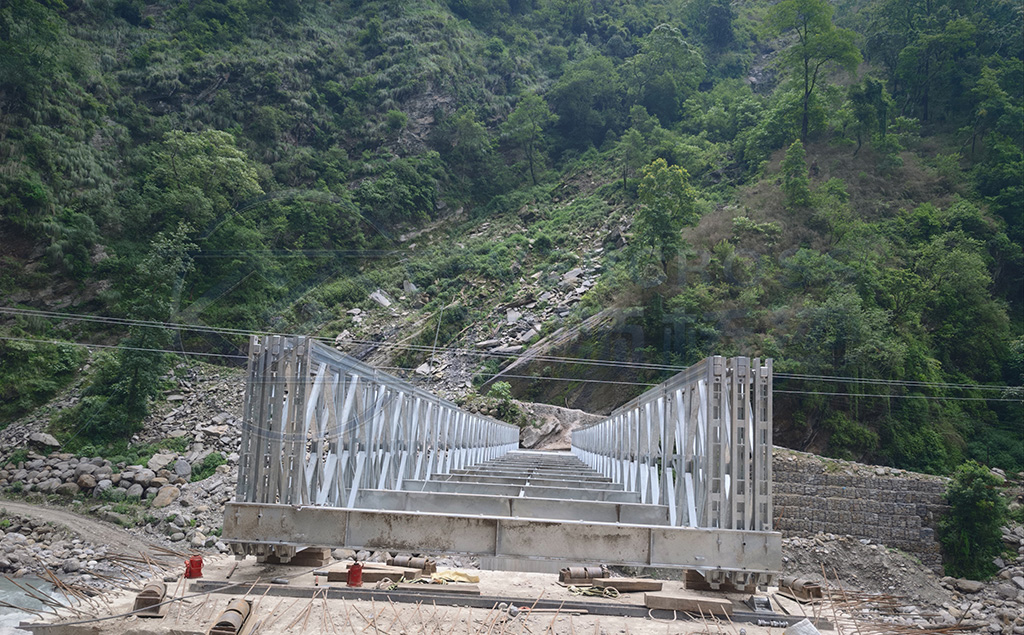
Modular steel bridges use standardized structural components that can be transported separately and assembled into a complete crossing. Depending on the design, these components may include steel panels, chords, transoms, bracing, deck units, bearings, and connection hardware.
A Bailey bridge is a well-established example of modular steel bridge engineering. Its panel-based configuration allows engineers to adapt the structural arrangement to different span lengths and loading requirements within the limits of the selected system.
At Evercross Bridge, we focus on prefabricated steel bridge solutions, including modular and emergency bridge configurations, designed around the requirements of individual projects.
A typical deployment process involves:
1. Engineering assessment: Determine the crossing length, required vehicle loads, foundation conditions, hydraulic requirements, and applicable design standards.
2. Component manufacturing: Fabricate and inspect structural elements under controlled factory conditions.
3. Transportation planning: Organize components, connection hardware, lifting equipment, and installation tools for delivery to the site.
4. Bridge assembly: Install the components according to the approved erection sequence and temporary stability requirements.
5. Inspection and commissioning: Verify connections, bearings, deck installation, alignment, and other specified acceptance criteria before opening the bridge to traffic.
The main advantage is not simply that individual components are easy to connect. The larger benefit is that manufacturing, logistics planning, and site preparation can proceed in parallel, reducing the amount of work that must be completed at the crossing itself.
Modular steel bridges are particularly useful when communities need to restore road access quickly or when permanent bridge construction will take considerable time.
Potential applications include:
- Emergency road crossings after floods and earthquakes.
- Temporary bypasses during bridge replacement.
- Access roads for construction and infrastructure projects.
- Remote crossings serving rural communities.
- Humanitarian logistics and disaster recovery operations.
- Temporary industrial access where existing infrastructure is unavailable.
For international procurement, bridge selection should be based on verified engineering documentation rather than the term *emergency bridge* alone. Buyers should request drawings, design load information, material specifications, connection details, inspection records, and installation requirements.
Load capacity depends on the complete structural configuration, not merely on the steel grade or the presence of modular panels.
Engineers must consider span length, bridge width, support conditions, vehicle loading, dynamic effects, structural stability, and the capacity of the foundations and abutments.
At Evercross Bridge, our D-type modular bridge has achieved a tested single-span length of up to 91 metres. This is a company-provided project and product capability statement; the applicable load rating, test configuration, and permitted operating conditions must be confirmed for each proposed installation.
Similarly, AASHTO HL-93 is a specific highway bridge design loading model, not a universal certification that every Bailey bridge automatically satisfies. Any claim of compliance should be supported by project-specific calculations and the relevant approval documentation.
Prefabrication shifts suitable manufacturing work away from the construction site. Structural members, deck panels, bracing, connection plates, and other components can be manufactured, inspected, and prepared for transport before installation begins.
According to the FHWA, prefabricated bridge elements and systems can reduce on-site construction time, traffic disruption, weather-related delays, and some environmental impacts.
For emergency bridge projects, these benefits can be particularly important when the damaged crossing is the only practical access route to a community.
Factory-based production also creates opportunities for repeatable inspection procedures, including:
- Dimensional and geometric checks.
- Weld inspection in accordance with the specified quality plan.
- Verification of material certificates and traceability.
- Checking bolt holes, connection interfaces, and component identification.
- Coating inspection and documentation.
- Trial assembly or fit-up checks where required.
The precise inspection plan should reflect the bridge design, manufacturing specifications, contract requirements, and applicable standards.
Building Information Modeling (BIM) can help project teams coordinate bridge geometry, component interfaces, transportation constraints, and construction sequences before the physical installation begins.
For a modular emergency bridge, a coordinated digital model can support:
- Clash detection between structural components and site constraints.
- Planning of delivery order and component storage.
- Identification of lifting points and handling requirements.
- Visualization of erection sequences.
- Coordination between designers, manufacturers, contractors, and site engineers.
Digital planning does not eliminate the need for site surveys or engineering approval. Instead, it helps teams identify potential problems earlier, when changes are generally easier to manage.
Our recommendation: Include a coordinated drawing package, a component list, installation instructions, and a clearly defined inspection and acceptance plan in the procurement scope.
Material selection affects bridge weight, transportation costs, installation equipment, corrosion protection, maintenance, and structural performance.
Material |
Main advantages |
Important considerations |
Potential applications |
Structural steel |
High strength, robust connections, adaptable modular configurations |
Corrosion protection, transport weight, inspection and maintenance |
Emergency road bridges, modular bridges, heavy-duty crossings |
Aluminum |
Low density and good corrosion resistance in suitable environments |
Alloy strength, fatigue, connection design, and cost |
Lightweight pedestrian or specialized bridge systems |
Fiber-reinforced polymer (FRP) |
High strength-to-weight ratio and corrosion resistance in suitable applications |
Connection detailing, fire performance, long-term behavior, and cost |
Deck panels, pedestrian bridges, selected lightweight structures |
Precast concrete |
Durable, stiff structural elements when properly designed and manufactured |
Heavy transport and lifting requirements, foundation capacity, connection design |
Permanent bridge components and selected accelerated construction projects |
No single material is optimal for every emergency bridge. Steel remains an important choice where robust structural capacity, reusable components, and modular assembly are priorities.
For steel bridge components, corrosion protection must be selected according to the exposure environment and maintenance strategy. Hot-dip galvanizing is one established option. ISO 1461:2022 specifies general properties and test methods for hot-dip galvanized coatings on fabricated iron and steel articles; it does not, by itself, establish a universal service life for every bridge environment.
Actual coating durability depends on factors such as coating characteristics, atmospheric corrosivity, detailing, abrasion, and maintenance.
Structural health monitoring can supplement routine inspections by collecting information about selected aspects of a bridge's behavior.
Depending on the engineering objectives, a monitoring system may include:
- Strain gauges to measure strain at selected structural locations.
- Accelerometers to record vibration and dynamic response.
- Displacement sensors to monitor movement at specified points.
- Temperature sensors to record thermal conditions that may affect structural behavior.
- Environmental sensors to measure conditions such as wind speed or humidity when relevant.
The collected data can help engineers investigate changes in structural response, prioritize inspections, and evaluate whether further assessment is needed.
However, sensors do not automatically establish that a bridge is safe or unsafe. Measurements require appropriate baselines, suitable sensor placement, calibration, data interpretation, and engineering review. A monitoring system should supplement, not replace, required inspections and operating controls.
For a bridge intended to remain in service beyond a short emergency period, project owners can consider the following steps:
1. Record baseline measurements after installation and acceptance.
2. Identify critical components and define monitoring objectives.
3. Establish inspection intervals and any load restrictions.
4. Set thresholds for reviewing unusual readings, based on engineering analysis.
5. Document maintenance actions and reassess the monitoring plan as operating conditions change.
For short-term deployments, a well-organized manual inspection plan may be more practical than a comprehensive sensor network. The appropriate level of monitoring depends on the bridge's risk profile, service duration, traffic, and available maintenance resources.
Three-dimensional printing is attracting attention in construction because it can automate the production of selected geometries and reduce the need for conventional formwork in suitable applications.
The National Institute of Standards and Technology (NIST) describes additive manufacturing with cement-based materials as an evolving technology with potential applications in construction efficiency, safety, and infrastructure work.
In emergency bridge projects, possible uses include selected non-primary structural components, customized molds, repair elements, and certain site-specific concrete applications, subject to engineering validation.
Nevertheless, 3D printing is not a universal replacement for conventional steel bridge fabrication. Primary load-bearing bridge components must meet the applicable requirements for strength, fatigue, durability, connection performance, and inspection. Printed materials and processes require their own qualification and quality assurance.
For many rapid assembly steel bridge projects, conventional prefabrication remains the more established approach. Additive manufacturing is best assessed as a complementary technology where it offers a demonstrated technical or logistical advantage.
Cantilever launching is an installation method in which bridge sections are assembled from one side of an obstacle and progressively advanced toward the opposite support.
A launching nose may be attached to the leading end to help manage the geometry and bending effects during the launching process. Temporary supports, counterweights, and other measures may be required depending on the bridge configuration.
This technique can be useful at river crossings, ravines, and remote locations where erecting large cranes or extensive temporary scaffolding is difficult.
However, launching is an engineered construction operation, not simply an alternative assembly method. The design team must evaluate temporary structural forces, deflection, stability, bearing conditions, connection behavior, and the capacity of the launching equipment.
A suitable launching plan should include:
- A verified erection sequence and temporary works design.
- Defined load limits for each launching stage.
- Survey and deflection monitoring requirements.
- Inspection of connections and supports.
- Clear stop-work criteria and contingency procedures.
- Controlled access to the launching zone.
The principal advantage is the potential to reduce the need for access from below the crossing. Whether it reduces overall project time or cost depends on the site, bridge design, and installation resources.
The latest technology is not necessarily the best choice for every project. Procurement teams should start with the operational problem and work backward to the appropriate bridge configuration.
Selection factor |
Questions to resolve before procurement |
Span and geometry |
What is the clear crossing length, available bearing area, required width, and vertical clearance? |
Loading |
Which vehicles will use the bridge, and what design code and load model apply? |
Site conditions |
Are the banks stable? What are the foundation, flood, scour, and access conditions? |
Installation |
Are cranes available? Is cantilever launching feasible? What equipment and crew are required? |
Logistics |
Can components reach the site by road, rail, or sea? Are lifting and storage facilities available? |
Service duration |
Is the bridge a short-term emergency crossing, an interim structure, or a longer-term installation? |
Durability |
What corrosion protection, inspection frequency, and maintenance arrangements are appropriate? |
Compliance |
Which local permits, design approvals, material records, and inspection documents are required? |
For government buyers, engineering consultants, and infrastructure contractors, we recommend the following process:
1. Define the emergency scenario. Establish the required opening date, intended traffic, design life, and consequences of a delayed installation.
2. Confirm site data. Obtain a survey, geotechnical information, hydrological assessment, and access and transport constraints.
3. Compare complete bridge systems. Assess the structural design, span arrangement, installation method, foundation requirements, and total project cost.
4. Verify manufacturing and quality documentation. Review material traceability, inspection records, relevant certificates, drawings, and test documentation.
5. Agree on installation and handover requirements. Define responsibilities, acceptance criteria, operating restrictions, inspection schedules, and maintenance arrangements.
This process helps prevent a common procurement mistake: selecting a bridge based on the quoted steel structure alone while overlooking foundations, transport, lifting, installation, and commissioning.
At Evercross Bridge, we integrate bridge engineering, manufacturing, and project coordination to support customers seeking prefabricated steel bridges and emergency crossing solutions.
Our company profile includes the following capabilities:
- More than 30 years of industry experience in steel bridge engineering and manufacturing.
- 47,000 m² production site in Zhenjiang, Jiangsu Province, including 22,000 m² of workshops.
- Up to 100-tonne lifting capacity at the production facility.
- Up to 91 metres of tested single-span length for our D-type modular bridge, subject to the applicable test configuration and project requirements.
- Annual production capacity of 30,000 tonnes, as stated in our company profile.
- Business coverage in more than 50 countries.
- More than 200 large government infrastructure projects delivered across Southeast Asia, Africa, and Latin America.
Our bridges have been used in markets including Papua New Guinea, Colombia, Malaysia, Myanmar, Ecuador, Laos, Cambodia, Tanzania, and Mozambique. These markets demonstrate the international reach of our work; individual project specifications, installation conditions, and acceptance records should be reviewed when evaluating a particular reference project.
We also report recognition as a National High-Tech Enterprise in China, a steel structure manufacturing qualification, and management or product-related credentials including ISO 9001, ISO 14001, ISO 45001, CIDB, COC, and PVOC. The exact scope, validity, issuing body, and applicability of each credential should be confirmed against the relevant certificate and destination-country requirements.
For us, a successful emergency bridge project is not measured solely by how quickly steel components can be assembled. It depends on whether the complete system is properly designed, delivered, installed, inspected, and maintained for its intended use.
The future of rapid assembly emergency bridges will likely involve the closer integration of established modular engineering with improved digital tools and more systematic asset management.
Three developments deserve particular attention.
First, digital design and logistics integration can help project teams coordinate manufacturing, component tracking, transportation, and installation planning. This is especially useful for international projects involving multiple suppliers and long delivery routes.
Second, risk-based structural monitoring can help owners prioritize inspections and maintenance when a bridge remains in operation for an extended period. Monitoring strategies should be selected according to engineering needs rather than adopting sensors solely because they are available.
Third, whole-life project planning can improve procurement decisions by accounting for installation equipment, foundations, corrosion protection, inspection, reuse, and eventual removal or permanent replacement. A bridge with a lower initial purchase price may not offer the lowest overall project cost.
The most practical path forward is to combine proven modular steel bridge systems with site-specific engineering, disciplined quality assurance, and digital tools that solve identifiable project problems.

Rapid assembly emergency bridge technology has advanced through modular steel systems, off-site prefabrication, improved materials, digital engineering, structural monitoring, and specialized installation methods.
Each technology offers distinct advantages, but none removes the need for proper structural design, site assessment, quality control, and commissioning.
At Evercross Bridge, we provide prefabricated steel bridge solutions supported by manufacturing experience, international project delivery, and engineering coordination. Whether your project involves restoring a damaged road crossing, constructing a temporary bypass, or developing a modular bridge for a remote location, the starting point should always be the actual span, loading, site conditions, and operational requirements.
Planning an emergency bridge or modular steel bridge project? Contact Evercross Bridge with your crossing length, required bridge width, vehicle loading, project location, expected service duration, and target installation date. Our team can review the requirements and discuss a suitable bridge configuration, technical documentation, manufacturing schedule, and installation approach.
A rapid assembly emergency bridge is a bridge system designed to restore access quickly after infrastructure damage or to provide a temporary crossing during construction. Many systems use prefabricated components that can be transported and assembled on-site.
Installation time depends on span, bridge configuration, foundation readiness, transport access, weather, equipment, and the required inspections. Some projects may achieve installation within a few days, but a 24–72-hour schedule should be treated as a project-specific target rather than a universal guarantee.
Yes, suitably engineered modular steel bridges can carry heavy road vehicles. The permitted loading depends on the structural configuration, span, design code, foundations, and approved operating conditions. Buyers should request project-specific load calculations and supporting documentation.
Evercross Bridge reports that its D-type modular bridge has achieved a tested single-span length of up to 91 metres. The applicable vehicle loading, structural configuration, and site conditions must be confirmed for each project.
Some modular steel bridges can serve for extended periods when they are designed, installed, inspected, and maintained appropriately. Suitability depends on the design life, environmental exposure, traffic demand, maintenance plan, and applicable approvals.
A Bailey bridge uses a modular structural arrangement designed for adaptable assembly and transportation. A conventional permanent bridge may use a wider range of structural forms and construction methods. The better choice depends on the required span, loading, service life, site conditions, construction schedule, and whole-life cost.
Buyers should provide the crossing length, required clear width, expected vehicle loads, site location, terrain and foundation information, installation access, intended service duration, applicable standards, and target delivery date. Site drawings, photographs, and available geotechnical or hydrological reports are also useful.
Not every emergency bridge requires a permanent electronic monitoring system. Monitoring requirements depend on structural risk, traffic, service duration, and owner specifications. All bridges should have an appropriate inspection and maintenance plan, with electronic sensors used where they provide meaningful additional information.
1. Federal Highway Administration (FHWA). *Prefabricated Bridge Elements and Systems (PBES).*
2. International Organization for Standardization (ISO). *ISO 1461:2022 — Hot-dip galvanized coatings on fabricated iron and steel articles: Specifications and test methods.*
3. National Institute of Standards and Technology (NIST). *Additive Manufacturing with Cement-Based Materials.*
4. Federal Highway Administration (FHWA). *Accelerated Bridge Construction (ABC).*
5. U.S. Department of Transportation. *Accelerated Bridge Construction Overview.*
6. Washington State Department of Transportation (WSDOT). *Bridge Design Manual, Chapter 14: Accelerated and Innovative Bridge Construction.*


