

Views: 221 Author: Evercross Bridge Publish Time: 2026-11-17 Origin: Evercross Bridge


Content Menu
● Why Bridge Access Matters to Solar Project Delivery
● What Are Modular Metallic Emergency Bridges?
● Where Modular Steel Bridges Fit into Photovoltaic Projects
>> Mountain Solar Farm Construction Access
>> Tidal-Flat and Coastal PV Developments
>> Emergency Access After Flooding or Storm Damage
>> Long-Term Maintenance Access
● Modular Metallic Emergency Bridge Design: Five Questions That Matter
>> 1. What Vehicles Will Actually Cross?
>> 2. Which Design Standard Governs the Project?
>> 3. Are Foundations and Approaches Included?
>> 4. How Will Floodwater and Debris Affect the Crossing?
>> 5. Can the Site Support the Erection Method?
● Steel Grades, Galvanizing, and Quality Documentation
>> Specify the Steel Grade, Not Just the Standard Name
>> Match Corrosion Protection to the Exposure
>> Agree on an Inspection and Test Plan
● How Quickly Can a Modular Bridge Be Installed?
● Modular Steel Bridge or Concrete Crossing?
>> Evaluate Lifecycle Cost Rather Than Purchase Price
>> Make Environmental Claims Project-Specific
● Evercross Bridge: Manufacturing Capacity and International Experience
● What to Send with a Solar Project Bridge Enquiry
● Plan the Crossing Before It Becomes a Construction Bottleneck
>> 1. What are Modular Metallic Emergency Bridges used for in PV projects?
>> 2. Can a modular bridge carry heavy transformers or piling equipment?
>> 3. Can a modular emergency bridge remain permanently?
>> 4. How long does installation take?
>> 5. Does hot-dip galvanizing guarantee 20 years without maintenance?
>> 6. Can bridge components be reused on another solar project?
>> 7. Which documents should an EPC contractor request?
Modular Metallic Emergency Bridges help photovoltaic developers establish vehicle access across gullies, waterways, and damaged road sections. For solar EPC contractors working in mountainous areas, coastal zones, or remote regions, a prefabricated steel bridge can become an important link between equipment delivery, construction progress, and long-term maintenance access. However, the right solution begins with access planning—not simply a bridge quotation.
At Evercross Bridge, we approach bridge selection as part of the wider project logistics strategy. The crossing must accommodate the actual vehicles, suit the ground conditions, and remain manageable throughout installation, operation, and eventual removal.
This guide explains where modular steel bridges fit into PV projects, which technical questions matter most, and what buyers should prepare before requesting a proposal.
Solar development continues to expand rapidly. The International Energy Agency's *Renewables 2025* projects approximately 4,600 GW of global renewable power capacity growth between 2025 and 2030, with solar PV accounting for almost 80% of that increase. These are forecasts, not completed installations.
For developers, expanding deployment creates a practical challenge: suitable solar resources do not automatically come with suitable construction access.
A site may have adequate access for survey vehicles but not for transformer transporters. A rural crossing may support local traffic while remaining unsuitable for repeated construction deliveries. Seasonal rainfall may also change the usability of an otherwise accessible route.
The procurement question is therefore broader than "What bridge span do we need?"
It is: "What crossing arrangement will support the required vehicles, within the available construction window, at an acceptable lifecycle cost?"
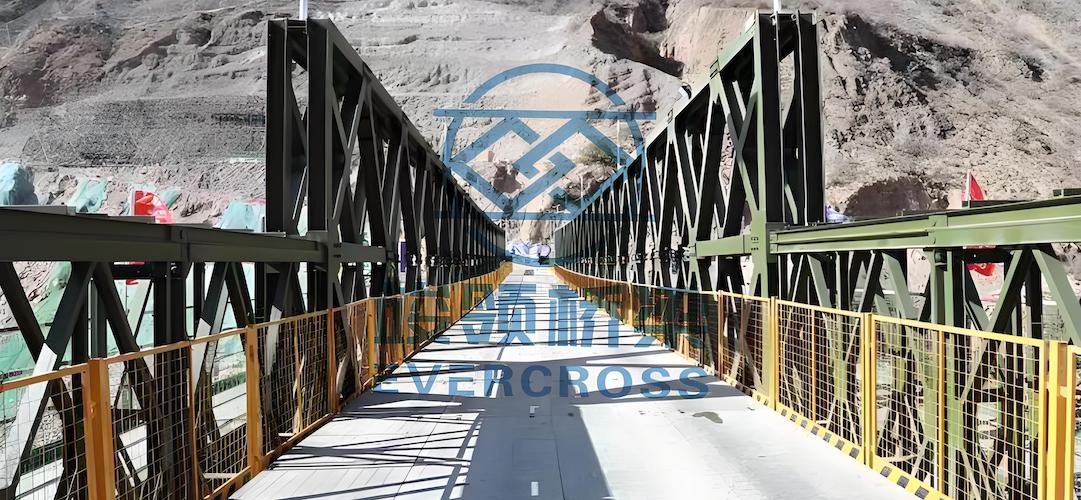
In this article, the term describes prefabricated steel bridge systems assembled from repeatable structural components. These may include truss panels, bracing, transoms, deck units, bearings, pins, and bolted connections.
Bailey-type bridges are one familiar form of modular panel bridge. However, different bridge systems use different connection details, structural arrangements, and erection procedures. Buyers should not assume that components from separate systems are interchangeable.
For PV projects, the intended role may include:
- Temporary access during construction.
- Replacement of a damaged crossing.
- Emergency access for repair teams.
- Reusable infrastructure serving successive projects.
- A longer-term maintenance crossing, subject to appropriate design and approval.
A temporary bridge is not automatically suitable for permanent service. Its intended design life, traffic demands, environmental exposure, inspection requirements, and regulatory acceptance must be established separately.
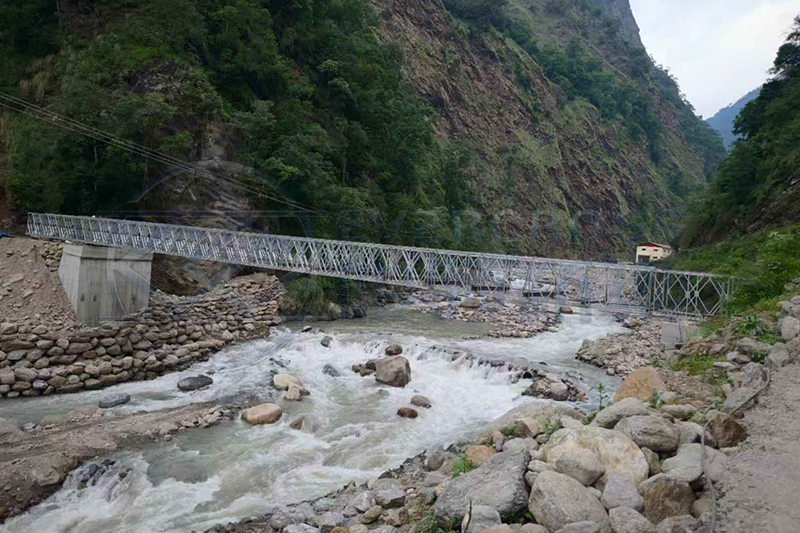
Mountainous developments may require crossings over steep drainage channels or seasonal streams.
A modular bridge can form part of an access route for module deliveries, excavators, piling equipment, and other construction vehicles. However, bridge selection must consider the entire route.
A suitable bridge does not solve an inadequate turning radius, an unstable approach embankment, or insufficient clearance beneath overhead utilities.
For EPC teams, route surveys and bridge design should therefore proceed together rather than as separate procurement exercises.
Coastal projects require particular care because soft ground, tidal variation, saline exposure, and environmental restrictions can interact.
A modular steel superstructure may be considered within a purpose-designed access trestle. Its feasibility depends on foundations, lateral stability, marine exposure, and construction methodology.
A traffic bridge and a working platform are also different applications. Equipment operating from the deck can introduce loads that are not represented by ordinary vehicle passage.
Where a piling rig or crane will work from a bridge or trestle, the design brief must identify the operating configuration, concentrated loads, and applicable restrictions.
A replacement crossing can help restore access to damaged PV arrays, transformers, and electrical infrastructure.
Nevertheless, rapid deployment should not bypass site assessment. If flooding has damaged the original bridge, the remaining abutments and surrounding ground cannot simply be assumed safe.
Scour—the removal of soil around bridge foundations by flowing water—is a key consideration. FHWA guidance addresses long-term channel degradation, contraction scour, and local scour at piers or abutments.
Some developers may prefer to retain a modular bridge after construction.
This can be a reasonable option when assessed from the beginning. The evaluation should address expected traffic, fatigue exposure, corrosion protection, drainage, inspection access, and maintenance responsibilities.
"Reusable" and "permanent" describe different attributes. A bridge may be designed for repeated relocation without automatically meeting the requirements of an indefinite installation.
Gross vehicle weight alone is insufficient for selecting a bridge.
The design team should also receive:
- Axle loads and axle spacing.
- Wheel or track contact arrangements.
- Vehicle dimensions.
- Proposed crossing speed.
- Frequency of crossings.
- Whether multiple vehicles may occupy the bridge.
- Braking, stopping, and traffic-control requirements.
For example, two vehicles with the same total weight can place different demands on a structure because their axle arrangements differ.
Do not select a bridge from a generic table stating that one truss configuration always carries a particular tonnage. Capacity must relate to the actual span, structural arrangement, deck system, and loading conditions.
FHWA's inspection framework illustrates this principle by requiring analysis of routine and special permit loads for the bridges they cross. Its legal applicability is specific to the relevant US bridge network, but the engineering lesson is useful internationally.
The governing standard should be agreed with the owner and approving authority before detailed design.
A tender may refer to AASHTO requirements, Eurocodes, AS 5100, or national bridge standards. Naming several standards in a brochure is not evidence that every bridge configuration complies with all of them.
The proposal should identify:
1. The governing standard and edition.
2. Relevant national or project-specific requirements.
3. Design vehicle and load combinations.
4. Serviceability criteria.
5. Design life and environmental assumptions.
6. Required independent checking or local approval.
This makes technical comparisons more meaningful and reduces the risk of redesign after contract award.
The steel superstructure is only one part of the crossing.
The project must also address bearing seats, abutments, foundation capacity, approach geometry, drainage, and erosion protection.
Clarify whether the supplier's scope covers:
- Superstructure design only.
- Preliminary foundation reactions.
- Detailed substructure design.
- Erection engineering.
- Approach works.
- Installation supervision.
- Local approval support.
A clear responsibility matrix helps prevent gaps between the bridge supplier, civil contractor, geotechnical consultant, and EPC team.
A clear-span layout may avoid placing intermediate piers within the channel. That does not make the crossing flood-proof.
The hydraulic assessment should consider water levels, flow conditions, debris accumulation, channel behaviour, foundation exposure, and the vulnerability of approach embankments.
FHWA's HEC-18 guidance connects scour assessment directly to foundation design and flood conditions. The relevant lesson is that flood resilience depends on the whole crossing, not merely the strength of its trusses.
Erection feasibility should be checked before committing to a configuration.
The contractor needs sufficient space and ground capacity for delivery vehicles, component storage, assembly, lifting equipment, or launching operations.
Assembly is not "tool-free." Depending on the system, it requires suitable tools, lifting arrangements, temporary works, trained personnel, and an approved erection procedure.
A bridge that is efficient to manufacture may still be difficult to install if the launch area or crane position has not been assessed.
A material standard identifies a family of requirements. It does not replace a complete material specification.
ASTM A709 covers multiple bridge-steel grades and strength levels. Certain grades have enhanced atmospheric corrosion resistance; others do not. Therefore, describing all ASTM A709 steel as "weathering steel" is incorrect.
The project specification should identify the required grade, mechanical properties, toughness requirements where applicable, traceability, and welding provisions.
Avoid treating different steel specifications as automatically interchangeable. Any substitution should receive the required engineering approval.
Hot-dip galvanizing may form part of the corrosion-protection strategy.
ISO 1461:2022 specifies general properties and test methods for hot-dip galvanized coatings on fabricated iron and steel articles. It does not establish one universal service-life guarantee for every environment.
For coastal PV projects, the specification should consider actual exposure, including wetting conditions, salt deposition, drainage, inaccessible surfaces, and maintenance access.
Buyers should request the proposed protection system, inspection criteria, repair procedure, and maintenance assumptions instead of relying on a blanket "20-year protection" statement.
A practical inspection and test plan should define which records are required and when inspections occur.
Typical procurement requirements may include:
- Material certificates and component traceability.
- Welding procedures and personnel qualifications.
- Weld inspection records.
- Dimensional inspection reports.
- Coating inspection reports.
- Connection-component documentation.
- Packing lists and identification marks.
- Assembly drawings and maintenance instructions.
Do not assume that every component receives full-scale static, dynamic, and fatigue testing. The supplier should distinguish between design validation, system qualification, production inspection, and any project-specific load testing.
Separate superstructure assembly time from the total time required to open the crossing.
The complete programme may include:
1. Site surveys and ground investigation.
2. Hydraulic and structural design.
3. Approvals and environmental permissions.
4. Foundation and approach construction.
5. Manufacturing and protective treatment.
6. Shipping and inland transport.
7. Assembly and erection.
8. Inspection and authorization for traffic.
A short on-site assembly period does not mean the complete crossing can always open within 24–72 hours.
When evaluating a schedule, ask what must already be complete for the proposed erection duration to apply. Prepared foundations, available components, suitable equipment, and favourable site conditions should be stated explicitly.
The best solution depends on the project rather than the material alone.
Decision factor | Modular steel bridge | Concrete crossing |
Intended use | Worth evaluating for temporary or relocatable access | Worth evaluating for a fixed long-term crossing |
Construction planning | Factory production can be coordinated with site works | Programme depends on the chosen concrete construction method |
Site constraints | Requires an achievable lifting or launching arrangement | Requires a workable construction method for the location |
Reuse | Components may be redeployed after inspection and approval | Relocation potential depends on the structural system |
Maintenance | Requires inspection of steelwork, connections, deck, and protection | Requires inspection of concrete, reinforcement-related deterioration, joints, and foundations |
Commercial comparison | Include shipping, erection, removal, and refurbishment | Include construction, maintenance, and any eventual removal |
This table is a procurement framework, not a claim that modular steel always has the lower price or shorter programme.
For reusable bridge systems, assess:
Total ownership cost = acquisition + transport + installation + inspection + maintenance + removal + refurbishment − residual value.
The number of realistic redeployments matters. Reuse savings should not be assumed if future projects require incompatible spans, widths, or loading arrangements.
Likewise, quantify schedule value carefully. Earlier access can support construction progress, but it does not guarantee earlier grid connection when electrical works, permits, or grid availability remain critical constraints.
Reusing components can reduce the need to purchase new bridge materials for later crossings. However, a defensible carbon comparison should also consider steel production, transport, foundations, installation equipment, maintenance, and the number of actual reuse cycles.
Avoid claims such as "zero construction waste" or "always lower carbon than concrete" without a defined assessment boundary and supporting calculations.
Evercross Bridge integrates research and development, production, and sales, with services covering bridge design, manufacturing, transportation, and installation support.
With over 30 years of industry experience and operations spanning more than 50 countries, Evercross is headquartered in Shanghai and maintains a production base in Zhenjiang, Jiangsu:
- A 47,000 m² manufacturing site.
- Approximately 22,000 m² of production workshops.
- A 100-tonne lifting capability.
- Annual production capacity of approximately 30,000 tonnes.
In addition, Evercross has successfully delivered over 200 large-scale government infrastructure projects across Southeast Asia, Africa, and Latin America. Our company is recognized as a "National High-Tech Enterprise" in China, holds a qualification certificate for steel structure manufacturing, and has obtained various quality and management system certifications, including ISO 9001, ISO 14001, ISO 45001, CIDB, COC, and PVOC.
A useful request for quotation should contain more than a preferred span and nominal load.
Information required | Why it matters |
Site location and destination country | Establishes logistics and approval context |
Survey drawings and crossing geometry | Defines layout options |
Required clear roadway width | Helps establish vehicle clearance |
Vehicle axle data and dimensions | Supports load assessment |
Ground investigation information | Informs foundation feasibility |
Flood and tidal information | Supports hydraulic and environmental assessment |
Intended service period | Distinguishes temporary and longer-term requirements |
Available erection space and equipment | Helps select an installation method |
Delivery and access deadlines | Supports a realistic programme |
Required standards and documents | Defines technical acceptance expectations |
For an initial consultation, incomplete information can still be useful. Clearly identify assumptions and outstanding investigations rather than presenting preliminary data as confirmed design inputs.
A modular bridge should be selected as an engineered access system, not an isolated steel product.
For photovoltaic projects, the most important decisions connect vehicle loads, foundations, water conditions, erection logistics, inspection, and future use.
Contact Evercross Bridge with your site location, crossing dimensions, vehicle axle information, intended service period, and delivery requirements. Request a project-specific proposal identifying the design basis, preliminary configuration, erection assumptions, supply scope, and required documentation.
That gives your EPC team a stronger basis for comparing options and planning the next engineering stage.
They can provide temporary construction access, replace damaged crossings, or support maintenance access. Suitability depends on the selected system, site conditions, vehicle loads, and required approvals.
Potentially, but gross weight alone cannot confirm suitability. The bridge designer needs axle loads, axle spacing, vehicle dimensions, operating conditions, and the proposed crossing arrangement.
Equipment working from the deck requires a separate assessment of its operating loads.
Only when its design and approval address the intended long-term service. Temporary acceptance should not be treated as permanent approval. Inspection, maintenance, durability, and traffic requirements must be defined.
There is no universal duration. Superstructure assembly may be relatively short when foundations, components, equipment, and approvals are ready. The total crossing programme also includes design, civil works, transport, and commissioning.
No universal guarantee follows from specifying ISO 1461 alone. The standard addresses coating properties and testing; actual maintenance needs depend on exposure, coating condition, detailing, and service requirements.
Reuse may be possible after inspection and engineering review. The next project may require a different span, deck arrangement, load capacity, or protective treatment. Reassembly should follow the applicable system documentation.
Request the design basis, calculations required by the contract, material records, fabrication and coating inspection documents, erection instructions, operating restrictions, and maintenance requirements. Confirm whether independent review or destination-country approval is also needed.
1. International Energy Agency (IEA). (2025). *Renewables 2025: Analysis and Forecasts to 2030 — Executive Summary.*[Read the executive summary]
2. Electronic Code of Federal Regulations (eCFR). *23 CFR § 650.313 — Inspection Procedures.*[Read the regulation]
3. Federal Highway Administration (FHWA). (2012). *Evaluating Scour at Bridges, Fifth Edition.*[Read the technical publication — PDF]
4. International Organization for Standardization (ISO). (2022). *ISO 1461:2022 — Hot Dip Galvanized Coatings on Fabricated Iron and Steel Articles — Specifications and Test Methods.*[View the official standard page]
5. ASTM International. (2021). *ASTM A709/A709M-21 — Standard Specification for Structural Steel for Bridges.*[View the official standard page]


