

Views: 221 Author: Evercross Bridge Publish Time: 2026-10-13 Origin: Evercross Bridge


Content Menu
● Single-Span Steel Bridge vs. Multi-Span Concrete: What Are You Comparing?
>> Establish an Equivalent Design Basis
● Narrow Valley Bridge Comparison at a Glance
● Why Foundations Can Decide Narrow Valley ROI
>> Avoiding Piers Can Remove More Than Concrete Quantities
>> A Clear Span Does Not Eliminate Flood Risk
● Construction Speed: Compare the Entire Delivery Schedule
>> Where Prefabricated Steel Can Create Value
>> Concrete Is Not Necessarily the Slow Alternative
● How to Calculate Bridge ROI Without Misleading Numbers
>> Illustrative Narrow Valley Cost Comparison
● Durability and Maintenance: Neither Material Is Maintenance-Free
>> Steel Requires an Exposure-Specific Protection Strategy
>> Concrete Requires Protection of Embedded Steel
● Evidence Check: What Published Cost Studies Actually Show
● Carbon and Environmental Value Need Their Own Assessment
● A Five-Step Procurement Workflow
>> 1. Investigate the Crossing
>> 2. Develop Comparable Concepts
>> 4. Request Transparent Pricing
>> 5. Review Lifecycle Value and Responsibility
● How Evercross Bridge Supports Project Evaluation
● Turn the Comparison into a Project-Specific Decision
>> Is a single-span steel bridge always cheaper?
>> Can a prefabricated steel bridge be permanent?
>> Does eliminating piers remove scour risk?
>> Can multi-span concrete use accelerated construction?
>> What information should I send for a preliminary quotation?
A single-span steel bridge can deliver better narrow valley ROI when avoiding intermediate piers reduces foundation costs, environmental disturbance, and construction delays. A multi-span concrete bridge can be more economical when stable pier locations, efficient local production, and straightforward site access support shorter, repeatable spans.
When comparing a single-span steel bridge vs. multi-span concrete, I would start with the valley—not the material price.
The decisive question is which complete bridge system provides the required performance at the lowest risk-adjusted lifetime cost. A cheaper superstructure can become an expensive project when its foundations require difficult access, deep excavation, or extensive flood protection.
This guide compares both options through engineering feasibility, construction logistics, maintenance, and investment value.
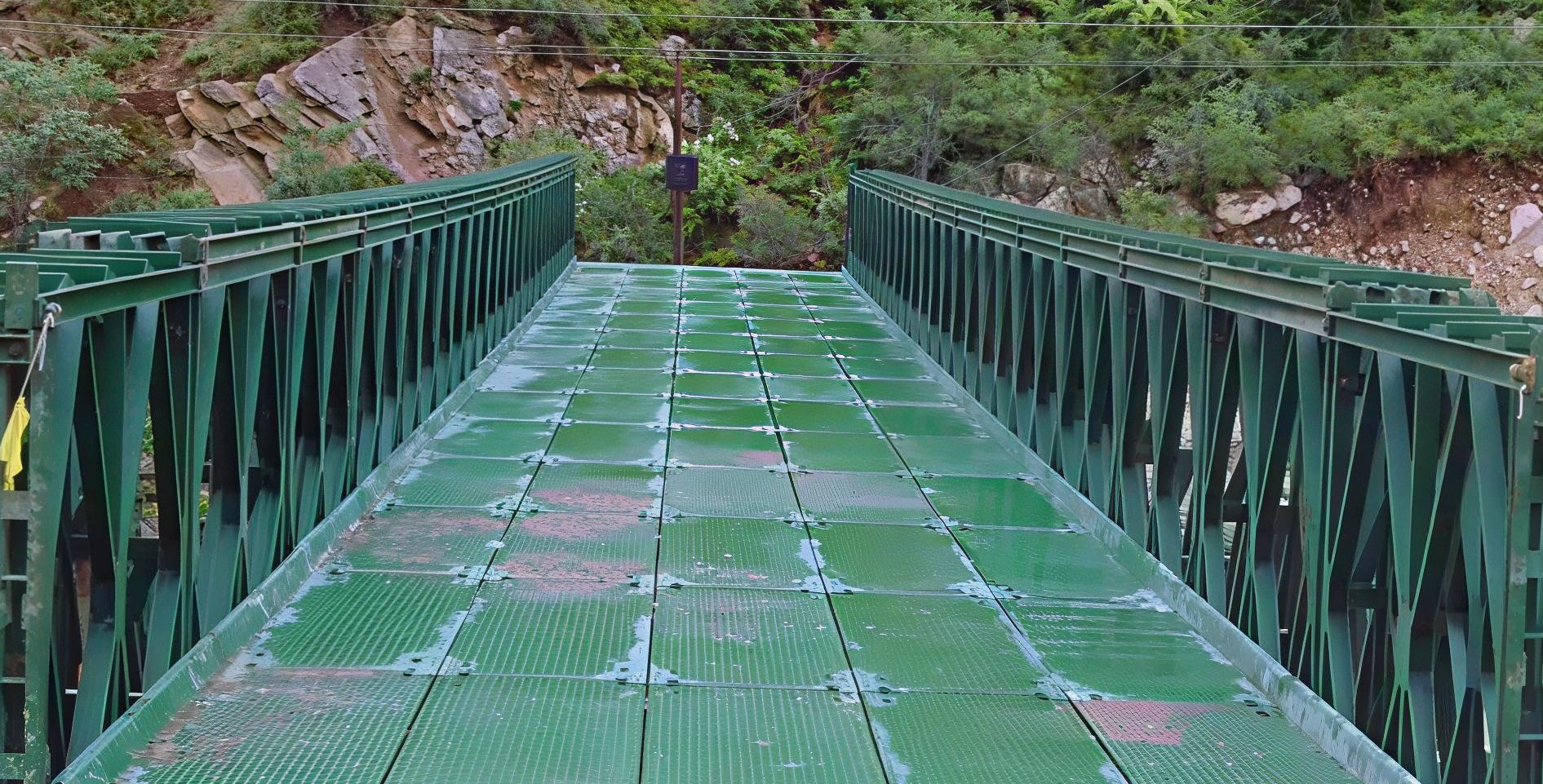
A single-span steel bridge crosses between two end supports without intermediate piers. Its primary structure may use steel girders, a truss, or an engineered modular system. The deck can still contain concrete.
A multi-span concrete bridge divides the crossing into several shorter spans supported by abutments and intermediate piers. Its superstructure may use reinforced concrete or prestressed concrete, constructed onsite or assembled from precast elements.
This distinction matters: the comparison changes both structural material and support arrangement.
It also does not mean "prefabricated versus conventional." Concrete bridges can use prefabricated components and accelerated construction methods too. FHWA identifies prefabricated bridge elements and systems as a way to reduce onsite construction and traffic disruption across different bridge configurations.
Before comparing prices, specify the same:
- Roadway width and vehicle loading.
- Design life and reliability requirements.
- Hydraulic clearance and flood criteria.
- Seismic, wind, and temperature conditions.
- Deck performance, barriers, and pedestrian provision.
- Inspection access and maintenance obligations.
Otherwise, apparent savings may simply reflect different specifications.
The following table is a screening framework, not a substitute for site-specific design. FHWA's prefabrication decision framework emphasizes access, transportation, supplier capability, and construction requirements when evaluating alternatives.
Decision factor |
Single-span steel bridge |
Multi-span concrete bridge |
Intermediate supports |
None within the clear span |
Required between spans |
Foundation strategy |
Loads concentrated at end supports |
Loads distributed across more support locations |
Valley-floor work |
May avoid permanent pier construction |
Requires access to intermediate foundations |
Construction approach |
Crane erection, assembly, or engineered launching |
Cast-in-place work or precast erection |
Logistics constraint |
Steel component dimensions, assembly space, erection equipment |
Concrete supply or transport of heavy precast units |
Maintenance focus |
Corrosion protection, connections, fatigue-sensitive details |
Concrete condition, reinforcement or tendon protection |
Strongest potential advantage |
Avoiding difficult piers and shortening disruption |
Efficient repetition where foundations and supply chains are favorable |
An intermediate pier creates a chain of construction activities: access preparation, excavation, foundation installation, reinforcement, concrete placement, and inspection.
If the valley contains a river, soft deposits, or difficult terrain, the pier may also require temporary works and additional environmental controls.
Removing that pier therefore changes more than the bill of quantities. It can remove a difficult workfront from the project.
However, a longer clear span can increase superstructure demands and reactions at the abutments. I would never treat "no piers" as equivalent to "simple foundations." Both banks still require geotechnical investigation and appropriate foundation design.
Where a valley carries water, eliminating intermediate piers removes those particular pier-scour locations. It does not eliminate abutment scour, contraction scour, bank erosion, or channel migration.
FHWA's HEC-18 addresses pier scour, abutment scour, and debris-related effects. A clear-span option still needs a hydraulic assessment covering the opening, foundation stability, and flood behavior.
The practical question is whether avoiding piers produces a meaningful reduction in foundation exposure and construction difficulty—not whether steel automatically makes a crossing flood-proof.
A prefabricated steel bridge can allow manufacturing to proceed while foundations and approaches are constructed.
This parallel workflow can reduce onsite activity. FHWA identifies reduced construction time, weather-related delays, and traffic impacts among the potential benefits of prefabricated bridge systems.
However, the complete schedule must also include:
- Design approval and fabrication release.
- Material procurement and production.
- Shipping, customs clearance, and inland transport.
- Foundation readiness.
- Assembly, erection, deck completion, and acceptance.
A short erection window is not the same as a short project delivery period.
Precast concrete can also shift work away from the site. Where a capable local precast supplier and suitable transport routes exist, a multi-span concrete bridge may offer an efficient programme.
Conversely, either option can lose its advantage if oversized components cannot negotiate local roads.
FHWA specifically highlights hauling restrictions, turning radii, permitted loads, and erection feasibility during preliminary planning. These checks belong before supplier selection, not after fabrication begins.
For public infrastructure, ROI is best understood as investment value rather than a simple sales-style return percentage.
A robust comparison separates owner expenditure from wider economic effects. NCHRP Report 483 provides a bridge life-cycle cost methodology involving alternative strategies, cost estimates, vulnerability, and net present values.
The owner-cost account should include design, construction, inspection, maintenance, rehabilitation, and end-of-life expenditure, adjusted for any justified residual value.
The wider economic account can include traffic delays, detour operating costs, and documented disruption to essential services.
Do not mix these without explanation. Reduced road-user costs benefit the community, but they do not necessarily appear as savings in the bridge owner's budget.
Consider two hypothetical designs for the same crossing. These figures are assumed inputs—not market quotations, Evercross project results, or industry averages.
Initial cost category |
Single-span steel |
Multi-span concrete |
Superstructure and deck |
$950,000 |
$760,000 |
Foundations and supports |
$320,000 |
$610,000 |
Transport and erection |
$210,000 |
$180,000 |
Temporary works and access |
$100,000 |
$170,000 |
Total initial owner cost |
$1,580,000 |
$1,720,000 |
Steel costs $190,000 more for the superstructure and deck, yet the assumed foundation and access savings make its complete initial cost $140,000 lower.
Now assume steel shortens disruption by 40 days and independently estimated road-user costs equal $4,000 per day. The additional economic benefit is $160,000.
The combined initial advantage becomes $300,000 before future maintenance, rehabilitation, discounting, and risk adjustments.
The lesson is not that steel always saves this amount. It is that comparing superstructure quotations alone can reverse the apparent result.
In this example, steel's additional superstructure and erection expenditure totals $220,000.
Foundation and temporary-access savings must exceed that amount for steel to win on initial owner cost.
Request sensitivity tests for:
1. Foundation depth and rock conditions.
2. Transport and erection costs.
3. Realistic schedule differences.
4. Coating and rehabilitation expenditure.
5. Flood-related repair scenarios.
An alternative that remains competitive across plausible scenarios is more defensible than one that wins only under optimistic assumptions.
Steel bridge maintenance should address corrosion protection, drainage, connections, and fatigue-sensitive details.
The specification must match the environment. Coastal exposure, salts, persistent moisture, and inaccessible details can materially affect preservation requirements.
FHWA's corrosion-control guidance discusses protective coatings and appropriately selected weathering steels. Its fatigue guidance also emphasizes design, evaluation, and inspection of steel bridge details.
Ask suppliers to explain the proposed protection system, preparation requirements, inspection access, and repair procedure—not merely state a coating thickness.
Concrete bridges also contain vulnerable steel reinforcement or prestressing systems.
FHWA identifies concrete quality, reinforcement protection, and corrosion-inhibitive grouts among corrosion-control measures. Its research also addresses chloride-induced deterioration and preservation of reinforced and prestressed concrete bridges.
A fair comparison therefore needs two credible maintenance plans.
Neither "steel rusts" nor "concrete lasts forever" is a useful procurement conclusion.
FHWA's prefabricated bridge cost study examined nine projects and reported reduced onsite construction time across all of them.
It also reported combined construction savings of $30 million, defined as the difference between engineers' estimates and awarded bids.
That definition matters.
The study does not establish a universal saving percentage, and it is not a direct test of single-span steel against multi-span concrete in narrow valleys.
I would use it as evidence that prefabrication can create measurable project value—not as a number to insert into an unrelated quotation.
For a stronger supplier case study, request the span arrangement, foundation conditions, original programme, actual completion dates, final scope, and cost-comparison basis.
Financial life-cycle cost and environmental life-cycle assessment answer different questions.
A credible environmental comparison considers material quantities, production, transport, construction, maintenance, and end-of-life treatment. Steel bridge life-cycle assessment literature emphasizes these stages and the influence of construction choices.
For narrow valleys, assess:
- Disturbance associated with intermediate foundations.
- Temporary roads and working platforms.
- Transport distances and shipment weights.
- Coating, repair, and deck-replacement requirements.
- Realistic reuse or recycling scenarios.
Do not claim that either material is automatically lower-carbon. Use comparable boundaries and project-specific quantities.
Commission topographic, geotechnical, and—where relevant—hydraulic investigations.
Evaluate steel and concrete options against identical performance requirements. Consider a single-span concrete option where feasible; a two-option comparison should not hide a credible third solution.
Check delivery routes, lifting locations, assembly areas, temporary stability, and access to every foundation. FHWA's framework treats these constraints as central decision inputs.
Separate foundations, superstructure, transport, erection, temporary works, exclusions, and maintenance assumptions.
Confirm who owns design approvals, interfaces, installation supervision, acceptance documentation, and future inspection planning.
Evercross Bridge has more than 30 years of industry experience, serves over 50 countries, and reports annual production capacity of 100,000 tonnes.
The company also reports more than 200 large government infrastructure projects across Southeast Asia, Africa, and Latin America.
Evercross offers prefabricated steel bridges, Bailey bridges, and emergency bridge solutions, supported by design, production, transport, and installation services.
For a narrow valley project, the most useful proposal is not simply a steel price. It is a coordinated package connecting structural design, foundation interfaces, shipping constraints, erection planning, and long-term maintenance.
Choose the solution that performs best across verified foundation conditions, construction constraints, and lifecycle assumptions.
Send Evercross Bridge your crossing survey, loading requirements, foundation information, access photographs, and target opening date. Request a preliminary single-span steel proposal with clearly stated assumptions, scope boundaries, transport arrangements, and installation requirements—then compare it against an equivalent concrete design.
No. It may offer better value when avoiding intermediate foundations offsets higher superstructure or erection costs. Favorable concrete production and pier conditions can change the result.
Yes, when the specific system is designed and approved for permanent service. Prefabrication describes production and assembly; it does not, by itself, establish service life or suitability.
No. Abutment scour, contraction scour, and other channel-related hazards can remain. Hydraulic assessment is still necessary.
Yes. Prefabricated concrete elements can reduce onsite work. Evaluate the actual delivery and erection method rather than assuming every concrete bridge is cast onsite.
Provide the crossing survey, required width, loading criteria, proposed span, ground information, flood data where applicable, site photographs, transport constraints, and target completion date.
1. Prefabricated Bridge Elements and Systems[fhwa.dot]
2. Framework for Prefabricated Bridge Elements and Systems (PBES) Decision-Makingfhwa.dot]
3. Evaluating Scour at Bridges, Fifth Edition - Hydraulic Engineering Circular No. 18 (HEC-18)fhwa.dot]
4. Bridge Life-Cycle Cost Analysis - NCHRP Report 483[onlinepubs.trb]
5. Prefabricated Bridge Elements and Systems Cost Study: Accelerated Bridge Construction Success Stories[fhwa.dot]
6. Best Practices for Corrosion Control and Mitigation[highways.dot]
7. Design and Evaluation of Steel Bridges for Fatigue and Fracture[fhwa.dot]
8. Corrosion Protection - Concrete Bridges[fhwa.dot]
9. Life Cycle Assessment of Steel Bridges During Construction and in Service[structuremag]
10. Accelerated Bridge Construction-Hosting organization: Transportation Association of Canada (TAC).[tac-atc]


