

Views: 211 Author: Evercross Bridge Publish Time: 2026-10-13 Origin: Evercross Bridge


Content Menu
● Key Takeaways for Prefabricated Steel Bridge Buyers
● What Is a Prefabricated Steel Bridge?
● Trend 1: Modular Steel Bridge Design With Application-Specific Flexibility
>> Standardized Components, Project-Specific Engineering
>> Bailey Bridges for Temporary and Permanent Crossings
● Trend 2: Faster Installation Through Better Construction Planning
>> Separate Assembly Time From Total Delivery Time
>> Design the Installation Method Early
● Trend 3: Durability-Led Materials and Connection Design
>> Higher Strength Does Not Solve Every Design Problem
>> Connections Deserve the Same Attention as Main Members
>> Select Corrosion Protection for the Exposure
● Trend 4: BIM and Digital Coordination With Measurable Deliverables
>> Use Digital Models to Resolve Interfaces
>> Automation Still Requires Quality Control
● Trend 5: Sustainability Measured Across the Bridge Lifecycle
>> Replace General Claims With Comparable Evidence
>> Consider Reuse Without Assuming Automatic Reusability
● Trend 6: Selective Structural Health Monitoring
● How to Compare Prefabricated Steel Bridge Costs
● A Practical Procurement Checklist for International Projects
● How Evercross Bridge Supports Project Delivery
>> Request a Project-Specific Bridge Proposal
>> 1. How quickly can a prefabricated steel bridge be installed?
>> 2. Are prefabricated steel bridges always cheaper?
>> 3. Can a Bailey bridge be used permanently?
>> 4. Does high-strength steel eliminate fatigue concerns?
>> 5. Does prefabrication make a bridge sustainable?
>> 6. Does every bridge need smart monitoring?
A prefabricated steel bridge offers more than faster assembly. For infrastructure owners, EPC contractors, and engineering consultants, its real value lies in coordinating structural design, factory production, transport, and installation before construction begins.
In 2026, the most useful design developments are not simply stronger steel or more sophisticated software. They are approaches that make bridge delivery more predictable: adaptable modular systems, better connection detailing, digital coordination, corrosion protection, and evidence-based lifecycle planning.
Prefabricated bridge elements and systems support accelerated bridge construction by moving work away from the final bridge alignment. The Federal Highway Administration identifies benefits including shorter onsite construction, improved constructability, reduced traffic impacts, and potential improvements in quality and safety.
This guide examines how those established practices translate into practical purchasing decisions—and where buyers should challenge overly optimistic claims.
- Evaluate installation speed separately from total project delivery time.
- Match modular bridge configurations to verified loads and site conditions.
- Treat fatigue, connections, and corrosion protection as core design requirements.
- Compare lifecycle costs rather than steel supply prices alone.
- Request supporting calculations, inspection records, and installation documentation.
- Use digital models and monitoring where they solve a defined project problem.
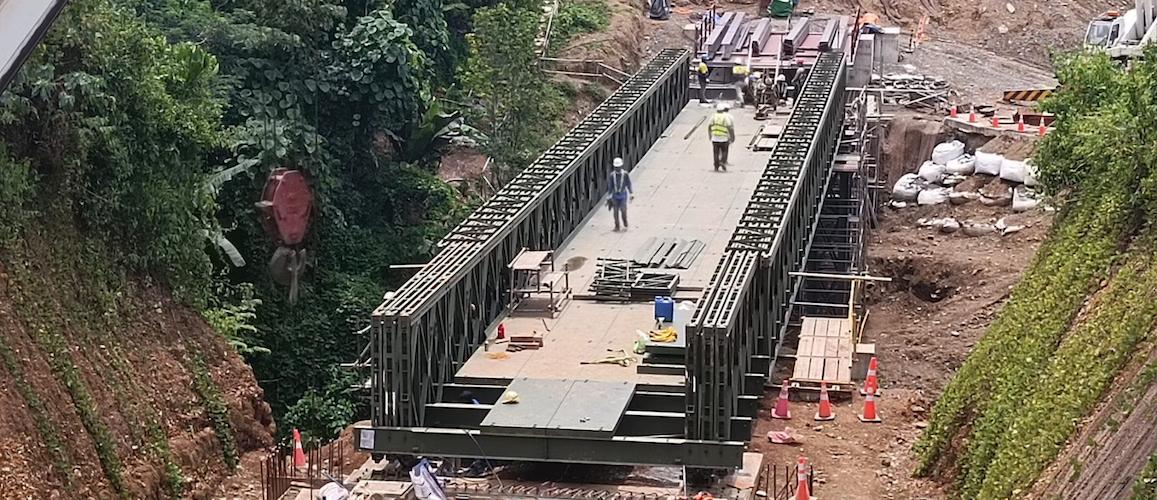
A prefabricated steel bridge uses structural components manufactured before final onsite assembly. Depending on the system, these may include truss panels, girders, crossbeams, bracing, and deck components.
The category includes different structural solutions rather than one universal product. Evercross Bridge's published product catalog lists Bailey bridges, modular steel bridges, plate girder bridges, truss bridges, and other steel bridge types.
The important distinction is between fabrication method and structural form. "Prefabricated" describes how components are produced and delivered; "Bailey," "truss," and "plate girder" describe particular systems or structural arrangements.
For buyers, the first question should therefore be: which configuration meets the crossing's span, loading, access, and service requirements?
Modular steel bridge construction combines repeatable components with project-specific engineering. Factory-built elements can reduce onsite work and exposure to weather-related delays, supporting the broader objectives of accelerated bridge construction.
However, modularity does not make capacity infinitely adjustable. Changing span, roadway width, deck type, or loading can alter member forces, connection demands, support reactions, and stability requirements.
The practical design objective is flexibility within verified limits.
A buyer assessing a modular bridge should request:
- The proposed structural arrangement.
- The applicable design code and vehicle loading.
- Clear roadway width and usable span.
- Deck specification and support reactions.
- Assembly requirements and configuration limitations.
These documents make comparisons more meaningful than product names alone.
Bailey-type systems are particularly relevant when buyers need transportable components and staged assembly. Evercross's catalog includes multiple Bailey bridge configurations, including single- and double-lane arrangements.
Nevertheless, temporary deployment and permanent service involve different requirements. A permanent installation must address its specified traffic demand, durability strategy, inspection access, and maintenance obligations.
The purchasing lesson is straightforward: select the engineered configuration, not simply a familiar bridge label.
Accelerated bridge construction can sharply reduce traffic disruption. FHWA reports that some ABC applications can replace bridges within 48–72 hours. That figure describes selected accelerated replacement operations—not a universal timeframe for designing, fabricating, shipping, and completing every prefabricated steel bridge.
A credible schedule should distinguish:
Project stage | What the buyer should verify |
Engineering | Design inputs, approvals, and drawing release |
Fabrication | Production duration and inspection hold points |
Logistics | Shipping, customs, and inland delivery |
Site preparation | Foundations, access, and bearing readiness |
Installation | Assembly method, lifting or launching sequence |
Handover | Final checks, documentation, and acceptance |
The fastest onsite installation still depends on everything arriving ready.
Installation planning should inform bridge design rather than follow it.
Relevant questions include:
- Can cranes reach the required position?
- Is there sufficient assembly space?
- Is launching feasible for the selected system?
- Are temporary works needed?
- How will workers access connections safely?
- Are river conditions or road closures limiting the available window?
FHWA's accelerated bridge construction guidance treats planning, fabrication, erection, and long-term performance as connected parts of successful delivery.
For remote crossings, resolving these questions early can be more valuable than reducing component weight alone.
High-strength steel can support efficient structural design, but strength is only one consideration. Fatigue and fracture require their own evaluation, including the effects of repeated moving loads and the locations where fatigue checks are necessary.
Consequently, buyers should not assume that a higher steel grade automatically delivers a longer service life.
An effective technical review considers the complete structural system: members, welds, bolts, pins, bearings, deck interfaces, and bracing.
A bridge specification should explain how connection quality will be verified.
Useful procurement requirements include material traceability, approved fabrication procedures, inspection records, dimensional checks, and clearly defined acceptance criteria.
From a procurement perspective, the strongest quality assurance package connects every delivered component to the approved design and inspection process. A generic statement that a bridge uses "premium steel" provides far less assurance.
FHWA's fatigue and fracture manual covers design, evaluation, repair, and retrofit, reinforcing the importance of treating durability as a continuing engineering responsibility.
Corrosion protection should reflect the site environment and the owner's maintenance strategy.
NSBA's steel bridge guidance addresses corrosion mechanisms and protection selection in relation to environment, lifecycle cost, and long-term performance.
For procurement, request the coating or protection specification, surface preparation requirements, inspection criteria, and procedures for repairing damage during transport or installation.
Avoid vague promises such as "maintenance-free." A clear maintenance plan is more useful than an absolute durability claim.
Building Information Modeling can support coordination between structural components, foundations, bearings, decks, and construction activities. However, the buyer should define the required deliverables rather than request "BIM" as a marketing feature.
A practical digital coordination scope might include:
1. A coordinated geometry model.
2. Component identification and assembly references.
3. Interface reviews before drawing approval.
4. Installation-stage visualization.
5. A defined as-built information package.
The value lies in identifying conflicts before they become onsite problems.
Research on bridge monitoring data also demonstrates how BIM environments can organize structural performance information and visualize sensor data. This supports information management; it does not prove that every project needs a complex digital twin.
Automated fabrication should be evaluated through actual process controls and inspection evidence.
Buyers should ask which operations are automated, how dimensions are verified, and how deviations are recorded and corrected. Machinery alone is not a substitute for an approved quality plan.
For a prefabricated steel bridge manufacturer, the useful commercial message is consistent, traceable production—not automation without supporting documentation.
Prefabrication can reduce environmental impacts by shortening onsite activity and moving production away from sensitive construction areas. FHWA identifies reduced site impacts as a potential benefit of accelerated bridge construction.
However, a steel bridge should not be assigned a universal carbon-saving percentage simply because it contains recycled material.
A meaningful comparison needs a defined assessment boundary and consistent assumptions. Procurement questions should cover steel production, fabrication, transport, installation, maintenance, and end-of-life treatment.
If suppliers provide environmental declarations or carbon calculations, check whether the compared options use equivalent load requirements, service assumptions, and reporting boundaries.
Some modular systems may be designed for disassembly and redeployment. Whether particular components remain suitable depends on their condition and the requirements of the next installation.
Buyers considering reuse should therefore request a documented inspection and engineering assessment process.
Lifecycle thinking also includes corrosion protection. NSBA guidance connects protection decisions with environmental exposure, maintenance, and lifecycle cost—not simply the initial coating price.
Structural health monitoring can provide information about bridge behavior under traffic and environmental conditions. Published examples describe sensors measuring responses associated with loading, aging, ground movement, and climatic events.
However, monitoring is most useful when the owner has defined what decisions the data will support.
Before specifying sensors, establish:
- The behavior or risk being monitored.
- The measurements required.
- Baseline conditions and alert thresholds.
- Power and communication arrangements.
- Responsibility for reviewing data.
- The action required after an alert.
Monitoring should support asset management rather than produce an unmanaged stream of measurements. BIM-based information management can help connect monitoring data with the relevant structural elements.
A low supply price does not necessarily mean a low completed-project cost.
Buyers should compare quotations against a common technical scope and separate factory supply from delivery, site works, installation, and maintenance.
Cost category | Questions to resolve |
Bridge supply | Are decks, bearings, fasteners, and protection included? |
Engineering | Are calculations and installation drawings included? |
Transport | Are freight, customs, and inland delivery clearly allocated? |
Construction | Who provides cranes, temporary works, and foundations? |
Maintenance | What inspections and protection repairs are anticipated? |
FHWA identifies potential cost benefits from accelerated construction, but those benefits depend on the selected method and project conditions. "Prefabricated" should not be treated as a guarantee of the lowest price.
Before requesting a final quotation, prepare a concise project brief:
1. Provide location, crossing geometry, and available surveys.
2. Define vehicle loading, roadway width, and intended use.
3. Identify the applicable design standard and approving authority.
4. Explain environmental exposure and required service assumptions.
5. Describe port, road access, and equipment restrictions.
6. Confirm responsibility for foundations and installation.
7. Request a deliverables list and project-specific schedule.
For emergency bridge deployment, incomplete site information should be identified explicitly. Urgency makes a clear statement of assumptions more important, not less.
According to company-provided information, Evercross Bridge has more than 30 years of industry experience, serves over 50 countries, has annual production capacity of 100,000 tonnes, and has delivered more than 200 large government infrastructure projects across Southeast Asia, Africa, and Latin America.
The company describes its service scope as bridge design, production, transport, and installation support. Its published catalog includes Bailey and other steel bridge systems.
For prospective buyers, the next step is to connect those capabilities to project-specific evidence: comparable references, design documentation, quality records, and a feasible delivery plan.
Send Evercross Bridge your required span, roadway width, design loading, location, site photographs, and target completion date.
Request a proposal that clearly identifies the bridge configuration, supply scope, design assumptions, transport plan, installation requirements, and approval responsibilities.
A useful proposal should help your team make an engineering and procurement decision—not simply provide a steel price.
Installation time depends on the system, site readiness, equipment, and construction method. FHWA reports 48–72-hour replacement windows for some ABC applications, but these should not be confused with complete project delivery times.
No. Their value depends on supply, transport, foundations, installation, traffic disruption, and maintenance. Accelerated methods can reduce certain costs, but the comparison must use equivalent project scopes.
Evercross offers Bailey bridge configurations for different requirements. Permanent use should be supported by project-specific engineering, applicable approvals, and an appropriate durability and maintenance strategy—not assumed from the product name.
No. Fatigue assessment considers repeated loading and relevant structural details. FHWA provides dedicated guidance for fatigue and fracture design and evaluation in steel bridges.
It can reduce onsite impacts, but overall environmental performance requires a wider assessment. Manufacturing, transport, maintenance, and service assumptions should also be considered.
Not necessarily. Monitoring should answer a defined operational question and include a plan for interpreting and acting on the data. Available research supports integrating monitoring information with bridge asset models.
1. Federal Highway Administration — "Prefabricated Bridge Elements and Systems."[fhwa.dot]
2. Federal Highway Administration — "EDC-2: Accelerated Bridge Construction."[fhwa.dot]
3. Federal Highway Administration — "Accelerated Bridge Construction" manual.[fhwa.dot]
4. Federal Highway Administration — "Design and Evaluation of Steel Bridges for Fatigue and Fracture."[fhwa.dot]
5. World Steel Association — "Life Cycle Assessment in the Steel Industry." [worldsteel]
6. American Institute of Steel Construction — "Environmental Product Declarations."[aisc]
7. International Organization for Standardization — "ISO 14001:2026 — Environmental Management Systems."[iso]
8. Federal Highway Administration — "Effective Wireless Sensor Systems to Monitor Structural Health and Assess Bridge Conditions."[fhwa.dot]
9. Evercross Bridge — "Steel Bailey Bridge" product category page. [baileybridgesolution]


