

Views: 221 Author: Site Editor Publish Time: 2026-03-03 Origin: Site


Content Menu
● Advanced Engineering Expertise and Design Versatility
>> Sophisticated Structural Analysis
>> Modular Customization for Diverse Applications
● Manufacturing Capacity, Scalability, and Supply Chain Stability
>> Automated Production for Precision and Speed
● Material Integrity and Rigorous Quality Assurance
>> Anti-Corrosion Excellence: Hot-Dip Galvanizing
● Authoritative Reputation and Strategic Partnerships
>> Proven Track Record with SOEs and Global Giants
>> Compliance with International Standards
● Transportation and Installation Services
>> Modular Shipping and Packaging
>> On-Site Technical Supervision and Knowledge Transfer
● Comprehensive Risk Mitigation and Safety Standards
>> Non-Destructive Testing (NDT)
>> Trial Assembly (Pre-Assembly)
● Comparative Analysis: Choosing the Right Partner
● Detailed Steps for Choosing a Manufacturer
● Frequently Asked and Questions regarding Temporary Steel Bridge
>> Q1: What is the lifespan of a temporary steel bridge?
>> Q2: How does EVERCROSS BRIDGE ensure the safety of its modular components?
>> Q3: Can these bridges be installed in remote areas without heavy cranes?
>> Q4: Do your bridges meet US (AASHTO) or European (Eurocode) standards?
>> Q5: What is the maximum span a temporary steel bridge can achieve?
Selecting the right temporary steel bridge manufacturer is a strategic decision that reverberates through every stage of a construction project, from initial budgeting to final site decommissioning. In the world of high-stakes infrastructure, a temporary bridge is far more than a stop-gap measure; it is a critical artery that ensures the continuity of transport, the safety of workers, and the adherence to strict project timelines. Whether you are dealing with a highway detour, an emergency disaster relief scenario, or a complex railway crossing, the structural integrity of your bridging solution is the foundation of your operational success.
As a global industry leader, EVERCROSS BRIDGE—ranked among China’s top three professional steel bridge producers with an annual output exceeding 10,000 tons—has spent decades refining the art and science of modular steel structures. Having partnered with massive state-owned conglomerates like CCCC (China Communications Construction Company), CREC (China Railway Group Limited), PowerChina, CGGC (Gezhouba Group), and CNOOC, we have seen firsthand how the choice of a manufacturer determines the outcome of multi-billion dollar international projects.
This guide provides an exhaustive analysis of the factors you must evaluate to ensure you partner with a manufacturer that delivers not just steel, but a high-performance engineering solution.
The primary differentiator between a generic steel fabricator and a specialized temporary steel bridge manufacturer lies in their engineering department. A bridge is a dynamic structure that must withstand fluctuating loads and environmental stressors.
A premier manufacturer must possess the internal capability to perform advanced finite element analysis (FEA). When you provide site specifications, the manufacturer’s engineers should be able to simulate real-world conditions, including dynamic vehicle impact, wind-induced vibration, and seismic resonance. They should utilize global industry-standard software like SAP2000 or Midas to ensure that every truss and panel is optimized for weight without compromising on the safety factor. At EVERCROSS BRIDGE, our engineering team focuses on maximizing the "strength-to-weight" ratio, ensuring that our bridges are both incredibly strong and easy to transport.
Not all temporary bridges are created equal. You need a manufacturer that offers a diverse "portfolio of solutions." This includes:
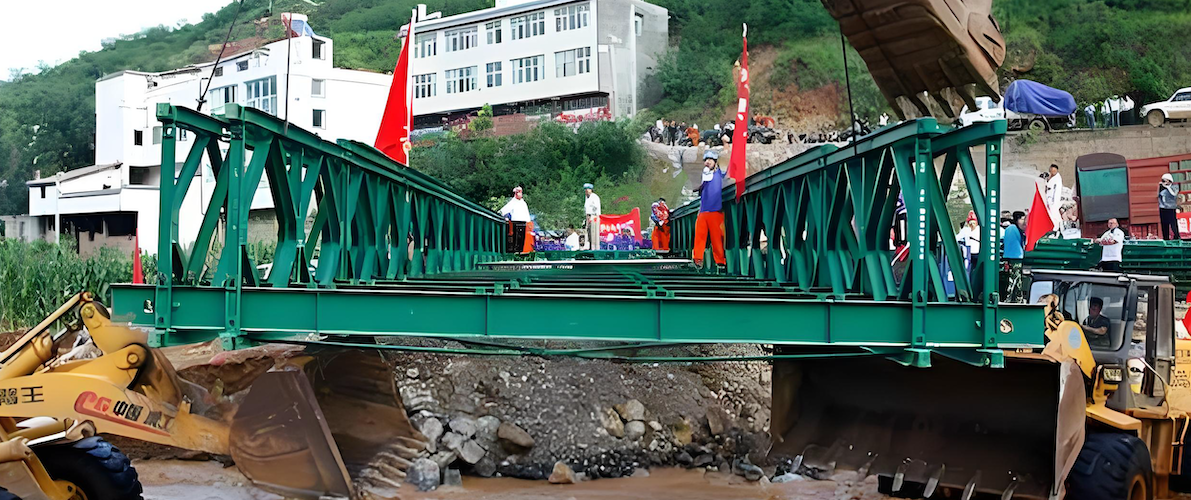
●Bailey Bridges (Compact 100/200): The gold standard for rapid deployment and versatility.
●Truss Bridges: Ideal for longer spans where mid-river piers are not feasible.
●Plate Girder Bridges: Best for heavy-duty railway or industrial mining applications. The manufacturer should be able to modify standard designs to accommodate specific widths (extra-wide lanes), pedestrian walkways, or specialized utility pipe supports.
In the infrastructure sector, "time is money" is an understatement. A delay in the delivery of a temporary bridge can halt a project entirely, leading to massive financial penalties. This is why manufacturing scale is a non-negotiable factor.
A manufacturer with a high annual output, such as the 10,000-ton capacity of EVERCROSS BRIDGE, provides a level of security that smaller shops cannot. Large-scale production implies two things: stability of raw material supply and bandwidth for urgent orders. Because we work with major steel mills like BaoSteel and AnSteel, we maintain a consistent inventory of high-tensile steel, allowing us to start production immediately while others are still waiting for material deliveries.
The "experience" component of E-E-A-T (Experience, Expertise, Authoritativeness, and Trustworthiness) is reflected in the factory floor. Look for manufacturers who utilize:
●CNC Plasma Cutting: For pinpoint accuracy in component dimensions.
●Robot Welding Cells: To ensure consistent weld penetration and eliminate human error in repetitive joints.
●Integrated Sandblasting Lines: To prepare the steel surface perfectly for protective coatings. Automation doesn't just speed up the process; it ensures that every single panel is interchangeable, which is vital for modular assembly on-site.
The "Trustworthiness" of a temporary steel bridge manufacturer is forged in the quality of the raw materials and the precision of the manufacturing process.
For temporary bridges, the material of choice is typically high-strength low-alloy (HSLA) steel, such as Q345B, Q355B, or Q420. These materials provide the necessary toughness to handle repetitive loading (fatigue) and extreme cold-weather conditions without becoming brittle.
Since temporary bridges are often reused or exposed to harsh environments (coastal salt spray, winter road salts, or tropical humidity), the surface treatment is critical. Hot-Dip Galvanizing (HDG) is the industry standard. A top-tier manufacturer will ensure a coating thickness of at least 85-100 microns, complying with ISO 1461. This ensures that the bridge remains maintenance-free for 20 to 50 years, significantly increasing its resale value or lifespan for the owner.
A manufacturer's "resume" is their most powerful credential.
When a manufacturer has long-standing relationships with entities like China Communications Construction Company (CCCC) or China Railway Engineering Corporation (CREC), it serves as a massive endorsement of their quality systems. These "Central Enterprises" have the most rigorous vetting processes in the world. They conduct regular factory audits, demand strict compliance with international standards, and require impeccable project management. EVERCROSS BRIDGE’s consistent cooperation with these giants on domestic and international railway and highway projects proves our ability to meet the highest global standards.
A global temporary steel bridge manufacturer must be a "chameleon" in terms of engineering standards. They should be deeply familiar with:
●AASHTO LRFD (USA): For North American highway projects.
●Eurocodes (EU): Specifically EN 1993 for steel structures.
●British Standards (BS 5400): Often used in Commonwealth nations.
●Australian Standards (AS 5100): For oceania-based projects. The ability to provide design calculations stamped by professional engineers (PE) in these jurisdictions is a hallmark of a top-tier provider.
The "Value" of a bridge manufacturer is often realized after the product leaves the factory.
Efficient logistics can save a project tens of thousands of dollars. The manufacturer should design bridge components specifically to fit within standard 40ft High Cube containers. This avoids the astronomical costs of "Out of Gauge" (OOG) shipping. Furthermore, components should be clearly labeled and palletized to allow for organized offloading at remote sites where space may be limited.
The user experience (UX) for a contractor involves how easy the bridge is to install. A manufacturer should provide:
●Detailed Assembly Manuals: Clear, step-by-step guides in English.
●On-Site Engineers: For complex projects, sending a technical supervisor to guide the local workforce is invaluable. This ensures the bridge is launched safely and prevents structural damage during the installation process.
Safety is an indispensable pillar in steel bridge engineering. Manufacturers must prioritize risk mitigation at every stage.
All critical welds should undergo NDT to ensure the absence of any hidden defects, inclusions, or cracks within the steel joints. Your manufacturer should include the NDT report as part of the final quality file.
Before shipping the steel bridge worldwide, specialized manufacturers conduct trial assembly at their facilities. This includes connecting the main trusses and crossbeams to ensure perfect alignment of every hole and tight fit of every pin. This "think before you act" approach prevents catastrophic delays on-site.
The following table highlights why prioritizing a high-capacity, professional manufacturer like EVERCROSS BRIDGE is superior to choosing a low-cost, small-scale workshop.
Selection Criteria | Professional Manufacturer (EVERCROSS) | Small-Scale Workshop |
Annual Capacity | 10,000+ Tons (Scalable) | 500-1,000 Tons (Limited) |
Engineering Support | Full FEA & Design Calculations | Standard "Copy-Paste" Designs |
Material Quality | Certified High-Tensile Steel (Q355B+) | Uncertified or Mixed Grade Steel |
Welding Standard | AWS D1.1 / ISO 3834 Certified | Uncertified Manual Labor |
Surface Treatment | Hot-Dip Galvanizing (85μm+) | Industrial Paint or Thin Zinc |
Documentation | Full QA/QC Dossier & MTCs | Minimal Paperwork |
Delivery Speed | Rapid (Stocked Materials) | Slow (Order-based Procurement) |
●Determine Load Capacity:Determine the bridge's intended use, such as light vehicles, heavy trucks (over 100 tons), or pedestrians.
●Find Case Studies:Check if the manufacturer has sufficient past experience and relevant case studies to showcase.
●Factory Visit:Visit the factory online or in person if possible to assess their production capabilities.
●Verify Certifications:Ensure they hold ISO 9001, ISO 14001, and relevant welding certifications.
●Evaluate Logistics Options:Confirm their ability to handle international shipping and provide on-site assembly guidance.
Selecting a temporary steel bridge manufacturer requires a holistic view that balances technical expertise with manufacturing muscle. A bridge is a life-safety structure, and there is no room for compromise. By choosing a partner like EVERCROSS BRIDGE, you are gaining more than a supplier; you are gaining a partner with a 10,000-ton annual capacity, a history of success with the world’s largest construction firms, and a commitment to engineering excellence.
Our experience in railway, highway, and international procurement projects ensures that we understand the complexities of your job site. From the first structural calculation to the final pin installation, we provide the reliability and authority needed to bridge the gap in your most challenging infrastructure projects.
While termed "temporary," these bridges are built to last. With Hot-Dip Galvanizing, a steel bridge can have a service life of 30 to 50 years. Many are used "temporarily" for 5 years and then relocated and reused multiple times.
We implement a 100% inspection policy on critical components. This includes raw material testing, robotic welding for consistency, and Non-Destructive Testing (NDT) on all load-bearing joints, followed by a trial assembly before shipping.
Yes! One of the biggest advantages of our modular designs (like the Bailey Bridge) is that they can be "launched" using a cantilever method. This requires only a small crew and basic machinery, making them ideal for remote or disaster-hit regions.
Absolutely. We customize our designs and material selections to comply with the specific national codes of the project location. We provide all necessary engineering documentation to satisfy local regulatory bodies.
Single spans can typically reach up to 60-70 meters depending on the load. For longer crossings, we design multi-span solutions using temporary piers or floating pontoons.


