

Views: 211 Author: Evercross Bridge Publish Time: 2026-09-24 Origin: Evercross Bridge


Content Menu
● Q345 vs. Q420 Steel: Quick Comparison
● What Q345 Steel Means in Bridge Fabrication
>> Why Q345 Has Been Widely Used
>> Practical Advantages of Q345 Steel
>> Where Q345 May Be Less Efficient
● What Q420 Steel Brings to Prefabricated Bridge Components
>> Higher Strength, Not an Automatic Upgrade
>> Q420 Requires Stronger Manufacturing Discipline
● Mechanical Properties: Why Thickness Matters
>> Expert Insight: Material Grade Is Only One Variable
● Q345 vs. Q420 in Real Bridge Design Conditions
>> 1. Strength-Governed Tension Members
>> 2. Compression Members and Buckling
>> 3. Bridge Girders and Deflection
>> 4. Fatigue-Sensitive Details
● Fabrication and Welding: The Deciding Factor Many Buyers Miss
>> Q345 Fabrication Considerations
>> Q420 Fabrication Considerations
>> Recommended Factory Quality Controls
● Cost Comparison: Price per Tonne vs. Cost per Bridge
>> A Practical Decision Example
● How to Choose Between Q345 and Q420
>> Step 1: Define the Design Basis
>> Step 2: Identify the Governing Limit States
>> Step 3: Optimize by Component, Not by Habit
>> Step 4: Verify Fabrication Readiness
>> Step 5: Compare Delivered Solutions
● Why Prefabrication Changes the Material Decision
● Q345 vs. Q420: Final Recommendation
>> 1. Is Q420 steel always better than Q345 steel for bridges?
>> 2. Can Q420 reduce the weight of a prefabricated steel bridge?
>> 3. Is Q345 steel still used in new bridge projects?
>> 4. Which steel is easier to weld: Q345 or Q420?
>> 5. Does higher yield strength improve bridge fatigue resistance?
>> 6. What documents should a buyer request for Q345 or Q420 bridge steel?
>> 7. Can Q345 and Q420 be used in the same steel bridge?
Choosing between Q345 steel and Q420 steel for prefabricated bridge components is not simply a question of selecting the grade with the higher nominal yield strength. For bridge owners, EPC contractors, consultants, and public-infrastructure buyers, the right decision must balance structural capacity, dead-load reduction, weldability, fatigue performance, low-temperature toughness, fabrication complexity, transport limits, inspection requirements, and lifecycle cost.
At Evercross Bridge, we have seen this decision affect every stage of a project—from the first structural calculation to factory assembly, overseas shipping, site erection, and long-term maintenance. With more than 30 years of steel-bridge manufacturing experience, annual production capacity of 100,000 tonnes, and deliveries across more than 50 countries, our engineering perspective is practical: Q345 is often the dependable all-round choice, while Q420 can create meaningful value where higher strength directly reduces steel weight or unlocks a more efficient bridge geometry.
This guide compares Q345 vs. Q420 steel for prefabricated bridge components and explains how project teams can make a technically sound, procurement-ready material decision.
> Important note: In current Chinese high-strength low-alloy structural-steel standards, Q345 has largely been superseded by Q355 for many new specifications. However, Q345 remains a widely used and widely searched reference grade in existing drawings, procurement documents, international tenders, and bridge-project discussions. Material selection must always follow the applicable contract specification, governing design code, mill certificate requirements, and approved calculation package.
The "Q" in Q345 and Q420 refers to the steel's specified yield-strength level. The numerical value indicates nominal yield strength in MPa under the applicable thickness range and product standard.
Comparison Factor | Q345 Steel | Q420 Steel | What It Means for Prefabricated Bridges |
Nominal yield strength | 345 MPa | 420 MPa | Q420 provides approximately 22% higher nominal yield strength at the reference thickness |
Typical tensile-strength range | 470–630 MPa, depending on grade and thickness | 520–680 MPa, depending on grade and thickness | Q420 generally offers a higher tensile-strength range |
Weight-saving potential | Standard baseline | Potentially lower steel tonnage in strength-governed members | Q420 can reduce section size where strength—not stiffness or fatigue—controls |
Weldability | Generally favorable with qualified welding procedures | Requires more disciplined welding control | Q420 may need closer attention to preheat, heat input, consumables, and hydrogen control |
Ductility and fabrication tolerance | Often more forgiving | Still suitable, but higher-strength designs require tighter execution | Q345 can be advantageous for highly repetitive fabricated systems |
Typical bridge use | Modular bridges, truss bridges, emergency bridges, standard highway structures | Long spans, heavy-load modules, optimized girders, weight-sensitive transport | Actual selection depends on design conditions and fabrication capability |
Procurement cost per tonne | Usually lower | Usually higher | Higher-grade steel must deliver enough structural or logistics savings to justify its premium |
Best decision basis | Balanced cost, constructability, supply availability | Weight optimization and higher capacity | Do not select solely by yield strength |
The published reference ranges commonly cited for Q345 are around 345 MPa minimum yield strength at thinner plate ranges, tensile strength of approximately 470–630 MPa, and elongation requirements that vary by thickness and quality grade. For Q420, reported values include 420 MPa nominal yield strength and a 520–680 MPa tensile-strength range at relevant thicknesses. Critically, both grades have thickness-dependent properties, so a grade name alone is not enough for final bridge design.
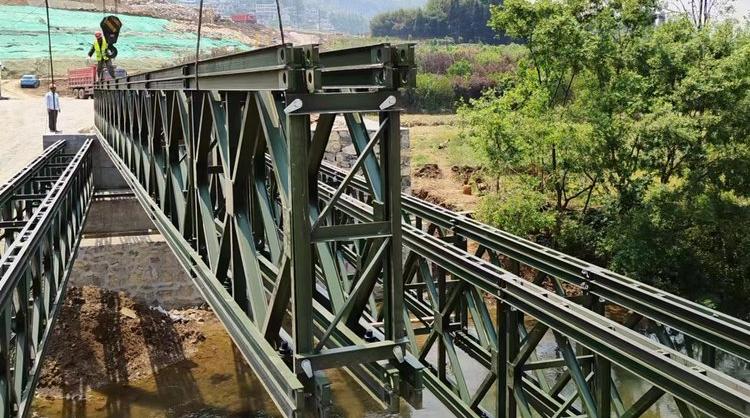
Q345 is a low-alloy high-strength structural steel traditionally specified for structural components requiring stronger performance than ordinary carbon steel. In bridge fabrication, it has historically been used for:
- Main truss members
- Steel girders and crossbeams
- Floor beams and stringers
- Portal frames and bracing members
- Bridge deck support structures
- Temporary bridges and emergency bridge modules
- Bolted connection plates and stiffeners
- Fabricated components for modular steel bridges
For many prefabricated steel bridge applications, Q345 offers a strong balance among mechanical performance, availability, processing familiarity, weldability, and cost control.
1. Good structural balance
Q345 offers sufficient strength for a wide range of modular and permanent bridge structures without forcing the fabricator to manage the tighter process controls associated with higher-strength material.
2. Familiar fabrication behavior
In factory production, repeatability matters. Q345 is well understood by many steel fabricators, welding teams, inspection personnel, and material suppliers. This can simplify welding-procedure qualification, production planning, and quality control.
3. Competitive cost efficiency
For standard spans or conventional bridge loading, Q345 may produce the most economical total project cost. A higher-strength steel grade is not automatically cheaper once material price, welding procedures, inspection, cutting, forming, and risk allowances are considered.
4. Suitable for modular bridge systems
Many prefabricated bridge systems are controlled by standard module widths, container or trailer shipping dimensions, bolted connection layouts, deck configuration, and erection methods. In these cases, changing from Q345 to Q420 may not produce enough steel reduction to justify a material upgrade.
Q345 can become less competitive when the structure is governed by high bending demand and member strength rather than stiffness, fatigue, geometry, or connection design. Examples include:
- Long-span prefabricated steel bridges
- Heavy truck-load crossings
- Mining-access bridges
- High-capacity industrial bridges
- Projects with strict shipment-weight limits
- Locations where crane capacity is limited
- Modular units requiring manual or light-equipment installation
In these cases, a Q420-based design may reduce the size or thickness of selected primary members—if all other design criteria remain satisfied.
Q420 steel has a higher nominal yield-strength level than Q345. At a reference condition, the difference is:
(420−345)÷345×100≈21.7%
That does not mean every Q420 bridge will use 21.7% less steel. A real bridge is rarely governed by yield strength alone.
For example, a long girder may be controlled by deflection. A welded detail may be controlled by fatigue. A compression member may be controlled by buckling. A connection may be governed by bolt bearing, block shear, slip resistance, local buckling, or installation geometry. Therefore, Q420 should be viewed as an optimization tool, not as a universal substitute.
1. Higher strength for selected primary members
Q420 can be valuable in main truss chords, major girders, heavily loaded cross-girders, and other strength-governed components. It enables engineers to explore thinner plates, smaller section dimensions, or greater member capacity.
2. Potential transport and erection savings
When a high-strength design legitimately reduces steel tonnage, it can improve logistics. This is especially useful in overseas projects with:
- Restricted road or port weight limits
- High inland transportation costs
- Remote construction sites
- Limited crane capacity
- Difficult mountain, island, forest, or flood-zone access
- Emergency reconstruction schedules
3. Potentially improved span-to-weight efficiency
For a modular bridge, reducing the weight of each prefabricated segment can make handling easier. This may support faster assembly, smaller lifting equipment, or more efficient packaging—although the result must be verified through a complete design and logistics study.
4. Stronger value in heavy-duty applications
Q420 can be particularly relevant for bridges carrying heavy vehicles, abnormal loads, mining equipment, or high-volume freight. Its higher strength can provide design flexibility where conventional sections become too heavy or too large.
Higher-strength steel needs a more controlled fabrication strategy. The bridge manufacturer must consider:
- Approved welding procedure specifications (WPS)
- Welder qualifications
- Consumable selection
- Preheat and interpass-temperature controls
- Heat-input management
- Hydrogen-control procedures
- Non-destructive testing scope
- Plate thickness and through-thickness performance
- Cut-edge quality and stress concentration control
- Dimensional tolerances after welding
Bridge steel is not selected on yield strength alone. Material toughness, ductility, fatigue performance, corrosion protection, and welding behavior can be equally important. Industry guidance for bridge steel highlights yield strength, ductility, and toughness as key material properties; it also warns that welding can cause local hardening and reduced toughness in heat-affected zones, with the concern increasing as plate thickness increases.
A common procurement mistake is to compare Q345 and Q420 only using their headline strength number. In practice, yield strength can decline as plate thickness rises.
For example, published Q345 data show that the minimum yield strength changes across thickness ranges, while Q420 data similarly show reduced minimum yield values as thickness increases.
Example Thickness Range | Q345 Minimum Yield Strength | Q420 Minimum Yield Strength | Engineering Implication |
Up to 16 mm | 345 MPa | 420 MPa | Nominal grade values are most directly represented |
Over 16 to 40 mm | Approximately 335 MPa | Approximately 410 MPa | Verify the actual specified plate thickness |
Over 40 to 63 mm | Approximately 325 MPa | Approximately 390 MPa | Strength advantage remains, but values change |
Over 63 to 80 mm | Approximately 315 MPa | Approximately 370 MPa | Heavy bridge plates require careful material selection |
The values above are illustrative material-property references and should not replace a project-specific mill certificate, approved material specification, or code-based design value.
From a bridge-engineering viewpoint, a better question is not:
> "Should we use Q345 or Q420?"
The more useful question is:
> "Which bridge members are strength-governed, what thicknesses will be used, what toughness class is needed, and will the steel-grade upgrade improve delivered project value?"
That approach prevents over-specification.
For truss bottom chords, tie members, or heavily loaded tension elements, Q420 may reduce the required net section where yield strength governs. This can reduce plate thickness or section area.
However, connection design still matters. If bolt-hole net-section rupture, bolt shear, block shear, fatigue, or gusset-plate geometry governs, the full strength advantage may not be realized.
For compression members, Q420 does not eliminate buckling. A slender truss chord can still buckle before reaching its full material yield strength.
In these cases, designers may need to increase section radius of gyration, adjust member geometry, add bracing, or control unsupported length. Using Q420 without revising the section shape may create only limited benefit.
In a girder bridge, bending strength may favor Q420. But serviceability deflection is often tied to elastic modulus, and the elastic modulus of structural steels is broadly similar regardless of whether the grade is Q345 or Q420.
In plain language: higher-strength steel can carry more stress, but it is not dramatically stiffer.
If deflection governs, simply upgrading the steel grade may not allow a proportionate reduction in girder depth or section inertia.
Welded bridge structures experience repeated vehicle loading. Fatigue performance depends heavily on detail category, stress range, weld geometry, residual stress, surface condition, and fabrication quality.
A higher yield strength does not automatically create proportionally higher fatigue resistance. For fatigue-sensitive areas, the design team should focus on detail optimization, weld quality, transitions, stiffener termination, inspection, and load-path continuity.
For projects in cold climates, high-altitude areas, or locations with significant temperature variation, toughness requirements become critical. Steel selection must address minimum service temperature, plate thickness, stress concentration, loading rate, welding effects, and fracture-risk assessment.
European bridge-steel guidance explains that fracture-toughness requirements depend on the material's yield strength and toughness, as well as member geometry, stress concentrations, and design temperature.
For prefabricated bridge components, the bridge does not perform only as a steel plate. It performs as a manufactured, welded, drilled, coated, transported, assembled, and inspected structural system.
Q345 is usually the practical choice when a project prioritizes:
- Rapid manufacturing of standardized modules
- Mature welding practices
- Cost-sensitive procurement
- Moderate span and load conditions
- High-volume repetitive fabrication
- Straightforward maintenance and spare-part compatibility
Q420 becomes more attractive when the project justifies increased engineering and quality-assurance effort through measurable benefits:
- Lower structural weight
- Higher load capacity
- Reduced shipment count
- Improved lifting feasibility
- Larger feasible span within a modular concept
- Lower foundation demand from reduced superstructure dead load
Whether Q345 or Q420 is used, a serious bridge supplier should offer a traceable quality plan covering:
1. Mill test certificates for chemical composition and mechanical properties
2. Incoming material inspection and heat-number traceability
3. Welding procedure qualification records appropriate to the grade and thickness
4. Welder performance qualification
5. Dimensional inspection for drilled holes, camber, member alignment, and fit-up
6. Non-destructive testing for critical welded joints
7. Coating inspection, including surface preparation and dry-film-thickness checks
8. Trial assembly before shipment when required by the contract
9. Packing and shipping plans aligned with field installation sequencing
This factory-first approach is especially important for international projects, where fixing a fabrication issue after overseas delivery can cause expensive delays.
The wrong way to compare Q345 and Q420 is to ask which grade has the lower price per tonne.
The better question is:
> Which grade produces the lowest verified total installed cost while meeting strength, fatigue, durability, logistics, and schedule requirements?
Cost Element | Q345 Impact | Q420 Impact | Buyer's Evaluation Question |
Raw material price | Typically lower | Typically higher | Does Q420's premium create enough weight or capacity benefit? |
Steel tonnage | May be higher | May be lower in strength-controlled members | What is the optimized bill of materials? |
Welding complexity | Usually more straightforward | May require tighter control | Are welding procedures and QA resources included? |
Transport | More weight may increase freight cost | Lower weight may reduce shipping burden | What are the route, port, and inland-load limits? |
Erection | Potentially heavier modules | Potentially lighter modules | Can lifting equipment or installation time be reduced? |
Maintenance | Depends mainly on coating, drainage, detailing | Same principle | Is corrosion protection specified properly? |
Lifecycle value | Strong for standard applications | Strong for optimized heavy-duty applications | Does the solution reduce total project risk? |
Imagine a remote government road project requiring a prefabricated bridge across a flood-prone river.
If Q420 reduces the mass of critical modules enough to allow shipment on standard trailers and installation with locally available cranes, the higher steel price may be offset by savings in logistics and erection.
But if the bridge is controlled by deflection, fatigue, standard connection geometry, or minimum section requirements, the weight reduction may be small. In that case, Q345 may provide the stronger commercial result.
The answer comes from design optimization, not material marketing.
Use this decision process before issuing a steel-bridge procurement specification.
Confirm:
- Design code and governing authority
- Design vehicle load or railway/industrial load
- Span arrangement and bridge width
- Seismic, wind, flood, and temperature conditions
- Required service life
- Corrosion environment
- Fatigue loading category
- Installation and maintenance access
Ask the bridge designer which criteria control each major member:
- Yielding
- Buckling
- Deflection
- Fatigue
- Connection capacity
- Local plate buckling
- Fracture toughness
- Transport weight or installation capacity
A hybrid material strategy can sometimes be more economical than specifying one grade everywhere.
For example:
- Use Q420 for selected primary chords or major girders
- Use Q345 for bracing, secondary members, connection plates, and less-demanding fabricated components
- Apply different toughness classes where environmental conditions require them
This requires disciplined material traceability and clear fabrication documentation, but it can improve overall value.
Before awarding the contract, require the manufacturer to demonstrate:
- Relevant bridge-project experience
- Welding capability for the selected steel grade
- Quality-management procedures
- Testing and inspection resources
- Trial-assembly ability
- Export packaging and overseas-installation support
- Material traceability from steel plate to final component
Request a comparison that includes:
- Structural calculation summary
- Steel weight by component
- Grade and thickness schedule
- Fabrication schedule
- Coating system
- Shipment plan
- Installation method statement
- Quality inspection plan
- Total delivered cost
Prefabricated bridge elements and systems are manufactured offsite or near the construction site and are intended to reduce onsite construction time and traffic or mobility impacts compared with conventional bridge construction methods.
For Evercross Bridge customers, this changes the Q345 vs. Q420 discussion. The material grade affects not only the structural model but also:
- Module weight
- Factory welding workload
- Container or breakbulk shipping strategy
- Onsite crane selection
- Bolted field-connection design
- Installation sequence
- Emergency-response speed
- Long-term replacement-part compatibility
A well-designed prefabricated steel bridge solution therefore integrates structural steel selection with manufacturing, international logistics, and site erection.
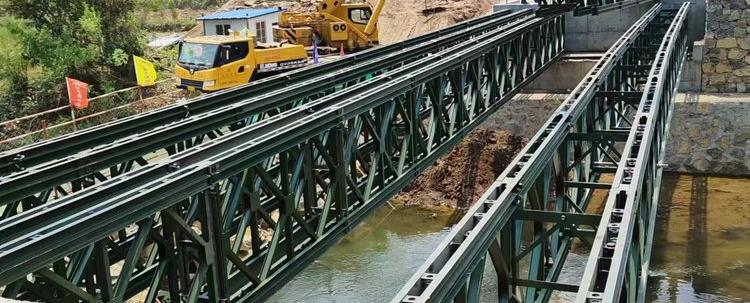
Choose Q345 steel when your project requires a proven, cost-effective, fabrication-friendly solution for standard modular steel bridges, emergency bridges, medium-load crossings, and general infrastructure applications.
Choose Q420 steel when the bridge has strength-governed primary members, heavy loading, long spans, challenging logistics, strict module-weight limits, or a clear business case for reducing steel tonnage.
The strongest solution is rarely "use the highest-strength steel everywhere." It is a verified bridge design that selects the right material grade, thickness, toughness level, welding procedure, corrosion-protection system, and installation method for the actual project conditions.
At Evercross Bridge, our engineers can evaluate your span, design load, site environment, transport restrictions, and installation requirements to recommend an optimized prefabricated steel bridge solution—from design and fabrication to shipment and onsite assembly.
Contact Evercross Bridge today to request a technical consultation, preliminary bridge concept, steel-grade recommendation, and project-specific quotation.
No. Q420 has higher nominal yield strength, but a bridge may be controlled by deflection, buckling, fatigue, connection capacity, or construction requirements. Q420 is best where its higher strength produces a measurable structural, logistics, or cost benefit.
Potentially, yes. Q420 can reduce member area or plate thickness in components controlled by material strength. However, the actual weight saving may be limited when stiffness, buckling, fatigue, connection design, or minimum thickness governs.
Q345 remains widely referenced in existing documents and many market discussions. However, newer Chinese standards have moved toward Q355 terminology in many applications. Buyers should follow the contract specification and verify the applicable standard before procurement.
Both can be welded when proper procedures are used. Q345 is generally considered more straightforward for routine fabricated structures. Q420 may require more rigorous control of welding parameters, preheat, consumables, hydrogen management, and inspection—especially for thicker material and critical welded details.
Not automatically. Fatigue performance depends heavily on stress range, welded-detail geometry, surface condition, residual stress, load cycles, and inspection quality. A higher-strength steel grade should not replace fatigue-detail design and quality control.
Request mill test certificates, material traceability records, grade/thickness schedules, welding procedure specifications, welder qualifications, non-destructive testing reports, coating inspection reports, dimensional inspection records, trial-assembly documentation, and shipping packing lists.
Yes, if the structural design, material schedule, welding procedures, identification system, and quality documentation clearly define where each grade is used. A mixed-grade design can be an efficient option when higher strength is needed only in selected primary members.
1. Federal Highway Administration (FHWA). "Prefabricated Bridge Elements and Systems (PBES)." [FHWA PBES page]
2. SteelConstruction.info. "Structural Steel for Bridges: Material Selection and Product Specification." [SteelConstruction.info bridge steel guidance]
3. World Material. "Q345 Steel: Q345A, Q345B, Q345C, Q345D, Q345E Equivalent & Properties." [Q345 material properties]
4. World Material. "Q420 Steel Chemical Composition, Properties, Specifications." [Q420 material properties]
5. European Commission Joint Research Centre. "Eurocode 3: Design of Steel Structures—Bridges." [Eurocode bridge design material]
6. British Standards Institution / EN 1993-1-10. "Eurocode 3: Design of Steel Structures—Material Toughness and Through-Thickness Properties." [EN 1993-1-10 overview]
7. GB/T 1591-2018 reference material. Notes the transition from Q345 to Q355 terminology in the updated high-strength low-alloy structural-steel standard. [GB/T 1591-2018 reference]


