

Views: 221 Author: Site Editor Publish Time: 2026-03-03 Origin: Site


Content Menu
● The Backbone of Modern Modular Infrastructure
● Decoding the Core: The Bailey Truss vs. The Bailey Bridge
>> The Bailey Truss: The "Cell" of the Structure
>> The Bailey Bridge: The "Organism"
● Technical Evolution: Comparing 321-Type and HD200 Systems
● The Anatomy of Strength: Critical Structural Components
● Manufacturing Excellence at EVERCROSS BRIDGE
>> The Power of Hot-Dip Galvanization (HDG)
● Engineering Best Practices: The Cantilever Launch Method
>> Detailed Step-by-Step Execution
● Bridging Global Standards: International Compliance
● Evercross Bridge's Project Experience
● Maintenance and Safety: Extending the Lifecycle
● The Future of Modular Bridging
● Frequently Asked and Questions regarding Bailey Truss and The Bailey Bridge
>> 1. What is the fundamental difference between a Bailey truss and a Bailey bridge?
>> 2. How do I choose between the 321-Type and the HD200-Type system?
>> 3. Can a Bailey bridge be installed without heavy cranes?
>> 4. Is a Bailey bridge considered a temporary or permanent solution?
>> 5. Does your Bailey bridge equipment comply with international load standards?
In the complex world of global civil engineering, few innovations have demonstrated the staying power and versatility of the Bailey bridge system. Originally conceived during World War II by Sir Donald Bailey, this modular solution revolutionized military logistics by allowing rapid assembly of heavy-duty crossings. Today, that legacy has evolved into a cornerstone of civilian infrastructure. At EVERCROSS BRIDGE, standing as a top-three professional manufacturer in China with an annual output exceeding 10,000 tons, we have refined this wartime invention into a high-precision industrial product.
The modern infrastructure landscape demands speed without compromising safety. Whether it is providing a lifeline after a natural disaster or supporting massive equipment transport for a hydroelectric dam, the Bailey truss remains the fundamental unit of progress. Having collaborated extensively with China’s "Big Five" state-owned enterprises—including CCCC (China Communications Construction Company), CREC (China Railway Group), PowerChina, Gezhouba Group, and CNOOC—we have seen these systems deployed across some of the most challenging terrains on Earth.
To the untrained eye, the terms "Bailey truss" and "Bailey bridge" might seem interchangeable. However, in the realm of structural engineering, they represent two distinct levels of assembly. Understanding this distinction is the first step in mastering modular bridge design.
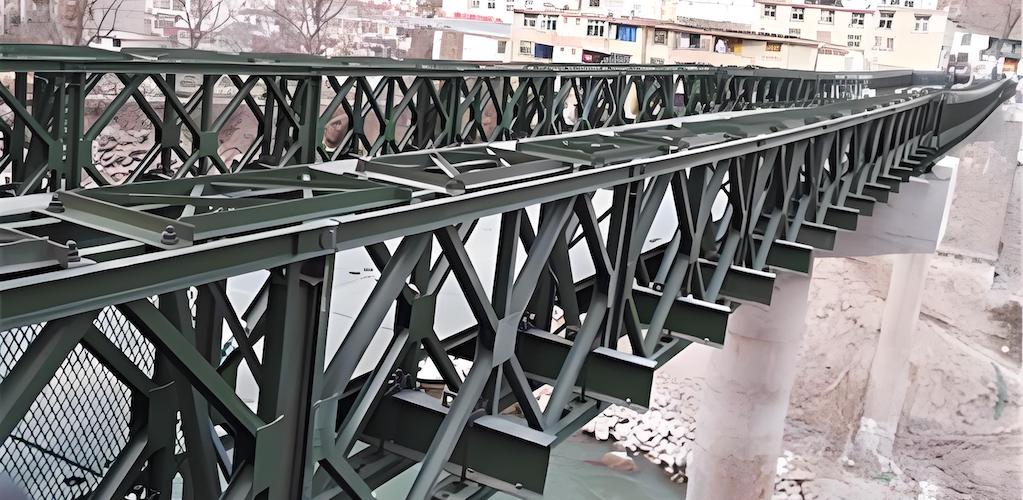
The Bailey truss, often referred to in the industry as a Bailey panel, is the basic modular unit. It is a rectangular steel frame, typically 3 meters long and 1.5 meters high (in the standard 321-type system). The truss is designed using a triangular web system—the most stable geometric shape—consisting of upper and lower chords connected by vertical and diagonal members.
●Structural Composition: These panels are fabricated from high-tensile steel, designed to be light enough for manual handling by a small squad of workers yet strong enough to support dozens of tons once integrated.
●Versatility Beyond Bridges: While bridges are their primary use, the modularity of the truss allows it to be used as a standalone structural element. Engineers use Bailey trusses for temporary piers, heavy-duty scaffolding, overhead gantry cranes, and even as reinforcement frames for tunnel construction.
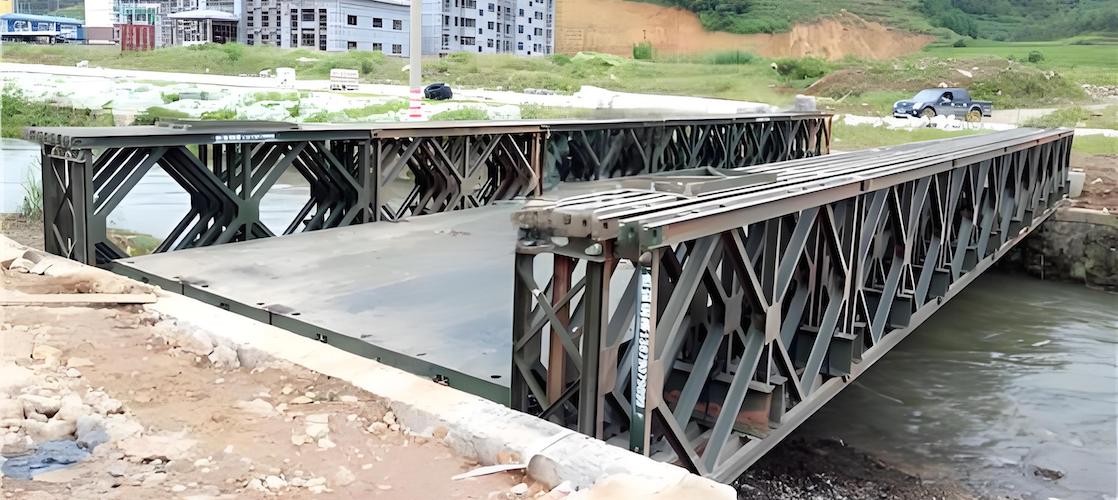
A Bailey bridge is the complete, functional structure formed by connecting multiple trusses. The beauty of this system lies in its scalability. To cross a wider gap, you add more trusses longitudinally. To carry a heavier load (such as a 60-ton tank or a multi-axle freight truck), you add rows of trusses side-by-side (Single-Single, Double-Single, or Triple-Single configurations) or even stack them vertically (Double-Double or Triple-Double).
●The Synergy: The connection between the two is symbiotic. A truss is a component; a bridge is the application. The strength of the bridge is determined by how these "cells" are arranged and fastened.
As engineering requirements have grown, the original Bailey design has branched into two primary standards: the 321-type (Compact 100) and the HD200 (Compact 200). Choosing between them is a matter of balancing span, load capacity, and budget.
Feature | 321-Type (Compact 100) | HD200-Type (Compact 200) |
Panel Dimensions | 3.0m x 1.5m | 3.048m x 2.134m |
Material Strength | Standard High-Tensile Steel | Enhanced Q355B or Higher |
Maximum Span | Efficient up to 45 Meters | Efficient up to 60+ Meters |
Connection Method | Simple Pin Connection | Reinforced Pin and Bolt Systems |
Primary Advantage | High Portability, Manual Assembly | Fewer Components, Higher Load |
Joint Design | High-density joints | Reduced joint frequency, lower deflection |
In modern highway construction, the HD200 system is increasingly preferred. Because the panels are taller (2.134m vs 1.5m), the "moment of inertia" is significantly higher. This means the bridge is stiffer and experiences less "sag" or deflection over long spans. For a project managed by CREC involving a 40-meter span, switching from a 321 reinforced design to an HD200 design can reduce the total steel weight by up to 15%, leading to significant savings in logistics and installation time.
A Bailey bridge is a symphony of parts working in tension and compression. Beyond the trusses, several critical components ensure the bridge doesn't just stand, but stays stable under dynamic loads.
●Transoms (Beams): These are the horizontal members that sit on the bottom chords of the trusses. They bridge the gap between the left and right truss walls and support the entire weight of the traffic.
●Sway Bracing: Without lateral bracing, a bridge is susceptible to "snaking" or buckling sideways. Sway braces are diagonal rods that lock the structure into a rigid rectangle.
●Rakers: These are small diagonal members that connect the truss to the transom, ensuring the vertical walls remain perfectly upright and do not tilt under heavy loads.
●The Connecting Pin: Perhaps the most vital small part. These are high-precision, heat-treated steel pins that lock trusses together. At EVERCROSS BRIDGE, our pins undergo 100% ultrasonic testing to ensure no internal fissures exist.
●End Posts: These are the "feet" of the bridge. They transition the load from the trusses down into the bearings and eventually into the ground or abutments.
Production at scale requires more than just a factory; it requires a deep commitment to metallurgical science and precision engineering. As a provider to PowerChina and Gezhouba Group, our manufacturing process is designed to withstand the most extreme environmental conditions.
The integrity of a Bailey truss depends entirely on its weld joints. We utilize Automatic Submerged Arc Welding (ASAW) and CO2 Shielded Welding to ensure deep penetration and zero porosity. Every batch of trusses undergoes rigorous X-ray or magnetic particle inspection to detect any structural anomalies.
Many domestic manufacturers use simple paint or spray coatings. However, for international procurement projects—especially those in coastal regions or tropical rainforests—we mandate Hot-Dip Galvanization.
●The Process: The entire steel truss is submerged in a bath of molten zinc at 450°C.
●The Result: The zinc reacts with the steel to form a series of zinc-iron alloy layers. This provides a "sacrificial" barrier that prevents rust for over 50 years, even if the surface is scratched during assembly.
We source our steel exclusively from top-tier Chinese mills like Baosteel or Ansteel. By using Q355B low-alloy high-strength steel, we ensure our trusses have a yield strength that exceeds 345 MPa, providing a safety factor that is well above industry averages.
One of the greatest advantages of the Bailey system is that it can be built on one side of a river and "pushed" across to the other side without any support in the middle. This is known as the Cantilever Launch.
●The Launching Nose: Before the actual bridge is built, a "nose" is constructed. This is a lightweight version of the bridge (usually just a single row of trusses) that is angled slightly upward.
●Roller Stations: Rocking rollers are placed on the "home" bank. These rollers allow the bridge to slide forward while distributing the weight to the ground.
●The Push: Using a winch, a bulldozer, or even manual labor for smaller spans, the bridge is pushed toward the "far" bank.
●Equilibrium Management: As more sections are added to the back of the bridge, the center of gravity stays behind the rollers. This prevents the bridge from tipping into the river.
●The Landing: Once the launching nose reaches the rollers on the far bank, it is dismantled, and the main bridge is lowered onto its permanent bearings using hydraulic jacks.
●Inadequate Counterweight: If the tail of the bridge isn't heavy enough, the nose will dip too far, missing the far-side rollers.
●Improper Leveling: If the rollers on both sides aren't perfectly aligned, the bridge can "track" to the left or right, putting immense stress on the sway braces.
When working with CNOOC or international government tenders, compliance with local engineering codes is non-negotiable. EVERCROSS BRIDGE products are designed to be "polyglot"—able to speak the language of any engineering standard.
●AASHTO (USA): We design for HS20 and HS25 loading patterns, common in American-led infrastructure projects.
●Eurocodes (EU): Our designs adhere to EN 1993 (Design of Steel Structures), ensuring safety and reliability across Europe and many African nations.
●British Standards (BS 5400): Still the gold standard for many Commonwealth countries, we provide full certification for these requirements.
●Chinese GB Standard (JT/T 728): The specific code for prefabricated highway steel bridges, which is often the baseline for our domestic SOE partners.
By maintaining these certifications, we enable our clients to pass local inspections and audits with ease, reducing the risk of project delays.
Evercross Bridge's prefabricated highway steel bridges, Bailey bridges, and Bailey beams enjoy a good reputation both domestically and internationally, and are exported to dozens of countries. The following are examples of some collaborative projects that have received consistent praise from our clients:
● New 40-Meter Bailey Bridge Revolutionizes Travel in Rural Ethiopia
● 64-Meter D Type Single-Span Modular Steel Bridge Project in Somalia
● 4 Sets LSB (Logistics Support Bridge) to the Ministry of Defence of Malaysia
● 45 sets of Compact-200 and 100 Bailey bridges to the Myanmar Railway Ministry
● 23 sets of Compact-200 Bailey bridges to the Ecuador Highway Department
While often categorized as "temporary," many Bailey bridges remain in place for decades. To ensure they remain safe for public or industrial use, a dedicated maintenance schedule is required.
●Monthly: Inspect the transom clamps. These can vibrate loose under constant traffic. Ensure they are tightened to the specified torque.
●Quarterly: Check for "ovalling" of the pin holes. If a hole is stretched, it indicates the bridge is being overloaded or the steel is fatiguing.
●Annually: For painted bridges, check for "edge rust" where the truss members meet. For galvanized bridges, inspect for any mechanical damage to the zinc layer.
●Post-Flood: If the bridge is in a flood-prone area, inspect the bearings and abutments for scour (erosion of the soil) which can cause the bridge to shift.
As a professional steel bridge manufacturer, we believe that the "users" of bridges are not only those who drive across them, but also the engineers who design them and the contractors who build them. We recommend optimizing the "user experience" in the following ways:
●Precise Marking: We recommend color-coding and numbering each delivered component to ensure accurate assembly.
●Digital Twin: Provide 3D CAD models for all bridges, enabling engineers to directly import designs into their project software.
●On-site Supervision: For complex bridge construction, it is necessary to send technical experts to the site to ensure the safe erection of cantilever beams.
The relationship between the Bailey truss and the Bailey bridge is a testament to the power of modular design. By perfecting the "cell," we enable the creation of "organisms" that can span any gap and carry any load. At EVERCROSS BRIDGE, our 10,000-ton annual capacity isn't just a number—it represents thousands of connections made, thousands of rivers crossed, and thousands of projects brought to life in partnership with the world's leading construction firms.
Whether you are responding to an emergency, supporting a massive industrial build, or bridging a remote rural community, the Bailey system remains the most reliable, adaptable, and cost-effective solution in existence.
The Bailey truss is the individual modular component (or "panel") that serves as the building block of the system. A Bailey bridge is the complete structural assembly created by connecting these trusses together. Think of the truss as a single Lego brick and the bridge as the finished model. While the bridge is the most common application, Bailey trusses can also be used independently for other structural needs like heavy-duty shoring, towers, or gantry frames.
The choice depends primarily on your span length and load requirements:
●Choose 321-Type (Compact 100): If you require maximum portability, manual assembly in remote areas, and spans generally under 45 meters for standard loads.
●Choose HD200-Type (Compact 200): For spans exceeding 45 meters or for projects requiring higher stiffness and lower deflection. The HD200 uses taller panels, which significantly increases the bridge's load-bearing efficiency and reduces the total amount of steel needed for long-distance crossings.
Yes, one of the primary advantages of the Bailey system is the Cantilever Launch method. This technique allows the bridge to be assembled on one side of a gap on rollers and then pushed across to the other side using a "launching nose." While a crane can speed up the assembly of individual panels on the bank, the actual "bridging" of the gap does not strictly require heavy lifting equipment over the water or chasm, making it ideal for emergency and remote site applications.
While originally designed for temporary military use, modern engineering and manufacturing have made them suitable for both.
●Temporary Use: Ideal for construction detours, disaster relief, or seasonal crossings.
●Permanent Use: When treated with Hot-Dip Galvanization, a Bailey bridge can have a service life exceeding 50 years. Many rural and industrial areas use Bailey bridges as permanent infrastructure because they are easier to maintain and faster to replace than traditional concrete structures.
Absolutely. As a leading global manufacturer, EVERCROSS BRIDGE designs and tests its components to meet and exceed international standards, including:
●AASHTO HS20/HS25 (United States)
●Eurocode 3 & 4 (Europe)
●British Standard HA/HB (United Kingdom/Commonwealth)
●JT/T 728 (China) We provide full technical documentation and load-calculation reports to ensure your project meets all local safety and regulatory requirements.


