

Views: 223 Author: Evercross Bridge Publish Time: 2026-11-27 Origin: Evercross Bridge


Content Menu
● Ecuador's El Niño Flood Crisis: Why Emergency Bailey Bridges Matter
● Why Do Bridges Fail During Severe Flooding?
>> Foundation and Abutment Scour
>> Floating Debris and Hydraulic Pressure
>> Changing Riverbed Conditions
● Why Bailey Modular Bridges Are Effective Emergency Crossing Solutions
>> Modular Components Enable Faster Assembly
>> Launching Technology Reduces River Construction Work
>> Flexible Configurations Accommodate Different Spans and Loads
>> Protective Coatings Improve Long-Term Durability
>> Reusability Creates Long-Term Infrastructure Value
● EVERCROSS Bailey Bridge Engineering Capabilities and Ecuador Project Experience
>> Ecuador HD200 Bailey Bridge Project
>> Manufacturing Quality and Project Support
● How to Specify a Bailey Bridge for Emergency Procurement
>> Structural Design and Load Requirements
>> Foundation and Hydraulic Assessment
>> Manufacturing and Quality Documentation
>> Transportation and Packaging
>> Installation Training and Technical Supervision
>> Post-Installation Inspection and Maintenance
● Why Choose an Experienced Bailey Bridge Manufacturer?
● Restore Connectivity with a Reliable Bailey Bridge Solution
● Frequently Asked Questions About Bailey Bridges
>> Q1. How quickly can a Bailey bridge be installed after a flood?
>> Q2. What load capacity can an emergency Bailey bridge support?
>> Q3. Can a Bailey bridge be installed without large cranes?
>> Q4. Can Bailey bridges withstand tropical rainfall and flooding?
>> Q5. Can a temporary Bailey bridge be reused after permanent reconstruction?
>> Q6. What information is required to obtain a Bailey bridge quotation?
When a flood washes away a bridge, restoring road connectivity becomes an immediate engineering and public safety priority. Hospitals, agricultural communities, construction sites and supply chains can all become isolated. In these situations, Bailey bridges provide a practical way to restore crossings without waiting for conventional bridge reconstruction to be completed.
Ecuador's 2026 El Niño-related rainfall events demonstrate the scale of this challenge.
On August 29, 2026, Ecuador's National Secretariat for Risk Management (SNGR) declared a nationwide red alert through Resolution SNGR-238-2026. According to its Situation Report No. 110, covering August 29 to November 26, rainfall had resulted in:
-2,131 adverse events across 24 provinces.
-122,790 people impacted.
-30,505 homes affected.
-53.66 km of roads affected.
-50 bridges damaged and 11 bridges destroyed.
These figures demonstrate how quickly extreme rainfall can disrupt essential transport infrastructure.
The Ecuadorian Ministry of Infrastructure and Technology (MIT) has also allocated approximately USD 40 million to emergency road infrastructure and response capabilities. Of this amount, USD 8.89 million was allocated to the procurement of 32 temporary Bailey bridges.
This investment highlights an important infrastructure priority: road authorities need bridge systems that can be transported, assembled and commissioned efficiently when existing crossings become unusable.
According to INAMHI's November 2026 climate outlook, rainfall conditions vary geographically, with the coastal region entering its climatologically wetter period towards January 2027. This makes continued infrastructure monitoring and advance emergency preparation particularly important.
From an engineering perspective, a bridge failure during a flood is not necessarily caused by insufficient strength in the steel superstructure.
In many cases, the actual failure begins beneath or around the bridge, where water flow changes the stability of the foundations and surrounding ground.
Four mechanisms deserve particular attention.
High-velocity water removes sediment around bridge foundations. This process, known as scour, can expose piles, undermine shallow foundations and reduce the supporting capacity of bridge abutments.
The problem becomes more serious when river channels change direction or carry unusually high sediment loads.
A bridge may remain structurally intact while the road leading to it is washed away.
Floodwater can erode embankments, damage retaining structures and create deep channels behind the abutments. Consequently, the crossing becomes unusable even when its main steel structure survives.
Floodwaters frequently carry tree trunks, branches and other debris.
These materials can accumulate against bridge trusses, increasing hydraulic resistance and imposing additional forces on structural members. Lateral water pressure can also affect bearings and substructures.
A temporary bridge must be designed for the actual river environment, not simply the original bridge dimensions.
Engineers need to evaluate:
-Design flood levels and expected water velocities.
-River width and potential channel migration.
-Scour depth and foundation conditions.
-Debris accumulation and impact risks.
-Bank stability and approach road conditions.
The Federal Highway Administration (FHWA) identifies scour assessment and foundation stability as essential considerations in bridge hydraulic engineering.
The engineering lesson is straightforward: a fast bridge installation is only successful when the foundations and hydraulic conditions are properly assessed.
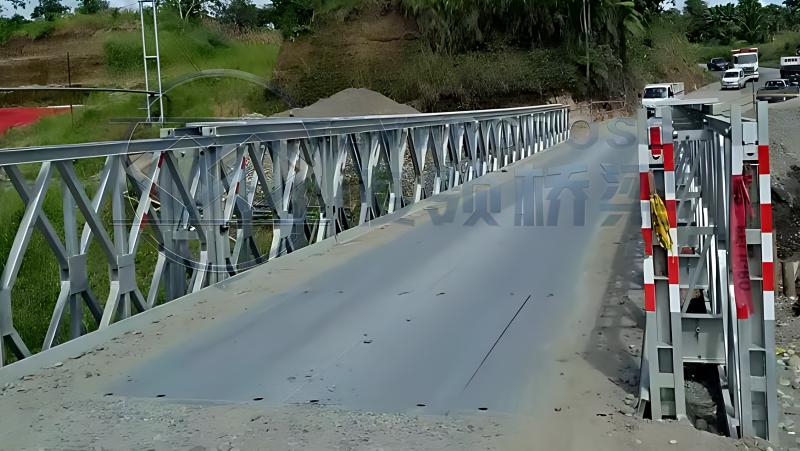
A Bailey bridge is a prefabricated modular steel truss bridge assembled from standardized structural components.
Its design allows bridge sections to be transported separately and connected at the construction site.
For emergency infrastructure projects, this offers several practical advantages.
Traditional bridge construction often involves extensive on-site fabrication, welding and concrete work.
A Bailey modular bridge uses prefabricated panels, transoms, stringers, bracing members, bolts and connecting pins.
This approach offers:
-Reduced dependence on extensive on-site welding.
-More predictable assembly procedures.
-Easier transportation in separate components.
-Greater flexibility in bridge length and structural configuration.
-Opportunities for local workforce training.
Because the main structural components are manufactured in advance, site preparation and component production can proceed simultaneously.
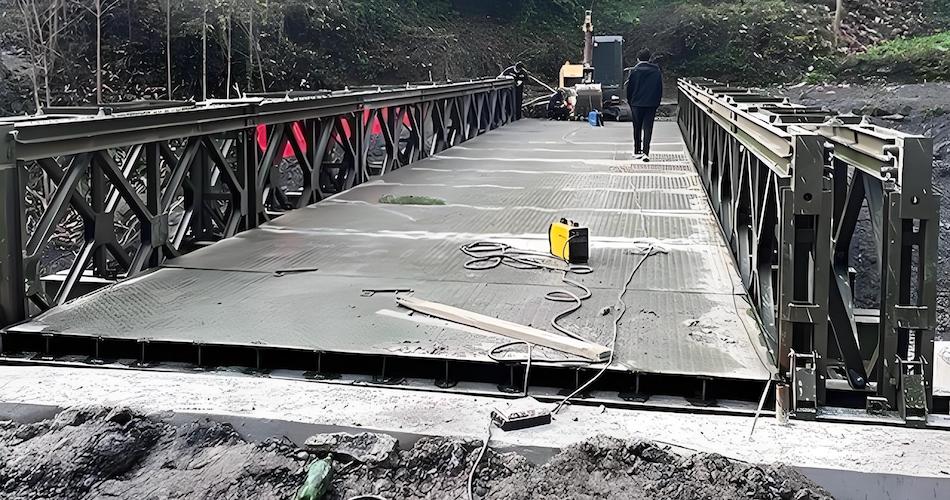
One of the most useful installation techniques is incremental launching with a launching nose.
Instead of lifting the entire bridge into position with large cranes, the assembled truss is gradually pushed or pulled across the river from one bank.
The general procedure is:
1.Prepare and inspect the supporting abutments.
2.Assemble the bridge truss and launching nose on the near bank.
3.Install launching rollers and temporary supports.
4.Advance the structure progressively across the river.
5.Land the leading end on the opposite bank.
6.Remove temporary launching equipment and complete the deck.
This technique can reduce the need for intermediate river piers and extensive heavy lifting equipment. However, launching forces, temporary structural stability, bearing conditions and site geometry must be checked before construction.
Bailey bridges can be configured using different combinations of truss rows and structural levels.
Configuration | Typical application |
Single-single | Shorter spans and lighter loading requirements |
Double-single | Increased structural capacity |
Triple-single | Higher load requirements |
Double-double | Longer spans and heavier loading |
Reinforced configurations | Project-specific span and loading conditions |
The final configuration must be established through structural calculations.
For highway applications, engineers may design against appropriate loading standards, including AASHTO HL-93, where required by the project specification.
Other important design considerations include:
-Bending and shear resistance.
-Vertical and lateral deflection.
-Fatigue performance.
-Connection strength.
-Dynamic vehicle loading.
-Wind and braking forces.
A longer span does not automatically mean a higher load capacity. Span, bridge width, structural configuration and vehicle loading must be evaluated together.
Flood-prone environments expose steel bridges to moisture, sediment, oxygen and potentially corrosive substances.
Hot-dip galvanizing provides a protective zinc coating that helps reduce steel corrosion.
For fabricated steel components, ISO 1461:2022 specifies coating properties and testing requirements for hot-dip galvanized coatings.
For bridges operating in tropical regions, appropriate surface protection, drainage, inspection and maintenance are all important to long-term performance.
Unlike many temporary construction solutions, a modular Bailey bridge can be dismantled after permanent infrastructure has been restored.
Its components can then be:
-Inspected and maintained.
-Repackaged for transportation.
-Stored as emergency bridge inventory.
-Reassembled at another suitable crossing.
This makes a Bailey bridge more than a temporary replacement structure. It can become a reusable emergency infrastructure asset for regional road authorities.
At EVERCROSS Bridge, we believe that successful emergency bridge solutions require more than supplying steel components.
They require coordinated engineering, manufacturing, transportation, installation and technical support.
With more than 30 years of industry experience, EVERCROSS specializes in Bailey bridges, modular steel bridges and emergency bridge systems.
Our manufacturing and engineering capabilities include:
-47,000 m² of factory land.
-22,000 m² of production workshops.
-100-tonne lifting capacity.
-30,000 tonnes of annual production capacity.
-Delivery experience in more than 50 countries.
-More than 200 large-scale government infrastructure projects.
Our D-type modular bridge systems have achieved single-span lengths of up to 91 metres in load-tested configurations, subject to the applicable structural design and project conditions.
Our experience in Ecuador includes a project delivered and commissioned in November 2018.
The project involved an HD200 Bailey bridge with the following specifications:
Project parameter | Specification |
Bridge type | HD200 Bailey bridge |
Single clear span | 33.528 m |
Carriageway width | 4.2 m |
Traffic arrangement | Single lane |
Design loading | AASHTO HL-93 |
Delivery year | 2018 |
The bridge was designed to meet the project's specified highway loading requirements.
This project demonstrates our experience in supplying modular bridge solutions for South American infrastructure conditions.
EVERCROSS combines engineering design with steel fabrication, quality inspection and international project delivery.
Our company holds ISO9001, ISO14001 and ISO45001 management system certifications, alongside relevant steel structure manufacturing qualifications and other market-specific certifications.
Our production capabilities support customized bridge engineering for:
-Emergency road restoration.
-Government infrastructure projects.
-Rural and regional road connections.
-Temporary construction access.
-Permanent modular steel bridge applications.
We also provide technical documentation, installation guidance and project-specific support to help customers coordinate local construction teams.
For government authorities and infrastructure contractors, selecting an emergency Bailey bridge should involve more than comparing steel prices or nominal bridge spans.
The most important procurement decision is whether the supplier can provide a complete, engineered bridge solution.
Based on our project experience, we recommend evaluating the following six areas.
Before requesting quotations, define:
-Required clear span and total bridge length.
-Roadway width and traffic arrangement.
-Maximum vehicle weight and axle loads.
-Applicable design codes, such as AASHTO LRFD.
-Required pedestrian walkways and safety barriers.
Where emergency vehicles, loaded trucks or construction machinery must cross, the design should reflect the actual vehicle combinations rather than a generic load rating.
The procurement specification should include a site assessment covering:
-Geotechnical conditions.
-Design flood level.
-Expected river velocity.
-Scour depth.
-Abutment stability.
-Debris impact exposure.
A modular superstructure cannot compensate for an inadequately designed foundation.
Request the following documentation from the manufacturer:
Document | Purpose |
Structural calculation report | Verify design capacity |
General arrangement drawings | Confirm geometry and layout |
Material certificates | Verify material specifications |
Welding and fabrication records | Confirm manufacturing quality |
Bolt and pin schedules | Support correct assembly |
Galvanizing inspection records | Verify corrosion protection |
Inspection and test reports | Establish product conformity |
Emergency bridge components may need to reach remote locations where road access is already restricted.
Container-compatible packaging can simplify international shipping and inland transportation.
Procurement teams should confirm:
-Component dimensions and shipping weights.
-Container loading arrangements.
-Packing lists and identification markings.
-Port handling requirements.
-Inland transportation restrictions.
-Availability of replacement components.
Even a well-designed modular bridge can experience installation problems if the assembly sequence is not followed correctly.
A complete supply package should consider:
1.Foundation acceptance and bearing preparation.
2.Component identification and inspection.
3.Truss assembly and connection checks.
4.Launching procedure and temporary stability.
5.Deck installation and safety barrier completion.
6.Final inspection and commissioning.
Local workforce training is particularly valuable for countries maintaining emergency bridge inventories, because it enables authorities to deploy and reuse components with less dependence on external technical teams.
Bridge commissioning should include the inspections and load verification required by the approved project plan.
During service, maintenance teams should regularly check:
-Bolts, pins and connection integrity.
-Deck condition and drainage.
-Galvanized coating damage.
-Bearing movement.
-Abutment settlement.
-Riverbed scour and approach erosion.
These measures help protect the bridge throughout its operating life.
An emergency bridge project involves several interconnected stages. A supplier that only manufactures steel components may leave important responsibilities to the buyer.
An experienced manufacturer should be able to coordinate:
1. Engineering Design
Span selection, load calculations, structural configuration and project drawings.
2. Manufacturing
Steel fabrication, component assembly, dimensional inspection and surface protection.
3. Transportation
Component identification, export packaging and international logistics coordination.
4. Installation Support
Assembly guidance, launching methods, technical supervision and local crew training.
5. Commissioning
Final inspection, required testing, documentation and handover.
At EVERCROSS Bridge, we provide integrated support throughout these stages, helping government departments, contractors and infrastructure developers implement suitable prefabricated steel bridge solutions.
Our objective is not simply to deliver a bridge. It is to help customers restore connectivity through a technically appropriate and operationally practical solution.
Flood damage can interrupt transportation in a matter of hours, but rebuilding conventional infrastructure can take months.
Bailey modular bridges offer a proven engineering approach to restoring essential road connections, combining prefabricated steel components, flexible structural configurations, incremental launching and component reusability.
For Ecuador and other flood-prone regions, advance preparation is especially important. Having suitable bridge designs, manufacturing capacity, transportation arrangements and installation procedures ready before an emergency can significantly improve response coordination.
With more than 30 years of industry experience, a 47,000 m² manufacturing facility and international project delivery capabilities, EVERCROSS Bridge is committed to providing dependable modular steel bridge solutions worldwide.
Planning an emergency bridge project or looking for a Bailey bridge manufacturer in China?
Contact EVERCROSS Bridge with your required span, roadway width, design load and project location. Our engineering team can help evaluate the appropriate bridge configuration and provide a project-specific proposal covering design, manufacturing, transportation and installation support.
Installation time depends on bridge span, structural configuration, site accessibility, foundation readiness and weather conditions. Component manufacturing and foundation preparation can proceed in parallel. A suitable single-span bridge may be assembled and launched within several days after components arrive, but an exact schedule requires a project-specific construction plan.
Bailey bridge load capacity depends on span length, truss arrangement, reinforcement and design specifications. Bridges can be engineered for different highway loading requirements, including AASHTO HL-93 where applicable. Heavy vehicle requirements must be verified through structural calculations.
Many Bailey bridges can be assembled using manual tools and suitable small lifting equipment. Incremental launching with a launching nose can reduce the need for large cranes at the river crossing. However, lifting and launching equipment requirements depend on bridge configuration and site conditions.
Bailey bridges can be designed for use in tropical environments. Hot-dip galvanized steel provides corrosion protection, while hydraulic assessment and appropriate foundation design address flood-related risks. No bridge should be considered flood-proof without evaluating its specific site conditions.
Yes. One of the major advantages of modular Bailey bridges is their reusable construction. After the temporary crossing is no longer needed, components can be dismantled, inspected, maintained and transported to another suitable location.
A manufacturer normally needs the following information:
-Required bridge span and overall length.
-Clear roadway width.
-Design vehicle and loading standard.
-Bridge configuration and intended use.
-Project location and environmental conditions.
-Expected delivery schedule.
-Required design, inspection and installation services.
Providing these details helps the engineering team recommend a more accurate and cost-effective solution.
1. Ecuador National Secretariat for Risk Management (SNGR) — National Situation Report No. 110: Rainfall and El Niño Impacts, November 26, 2026.
2. Ecuador Ministry of Infrastructure and Technology (MIT) — USD 40 Million Investment in Emergency Road Infrastructure.
3. INAMHI — Climate Forecast: November 2026 – January 2027.
4. Federal Highway Administration (FHWA) — Bridge Scour: Engineering Guidance and Technical Resources.
5. Federal Highway Administration (FHWA) — Evaluating Scour at Bridges.
6. International Organization for Standardization (ISO) — ISO 1461:2022 – Hot Dip Galvanized Coatings.
7. U.S. Department of the Army — Bailey Bridge Construction Manual, FM 5-277.


