

Views: 221 Author: Evercross Bridge Publish Time: 2026-03-03 Origin: Evercross Bridge


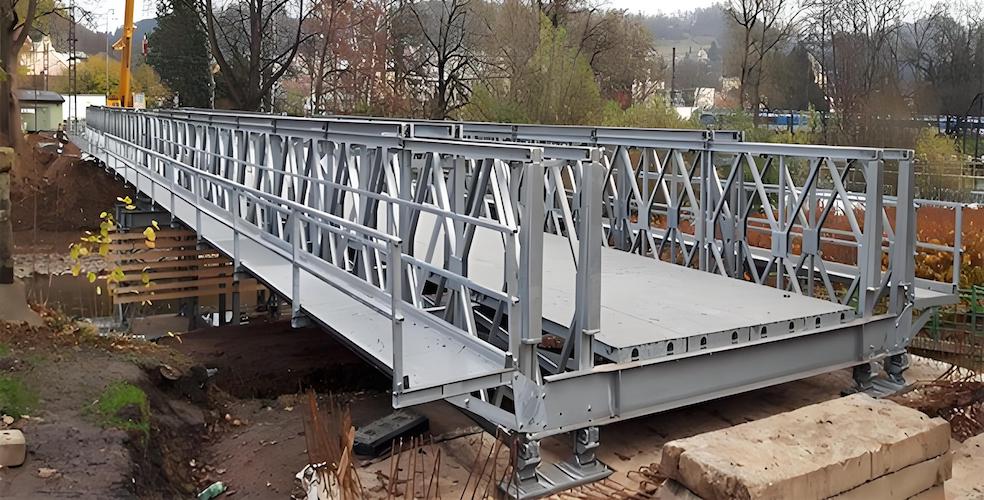
Content Menu
● The Engineering Science Behind Seismic Resilience in Modular Steel Bridges
● Advanced Seismic Isolation Systems: The "Shock Absorbers" of Infrastructure
>> 1. Lead Rubber Bearings (LRB)
>> 2. Friction Pendulum Systems (FPS)
● Structural Redundancy: A Deep Dive into Fail-Safe Modular Design
● Comparing Performance: Modular Steel vs. Traditional Concrete
● Post-Earthquake Resilience: Rapid Inspection and Recovery
● Industry Insights: Collaborating with Global Infrastructure Giants
● The Future of Seismic Design: AI and Smart Sensors
● Frequently Asked and Questions regarding Design of Modular Steel Bridges in Earthquake-prone Areas
>> 1. Why is the design of modular steel bridges preferred over concrete in earthquake zones?
>> 2. What are "sacrificial elements" in seismic bridge design?
>> 3. Can a modular bridge be used for permanent infrastructure in seismic areas?
>> 4. How long does it take to repair a modular bridge after a major earthquake?
>> 5. Does EVERCROSS BRIDGE provide customized seismic solutions?
In the realm of global infrastructure, the design of modular steel bridges in earthquake-prone areas has evolved from a secondary consideration to a primary engineering mandate. As seismic activity increases in frequency and intensity, the demand for resilient, rapidly deployable, and high-strength bridging solutions is at an all-time high.
EVERCROSS BRIDGE, a top-tier Chinese manufacturer with an annual production capacity exceeding 10,000 tons, stands at the forefront of this technological shift. By leveraging strategic partnerships with industry giants like CCCC (China Communications Construction Company), CREC (China Railway Group), and PowerChina, we have pioneered modular designs that do more than just span gaps—they survive catastrophes. This article explores the sophisticated engineering strategies that allow modern modular steel bridges to withstand the most violent seismic forces.
The fundamental challenge of seismic design is not "fighting" the earthquake, but managing the energy it releases. Unlike rigid concrete structures that often fail under the shear stress of lateral ground motion, the design of modular steel bridges in earthquake-prone areas prioritizes ductility and plasticity.
●Superior Strength-to-Weight Ratio: Steel is significantly lighter than reinforced concrete for the same load-bearing capacity. A lighter superstructure reduces the inertial forces generated during an earthquake, effectively lowering the seismic demand on the bridge's foundations and piers.
●Energy Dissipation through Ductility: Structural steel can undergo significant deformation before failure. In modular designs, specific components—often called "sacrificial elements"—are engineered to bend and absorb energy, protecting the primary structural skeleton from terminal damage.
●Controlled Fragmentation: Because these bridges are modular, the connections between segments act as natural "fuses." These joints can be designed to allow slight, controlled movements that prevent the entire structure from reaching a breaking point.
A critical component in the design of modular steel bridges in earthquake-prone areas is the integration of base isolation and damping technologies. These systems decouple the bridge deck from the ground, allowing the earth to move beneath the structure with minimal energy transfer to the deck.
Modern modular bridges often utilize Lead Rubber Bearings. These consist of alternating layers of rubber and steel plates with a central lead core. The rubber provides lateral flexibility, while the lead core dissipates energy by yielding during the earthquake.
The FPS uses the principle of a pendulum to mitigate seismic force. The bridge sits on a curved slider; during a quake, the bridge deck slides up the curved surface, converting kinetic energy into potential energy and friction, which naturally centers the bridge once the shaking stops.
Much like the shocks on a heavy-duty truck, viscous dampers use hydraulic fluid to resist motion and dissipate heat. In modular steel bridges, these are often installed at the expansion joints to prevent the segments from colliding (pounding) during extreme oscillations.
One of the most significant "information gaps" in current bridge literature is the role of structural redundancy in modular systems. At EVERCROSS BRIDGE, our engineering philosophy revolves around the "Multiple Load Path" theory.
In a traditional bridge, the failure of a single critical pier or girder can lead to a progressive collapse. However, the design of modular steel bridges in earthquake-prone areas utilizes a truss or box girder system with redundant connections. If a seismic event compromises one module or joint, the load is automatically redistributed to adjacent members.
●High-Strength Weathering Steel (Q345/Q420): We use specialized steel grades that maintain high yield strength even under the rapid-cycle loading characteristic of earthquakes.
●Precision Manufacturing: By producing components in a controlled factory environment (compliant with ISO 9001 and EN 1090), we eliminate the "human error" often found in on-site concrete casting, ensuring every bolt and weld meets 100% of the seismic design specification.
The following table highlights why global entities like CCCC and CREC increasingly prefer modular steel for high-risk zones.
Feature | Modular Steel Bridge | Traditional Concrete Bridge |
Seismic Weight | Ultra-light; lowers foundation load | Heavy; increases inertial force |
Ductility | Extremely High; "bends but doesn't break" | Brittle; prone to cracking/collapse |
Repair Speed | Days. Replace specific modules | Months. Often requires full rebuild |
Foundation Costs | Low; smaller piers required | High; requires massive piling |
Lifespan | 100+ years with galvanized coating | 50-75 years; prone to rebar corrosion |
A major innovation in 2024-2025 bridge technology is the focus on post-seismic recovery. In the wake of a disaster, infrastructure must be functional within hours for emergency services.
Traditional concrete bridges require extensive ultrasonic and X-ray testing to find internal cracks. In contrast, modular steel bridges allow for direct visual inspection of all load-carrying members.
The EVERCROSS Recovery Advantage:
●Immediate Access: Because components are bolted, not cast, engineers can check bolt torque and joint alignment immediately after the event.
●Segmental Replacement: If a module is damaged, a replacement can be trucked in from our 47,000 sqm production base and swapped out using standard cranes, restoring traffic in a fraction of the time.
●Temporary to Permanent Transition: Our modular bridges (like the 200-Type Bailey bridge) can serve as immediate emergency crossings and later be reinforced into permanent structures.
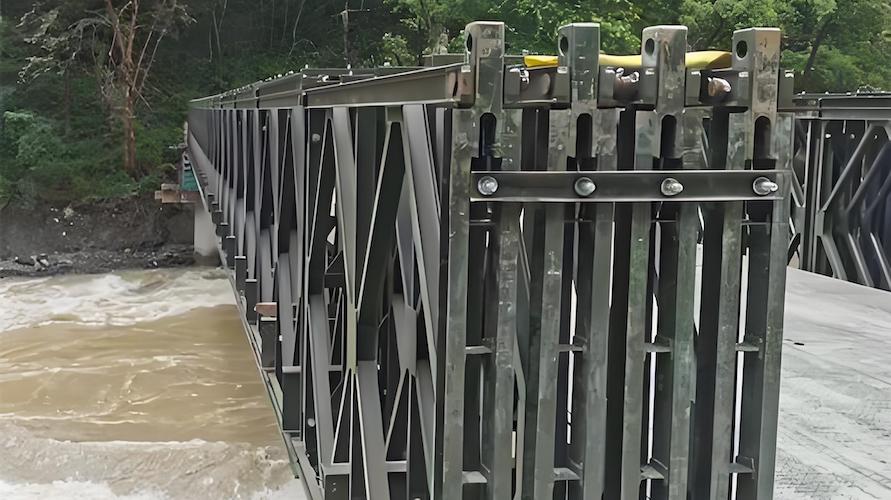
The success of EVERCROSS BRIDGE is rooted in our experience with major state-owned enterprises (SOEs). Our collaborations with China Communications Construction Company (CCCC) and China Railway Group (CREC) on projects like the Hong Kong-Zhuhai-Macao Bridge components and various high-speed rail supports have validated our seismic designs on a global scale.
In these projects, the design of modular steel bridges in earthquake-prone areas must meet rigorous international standards, including AASHTO LRFD (USA) and Eurocodes. Our ability to deliver over 10,000 tons of high-precision steel yearly ensures that even the most massive international projects remain on schedule, even in geologically unstable regions.
As we look toward 2030, the "smart bridge" is becoming a reality. Future designs of modular steel bridges in earthquake-prone areas will include:
●Embedded Strain Gauges: Sensors within the steel modules that report real-time data to a central hub during a seismic event.
●AI-Driven Predictive Maintenance: Algorithms that analyze vibration patterns to predict which modules might need adjustment before a failure occurs.
●Active Dampers: Dampers that adjust their resistance level in milliseconds based on the frequency of the incoming earthquake waves.
The transition toward modular steel bridge design represents a paradigm shift in how we approach seismic safety. By combining the inherent flexibility of steel with advanced isolation technologies and modular redundancy, engineers can now build infrastructure that is not only "earthquake-resistant" but "earthquake-resilient."
As a leader in the field, EVERCROSS BRIDGE continues to push the boundaries of what is possible, ensuring that our partners—from CCCC to international government agencies—have access to the safest, most efficient bridging solutions on the planet.
Are you planning a project in a high-seismic zone? Contact EVERCROSS BRIDGE Today for a comprehensive technical consultation and let our team of experts design your path to resilience
Modular steel bridges are lighter, reducing seismic inertial forces, and possess high ductility, which allows them to absorb and dissipate energy without catastrophic failure.
These are specific modular components designed to yield or deform first during an earthquake. By "sacrificing" these easily replaceable parts, the main structural integrity of the bridge is preserved.
Absolutely. While modular bridges are often associated with emergency use, modern engineering (like the GW-D Type) allows for permanent installations that meet the highest international seismic codes (AASHTO/Eurocode).
Because the components are standardized and bolted, a damaged module can often be replaced in a matter of days, compared to months or years for traditional concrete repair.
Yes. Leveraging our R&D center and 10,000+ ton capacity, we offer bespoke modular designs tailored to specific seismic zone requirements (Zone 1 to Zone 4) and soil conditions.


