

Views: 221 Author: Evercross Bridge Publish Time: 2026-07-08 Origin: Evercross Bridge


Content Menu
● What Is an Emergency Bridge?
● What Is a Permanent Steel Bridge?
● Tactical Speed – Why Emergency Bridges Win on Time-to-Open
>> Rapid Design and Standardization
● Long-Term Durability – The Strength of Permanent Steel Bridges
>> Material Selection and Protective Systems
>> Structural Redundancy and Fatigue Design
● Emergency Bridge vs. Permanent Steel Bridge – Key Comparison
● When Should You Choose an Emergency Bridge?
● When Should You Invest in a Permanent Steel Bridge?
● Hybrid Strategy – Converting Emergency Bridges to Permanent Assets
>> Convertible Emergency Bridges
● Practical Decision Framework for Owners and Engineers
>> Step-by-Step Selection Process
● Expert Insights from Evercross Bridge's Global Practice
>> Insight 1 – Prefabrication Is Not Just for Emergencies
>> Insight 2 – Stockpiled Emergency Modules Increase Network Resilience
>> Insight 3 – Standards and Certificates Matter
● FAQs
As a bridge owner, project consultant and long-term partner to public agencies across more than 50 countries, I have seen how the right choice between an emergency bridge and a permanent steel bridge can decide whether a corridor collapses or becomes a resilient backbone for decades. This article compares both solutions from a practical, engineering and procurement perspective, with a focus on prefabricated Bailey bridges and modular steel bridges widely deployed by Evercross Bridge in Southeast Asia, Africa and Latin America.
Emergency steel bridges and permanent steel bridges serve distinct mission profiles, even though they often share similar materials and modular technologies. Emergency bridges prioritize rapid deployment, temporary access and tactical resilience, while permanent steel bridges are engineered for service life, lifecycle cost control and long-term safety. For infrastructure decision-makers, understanding these differences is critical to avoid over‑investing in short-term fixes or under‑designing strategic corridors.
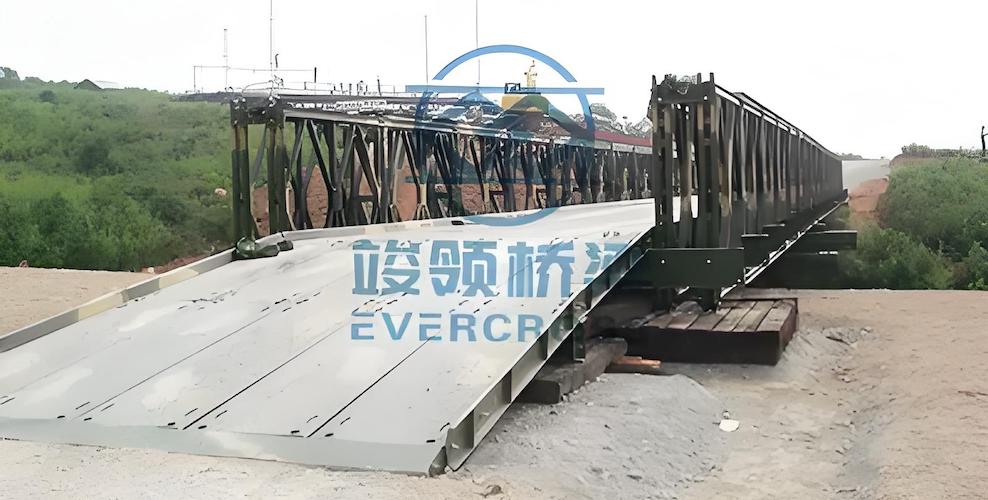
Emergency bridges are rapid-deployment structures designed to restore connectivity after disasters, washouts, war damage or major reconstruction works. Typical examples include modular Bailey bridges, HD200 series steel truss bridges, and temporary detour bridges installed beside damaged permanent structures. [dutch.steelbailey-bridge]
Key characteristics of emergency bridges:
- Fast deployment using standardized panels, crossbeams and deck units. [steelconstruct]
- Short to medium service duration, from weeks up to several years depending on design and maintenance. [steelconstruction]
- High adaptability to challenging terrain, river crossings and limited access sites. [aisc]
- Modular, reusable components, allowing relocation or reconfiguration for future emergencies. [prefabsteelbridge]
From my experience supporting governments in East Africa, an emergency Bailey bridge can move a corridor from "total disruption" to "safe, passable and controllable" in a matter of days, which is impossible for conventional cast‑in‑place structures.
Permanent steel bridges are long-term infrastructure assets designed to remain in service for decades under predictable traffic patterns and environmental conditions. Structures range from composite beam bridges and steel truss bridges to cable‑stayed and suspension bridges built to national or international bridge design codes.
Core attributes of permanent steel bridges:
- Design life typically 50–100 years, depending on standard and environment. [steelconstruction]
- Optimized for lifecycle cost, balancing capital expenditure, maintenance and eventual rehabilitation. [aisc]
- Tailored geometry, including custom spans, widths, clearances and aesthetics. [prefabsteelbridge]
- Integration with broader networks, including railways, expressways and multimodal freight corridors. [evercrossbridge]
In practice, permanent steel bridges are the anchor points of regional networks, while emergency bridges are the tactical tools that keep those networks alive during shocks or upgrades. [steelconstruction]
When a flood or landslide destroys a key bridge, time to reopen is often the most critical KPI. Prefabricated emergency bridges, especially modular Bailey bridges, are designed around tactical speed.
Because emergency bridge systems are standardized, design and checking processes are highly streamlined. Capacity, span length and configuration are defined by catalogue data and verified through proven engineering models rather than fully bespoke calculations for each project. [steelconstruct]
Emergency bridges typically feature:
- Pre-engineered panels and transoms that can be assembled with limited heavy equipment.
- Launch methods such as "cantilever launching" with temporary nose and locking devices, reducing the need for large cranes. [dutch.steelbailey-bridge]
- Hot-dip galvanized components that arrive ready for installation, with no on-site steel fabrication required. [prefabsteelbridge]
In the Tanzania HD200 Bailey bridge project, Evercross delivered multiple spans (30.48 m, 39.624 m, 42.672 m and 61 m) with professional temporary locking structures specifically developed to speed up launching while maintaining safety. This kind of system-level optimization is exactly what makes emergency bridges the first-choice solution for rapid response and rural road reopening.
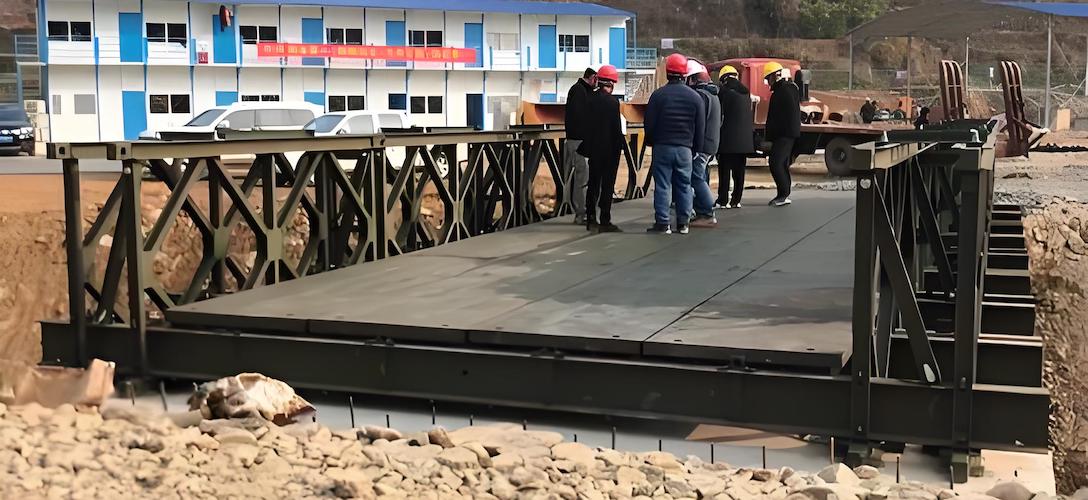
Permanent steel bridges invest heavily in durability, fatigue resistance and corrosion protection to support long service lives. While emergency bridges can be engineered for multi‑year use, permanent structures are built as strategic assets, often with higher design loads, redundancy and aesthetic requirements. [steelconstruction]
High-performance steels such as S450J0, Q355B and Q460C are widely adopted for chords, bracing, crossbeams and deck ribs in modern steel bridge design, combined with hot-dip galvanizing per ISO 1461 or advanced paint systems. The Tanzania HD200 Bailey bridges, for example, use graded steels with full hot-dip galvanizing to resist tropical heat and humidity, significantly reducing later maintenance costs and extending service life.
Permanent steel bridges are designed with:
- Higher safety factors and redundancy in truss or girder systems. [steelconstruction]
- Detailed fatigue analysis for repetitive traffic loads over decades. [steelconstruction]
- Strict compliance with national and international standards such as EN 1090 and related bridge design codes. [evercrossbridge]
The result is a robust, inspectable and maintainable asset that serves everything from rural communities to heavy freight corridors with predictable performance. [aisc]
Aspect | Emergency Bridge | Permanent Steel Bridge |
Primary mission | Rapid connectivity restoration in emergencies or during construction | Long-term network capacity and reliability |
Deployment speed | Days to a few weeks with modular systems | Months to years, including full design and construction |
Typical design life | Short to medium term; can be extended with good maintenance | 50–100 years depending on code and environment |
Structural system | Standardized modular truss (e.g., Bailey, HD200) | Custom truss, girder, arch, cable-stayed or suspension |
Cost focus | Minimize time and initial cost for connectivity | Optimize whole-life cost, including O&M |
Flexibility | High; modules can be reused or relocated | Lower mobility; fixed asset with tailored geometry |
Typical applications | Disaster relief, detours, temporary bypasses, military logistics | National highways, railways, urban arterials, major river crossings |
Construction equipment | Can be assembled with lighter equipment and launch systems | Usually requires larger cranes, piling rigs, complex staging |
This comparison shows that tactical speed and long-term durability are not competing values, but complementary design priorities that should be matched to your project context.
From an owner's perspective, an emergency bridge is the right choice when access is time-critical, but permanent design decisions are not yet ready. [steelconstruct]
You should prioritize an emergency bridge when:
1. A disaster or failure has cut off essential traffic (healthcare, food, fuel, relief). [aisc]
2. You need a safe detour to carry traffic while a permanent bridge is being rebuilt. [steelconstruct]
3. Budget is constrained in the short term, but future funding for a permanent structure is expected. [aisc]
4. The corridor's long-term alignment or design speed is still under study. [steelconstruction]
In these scenarios, deploying a modular emergency Bailey bridge allows agencies to buy time—maintaining economic and social stability while detailed geological, hydrological and traffic studies for permanent solutions are completed. [evercrossbridge]
A permanent steel bridge is the right option when the corridor is strategic, and there is clear visibility on traffic growth, environmental conditions and long-term funding. [steelconstruction]
Consider a permanent steel bridge when:
- The crossing serves national highways, rail lines or heavy freight. [evercrossbridge]
- There is established design traffic and credible growth forecasts. [steelconstruction]
- You want optimized lifecycle costs, including inspection, repainting and eventual strengthening. [steelconstruction]
- Aesthetic impact, urban integration or multimodal facilities (pedestrian, cycle paths) are important. [aisc]
As manufacturers and project partners, we often help clients upgrade from temporary modular bridges to fully integrated permanent steel structures, retaining certain components as backup emergency stock. This dual strategy enhances network resilience while keeping capital expenditure under control.
One of the most powerful approaches is a hybrid strategy: install a modular emergency bridge now, then either convert it to a permanent solution or relocate it after the main structure is complete. [patents.google]
Certain prefabricated emergency bridge systems can be designed with upgradable foundations, decking and protective systems, allowing them to transition from temporary to permanent. For example: [patents.google]
- Start with modular steel truss spans on simple abutments. [evercrossbridge]
- After detailed design, upgrade foundations, approaches and deck surfacing. [patents.google]
- Enhance corrosion protection with additional coatings and integrate permanent guardrails and sidewalks. [patents.google]
Patent literature on ready-package emergency bridge systems demonstrates clear methodologies for changing temporary bridges into permanent ones, which aligns closely with what we see in emerging markets where funding and design maturity increase over time. [patents.google]
To help buyers, public works departments and consultants make structured decisions, here is a simple framework you can apply.
1. Clarify mission profile
- Is the bridge meant for *rapid restoration* or *long-term capacity*? [steelconstruct]
2. Assess time constraints
- How many days or months can you afford to keep the corridor closed? [steelconstruct]
3. Quantify traffic needs
- What are the expected daily volumes, axle loads and growth trends? [steelconstruction]
4. Evaluate budget horizon
- Do you have funding only for an interim solution, or for a full lifecycle project? [steelconstruct]
5. Consider environmental and topographical risks
- Flood risk, scour, corrosion, seismic and access challenges. [aisc]
6. Explore hybrid options
- Can an emergency bridge later be upgraded or reused elsewhere? [patents.google]
By following this six-step process, stakeholders can avoid common pitfalls—such as installing a permanent structure where traffic does not justify the investment, or relying too long on emergency bridges in heavily loaded corridors without adequate reinforcement. [aisc]
Drawing on more than 100,000 tons annual capacity and over 200 large-scale government projects across Asia, Africa and Latin America, Evercross Bridge has developed several practical insights for balancing emergency and permanent bridge strategies. [evercrossbridge]
While modular Bailey bridges are widely recognized as emergency solutions, the same technology can underpin permanent rural bridges with proper foundations and corrosion protection. Many clients now deploy HD200 modular trusses as semi-permanent assets, especially in remote areas where full-scale construction equipment is unavailable. [prefabsteelbridge]
Maintaining a stock of standard truss panels, crossbeams and deck units means an agency can assemble an emergency bridge quickly anywhere in the country, instead of waiting for new fabrication. Manufacturers with strong OEM/ODM capabilities can help design country-specific emergency inventory, tailored to local truck loads, river widths and climate. [prefabsteelbridge]
For both emergency and permanent bridges, compliance with standards such as ISO 9001, ISO 14001, ISO 45001 and EN 1090 is crucial to ensure structural integrity and worker safety. Combined with project experience in belt-and-road markets, these certifications prove that prefabricated steel bridge solutions are mature, dependable technologies rather than experimental systems. [steelbailey-bridge]
If your agency or company is currently evaluating emergency bridge vs. permanent steel bridge options, the most effective next step is to engage with a specialist manufacturer and engineering partner.
> Ready to balance tactical speed with long-term durability? Contact Evercross Bridge's engineering team to evaluate whether an emergency Bailey bridge, a permanent steel truss bridge, or a hybrid strategy best fits your corridor—and receive a tailored design and deployment roadmap for your project.
1. Evercross Bridge – Company Introduction and Main Products.[evercrossbridge]
2. Evercross Bridge – Professional Steel Bridge Solutions and Global Market Focus. [evercrossbridge]
3. Evercross Bridge – Factory Tour and Prefabricated Steel Bridge Capabilities.[prefabsteelbridge]
4. Evercross Bridge – Tanzania HD200 Bailey Bridge Project News. [dutch.steelbailey-bridge]
5. Steel Temporary Bridges for Quick Infrastructure Repair – eBook. Steelconstruct.com.[steelconstruct]
6. Guidance Notes on Best Practice in Steel Bridge Design and Construction – SCI P185. Steelconstruction.info.[steelconstruction]
7. National Steel Bridge Alliance – Emergency Solutions Resource Center. American Institute of Steel Construction. [aisc]
8. Ready-Package Emergency Bridge and Construction Method for Changing the Same into a Permanent Bridge. Google Patents CN101906751A. [patents.google]
9. Evercross Bridge – Belt and Road Steel Truss Bridge Leaders 2026. [steelbailey-bridge]
Q1: Can an emergency Bailey bridge be used as a permanent solution?
Yes, with proper foundations, corrosion protection and traffic management, modular Bailey bridges can function as semi-permanent structures, especially in rural or low-volume corridors. [dutch.steelbailey-bridge]
Q2: How fast can an emergency bridge be installed after a disaster?
Depending on site conditions and inventory, a prefabricated emergency bridge can often be designed, transported and launched within days to a few weeks, restoring critical connectivity much faster than conventional construction. [dutch.steelbailey-bridge]
Q3: What is the typical service life of a permanent steel bridge?
Designed correctly, permanent steel bridges typically offer 50–100 years of service life, supported by scheduled inspections, repainting or galvanizing maintenance. [steelconstruction]
Q4: Are prefabricated steel bridges compliant with international standards?
Reputable manufacturers provide bridges that comply with EN 1090, ISO 9001, ISO 14001, ISO 45001 and related standards, ensuring quality, safety and environmental performance. [evercrossbridge]
Q5: How do I decide between emergency and permanent solutions for my project?
Use a mission-first framework: clarify whether your priority is rapid temporary access or long-term network capacity, then evaluate time constraints, traffic forecasts, budget horizon and environmental risks, ideally with support from an experienced steel bridge partner. [steelconstruct]


