

Views: 211 Author: Evercross Bridge Publish Time: 2026-05-26 Origin: Evercross Bridge


Content Menu
● The Engineering Philosophy of Bailey Bridges
● Core Advantages: Why Industry Leaders Choose Modular Steel
● Comparative Analysis: Bailey Bridge vs. Conventional Solutions
● Expert Insight: Mastering the Lifecycle and Maintenance
● The Future of Modular Infrastructure
● Frequently Asked and Questions regarding Bailey Bridge
In the demanding sectors of international infrastructure development, emergency disaster relief, and large-scale industrial construction, the selection of a temporary bridge system is not merely a logistical choice—it is a critical factor that dictates project safety, timelines, and long-term capital efficiency. At Evercross Bridge, we have spent years engineering, manufacturing, and deploying Bailey Bridges (modular steel truss bridges) across diverse global terrains. We recognize that project managers and engineers require more than just steel; they demand a reliable, standardized solution that bridges the gap between urgent necessity and long-term utility.
At its core, the Bailey Bridge is a masterpiece of modular engineering. Designed to be assembled from pre-fabricated steel truss units, these bridges prioritize high load-bearing capacity and structural redundancy. By utilizing high-strength, low-alloy steel, our manufacturing process ensures that each component—from the precision CNC-machined Bailey panels to the reinforced pins and bolts—meets the most rigorous international standards for safety and structural integrity.
Unlike conventional poured-in-place concrete or precast slab bridges, the Bailey Bridge represents a departure from site-intensive construction. It embodies the modern demand for "rapid deployment, high-reliability, and complete recyclability." Whether it is facilitating heavy machinery access in remote mining zones or serving as a vital link in post-disaster humanitarian aid, the Bailey Bridge stands as the undisputed benchmark in the temporary bridge market.
The competitive edge of a Bailey Bridge lies in its standardized, modular design. This architectural efficiency allows for unprecedented speed in both assembly and disassembly.
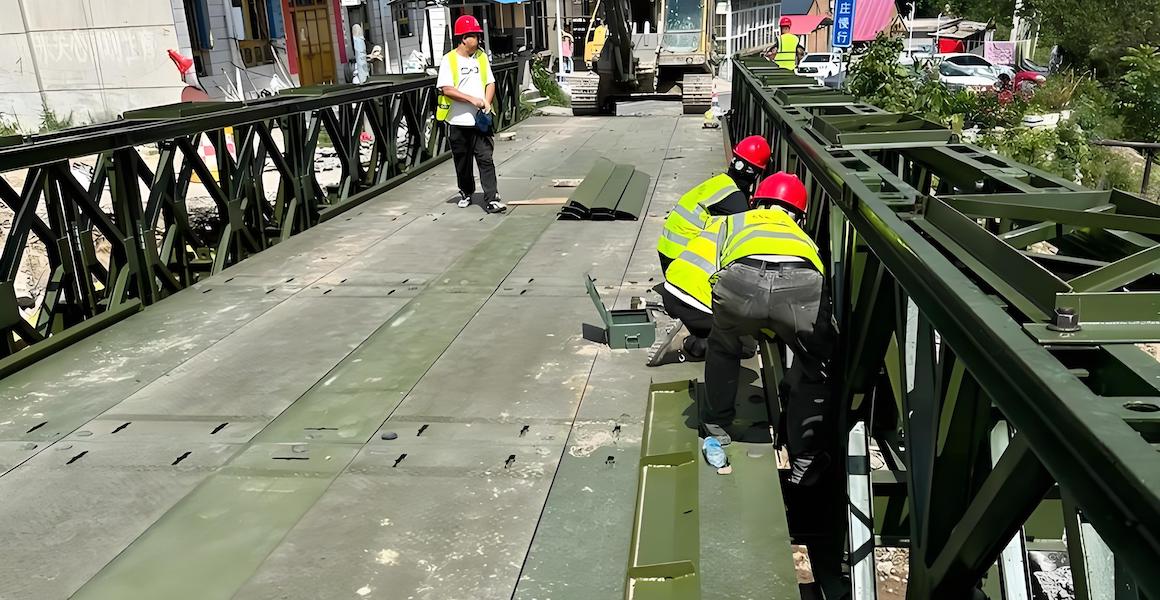
- Rapid Construction: With the correct professional crew and basic heavy-lifting machinery (such as hydraulic cranes or excavators), a standard 10–30 meter span can be assembled and fully operational within a single day.
- Unrivaled Load-Bearing Capacity: Through a combination of parallel and multi-layer truss configurations, these bridges can be engineered to support everything from light pedestrian traffic to 50-ton heavy-duty construction equipment.
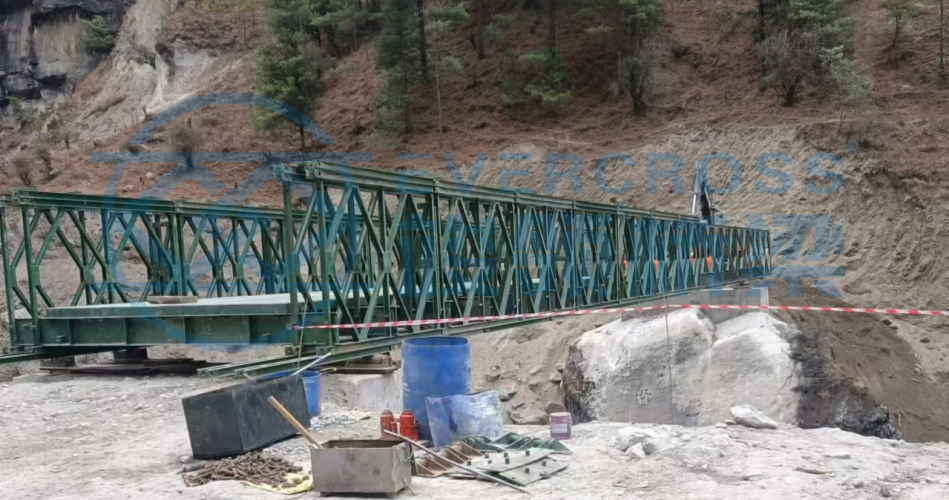
- Extreme Terrain Adaptability: Bailey Bridges thrive in environments where traditional foundation work is impractical. They can be installed on simple concrete pads, steel grillage, or natural rock bases, significantly reducing site preparation time and costs.
- Sustainability & Lifecycle Economics: Our components are designed for 100% reusability. Once a project concludes, the bridge can be disassembled, transported, and repurposed on a different site, making it a highly cost-effective investment over its 15+ year operational life cycle.
To understand why the Bailey Bridge remains the industry standard, one must consider its performance relative to alternatives.
Feature | Bailey Bridge | Prefab Steel Plate Bridge | Poured Concrete Bridge | Pontoon Bridge |
Assembly Time | Extremely Fast(Assembly and opening to traffic within a single day) | Relatively Fast | Extremely Slow (Construction period: approx. 15–30 days) | Relatively Fast |
Load Capacity | High(Flexibly scalable to accommodate heavy loads) | Moderate (Suitable for light to medium loads) | High | Medium |
Terrain Flexibility | Extremely Robust(Adaptable to all terrain types; requires only simple foundations) | Fair (Requires a level construction site) | Complex (Requires complex foundations; site constraints apply) | Single-purpose (Suitable only for aquatic environments) |
Reusability | High(Reusable repeatedly without damage; highly interchangeable components) | Medium (Some components are reusable) | None (Cannot be reused; demolition results in total loss) | Medium |
Life-Cycle Cost | Low(Optimized total cost: amortization plus O&M expenses) | Medium | Extremely High (High costs for both construction and demolition) | Medium(High maintenance costs) |
The Bailey bridge employs a fully modular and standardized design system; its core load-bearing components and associated connectors are all factory-prefabricated, standardized products. These components feature high versatility and interchangeability, eliminating the need for any on-site secondary processing and enabling a "transport-to-assembly, disassemble-and-relocate" workflow. By leveraging light-duty hoisting equipment and specialized construction crews, a standard Bailey bridge with a span of 10 to 30 meters can be fully assembled and ready for traffic within a single day—effectively resolving the industry-wide challenge of tight construction schedules for temporary bridges. The disassembly process is equally efficient and convenient; once dismantled, the components can be sorted, packaged, and transported without damage, laying the groundwork for future reuse and perfectly aligning with the "short-cycle, high-turnover" operational characteristics typical of temporary engineering projects.
The Bailey bridge features a triangular truss design, exhibiting exceptional resistance to bending, shearing, and lateral displacement; a single Bailey panel boasts a rated load-bearing capacity of up to 270 kN. Through flexible modular combinations—including parallel arrangements of multiple panels and multi-layer stacking—the bridge's load-bearing class can be readily adjusted to accommodate a diverse range of traffic requirements. These range from pedestrian and light passenger vehicle traffic to heavy-duty engineering machinery (such as excavators, dump trucks, and cranes) and emergency rescue vehicles, with a maximum load capacity capable of supporting heavy loads up to 50 tons. The structural components are fabricated from low-alloy, high-strength steel and undergo a dual anti-corrosion treatment—comprising shot blasting for rust removal followed by galvanization and painting. This process endows the structure with outstanding resistance to corrosion and abrasion, enabling it to provide long-term, stable service under complex field conditions without the need for frequent maintenance. By effectively minimizing on-site operation and maintenance costs, the bridge successfully balances the dual requirements of "temporary utility" and "safety and reliability." Furthermore, having successfully passed load-bearing capacity verification by independent third-party testing agencies, it fully complies with all relevant safety standards for temporary bridge traffic.
For engineering firms, controlling the costs of temporary works is paramount to enhancing project profitability—a key advantage inherent in the design of Bailey bridges. Upon disassembly, all structural components remain undamaged and can be repeatedly reassembled and reused across diverse projects and scenarios. Consequently, the amortized cost per use is significantly lower than that of traditional temporary bridge types, making them an ideal solution for integrated engineering and trading enterprises, overseas infrastructure projects, and organizations with ongoing requirements for temporary access. Furthermore, the components of a Bailey bridge feature a well-engineered unit weight (standard panels weigh approximately 270 kg), enabling long-distance transport via standard freight vehicles without the need for heavy-duty specialized transport equipment, thereby effectively reducing shipping costs. On-site operation and maintenance do not require a dedicated professional team; instead, only periodic inspections and tightening of vulnerable components—such as connectors and bearings—are necessary. Should individual components sustain damage, they can be rapidly replaced on a modular basis without necessitating a complete structural overhaul, thereby further minimizing the labor and material resources required for on-site maintenance and optimizing total costs over the entire lifecycle.
As experts in the field, we at Evercross Bridge advocate for a proactive maintenance approach to ensure the longevity of your investment. While our steel is treated with high-performance galvanized coatings to resist harsh environmental conditions, the most critical "hidden" factor in bridge longevity is the connection integrity.
1. Periodic Audits: Even in temporary applications, regular inspections of pins, bolts, and panel joints are essential. A quick tightening check can prevent premature fatigue.
2. Modular Replacement: One of the most significant benefits of this system is that if a single panel is damaged during a heavy loading event, you do not need to replace the entire bridge. Replacing a single, standardized component keeps the bridge in service for years.
3. Optimized Transport: Because individual Bailey panels are standardized and weight-optimized (typically ~270kg), they can be moved using standard flatbed trucks, eliminating the need for expensive, specialized heavy-haul equipment.
Looking ahead, we anticipate the role of Bailey Bridges growing even further as global infrastructure demands become more complex. Digital fabrication and advanced structural monitoring are the next frontiers. At Evercross Bridge, we are currently integrating more advanced welding inspection techniques and corrosion-resistant alloy research to ensure that our bridges not only meet current requirements but exceed the safety benchmarks of tomorrow.
For infrastructure projects that cannot afford downtime, the Bailey Bridge is not just a tool; it is a strategic asset. By combining high-strength engineering, unparalleled speed, and the ability to reuse components across multiple projects, it offers a level of economic and operational control that no other bridge type can match. Whether you are facing an emergency rescue mission or a long-term construction project, Evercross Bridge provides the design, manufacturing, and installation support you need to get the job done right.
Q1: What is the maximum span and weight capacity for a Bailey Bridge?
A: A single-span Bailey bridge can reach up to 60 meters. For longer spans, we implement multi-span designs with intermediate piers, reaching over 100 meters. Load capacities are highly customizable, with top-tier configurations capable of supporting 50-ton heavy machinery.
Q2: Are these bridges suitable for disaster relief and harsh environments?
A: Yes. Their triangular truss geometry provides exceptional resistance against wind, seismic, and lateral forces. They are the standard for rapid deployment in flood or earthquake scenarios.
Q3: How many times can a Bailey Bridge be reused?
A: With proper maintenance and our high-grade protective coatings, the structural components can be reused 8–10 times or more. The bridge's service life can exceed 15 years.
Q4: Does my site require complex foundations?
A: Not necessarily. One of the primary advantages of our system is its adaptability. We often use simplified concrete pads or even natural rock formations, depending on the geotechnical report of the site.
Q5: How can I optimize the cost of my temporary bridge project?
A: By treating the bridge as a reusable asset rather than an expense. At Evercross Bridge, we focus on modularity, which reduces transport costs, and durability, which minimizes the need for frequent part replacements, ensuring the best total cost of ownership.


